Painting Hub Services
GET FREE ESTIMATE
Interior Painting Services Main Line PA
What Is Interior Painting and What Does It Include?
Interior painting is the professional application of paint to the walls, ceilings, trim, doors, cabinets, and other interior surfaces of your home. It is the fastest, most impactful, and most cost-effective way to transform how a room looks and feels to you every day and to buyers when you list your home.
Professional interior painting differs from a DIY paint job in four key areas: the preparation work (patching cracks, holes, and imperfections; addressing surface gloss so new paint adheres correctly; protecting floors, trim, and furnishings), the priming strategy (not all surfaces accept paint without primer; new drywall, previously glossy surfaces, and stained walls all require specific primer approaches), the product quality (the difference between a $25 gallon of paint and a $70 gallon of Benjamin Moore Aura is immediately visible in coverage, color depth, and how the surface reads in light), and the application discipline (cutting clean edges at ceiling lines and trim, maintaining a wet edge to eliminate roller marks, and applying coats at the correct dry time).
Hynes Construction | 119 Sibley Ave, Ardmore PA 19003 | 610-896-6388 | Interior and Cabinet Painting | Low-VOC Options | Benjamin Moore and Sherwin-Williams | Free Estimates
Hynes Construction has been painting interiors in Ardmore, Bryn Mawr, Wayne, Narberth, Haverford, and all Main Line communities for over 50 years. We understand the specific characteristics of every era of Main Line construction: the original plaster walls of pre-1940 homes that require different patching and priming than modern drywall, the tongue-and-groove wood paneling of mid-century family rooms that needs careful surface prep, and the skim-coated drywall of 1990s and 2000s construction that shows roller patterns easily.
Request your free estimate or call 610-880-3890.
Interior Painting Services We Offer
Room Painting – Walls, Ceilings, and Trim
The core of our interior painting service is complete room painting: walls, ceiling, and trim in any combination. We paint entire homes, all rooms, hallways, and stairwells or individual rooms where an update is needed. We handle rooms of any complexity: standard rectangular bedrooms, living rooms with coffered ceilings, dining rooms with chair rail and wainscoting, kitchens with backsplash-adjacent surfaces, bathrooms with tile-adjacent surfaces, and two-story foyers with 18+ foot heights requiring specialized access equipment.
Accent Walls and Decorative Finishes
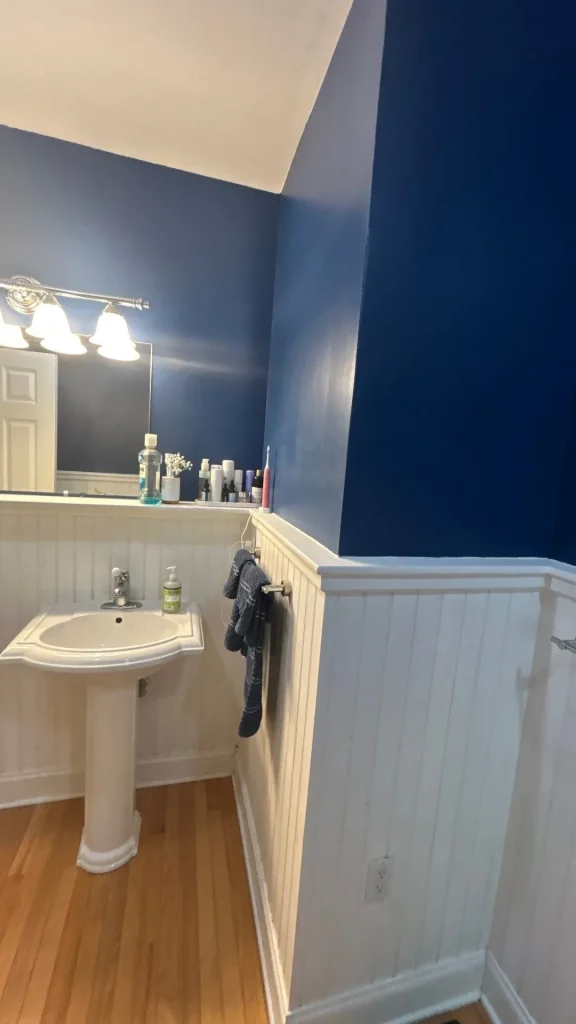
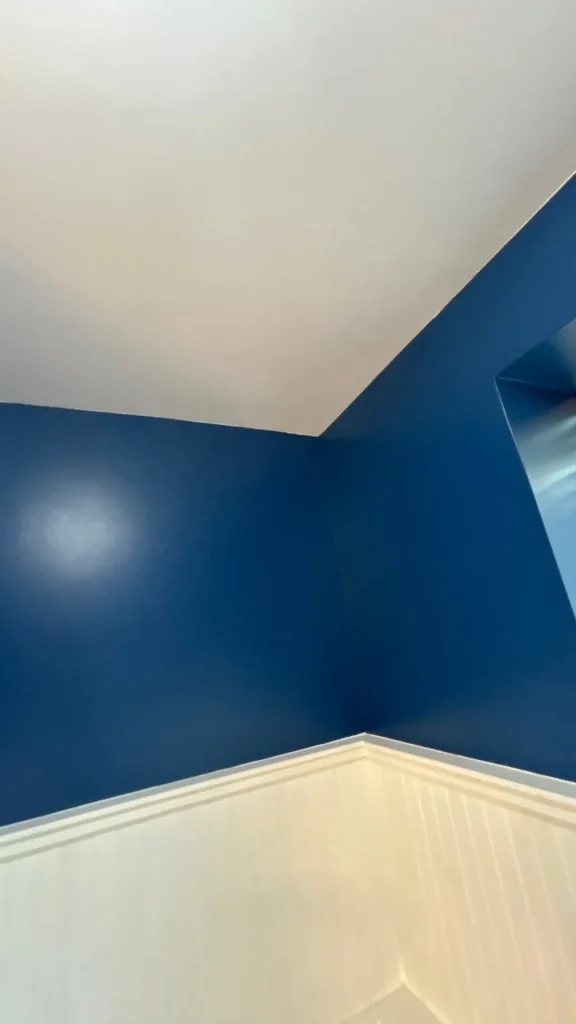
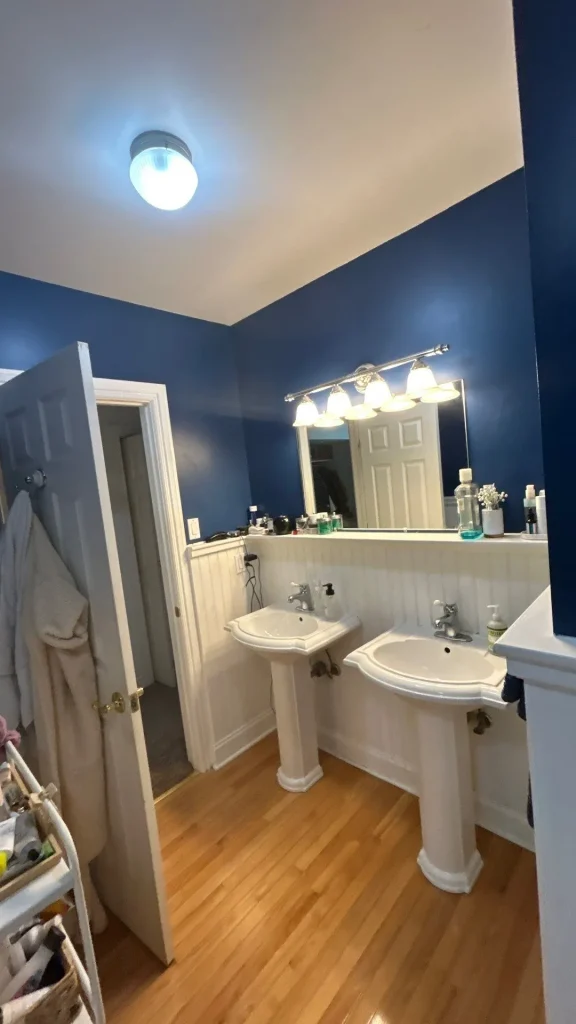
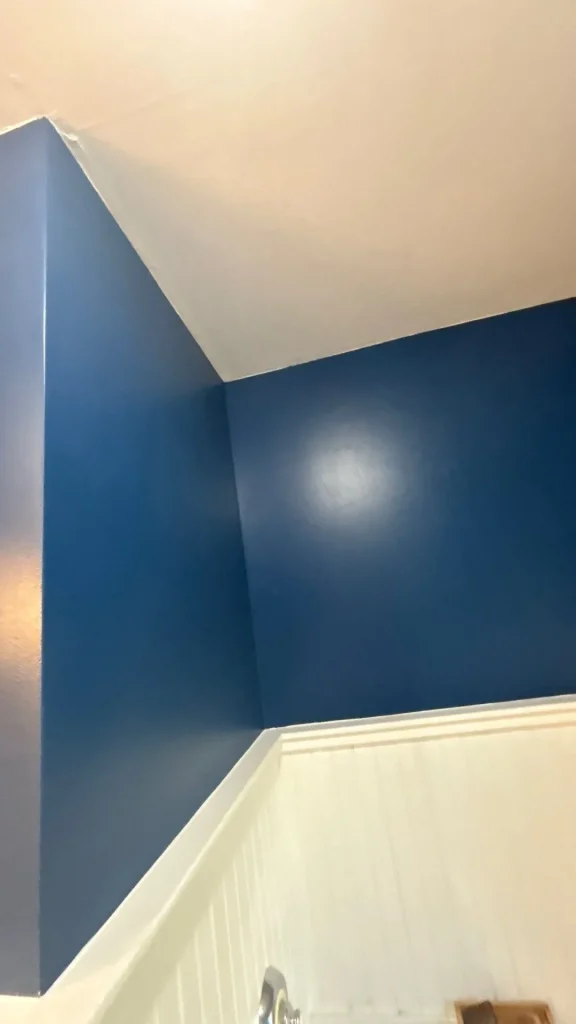
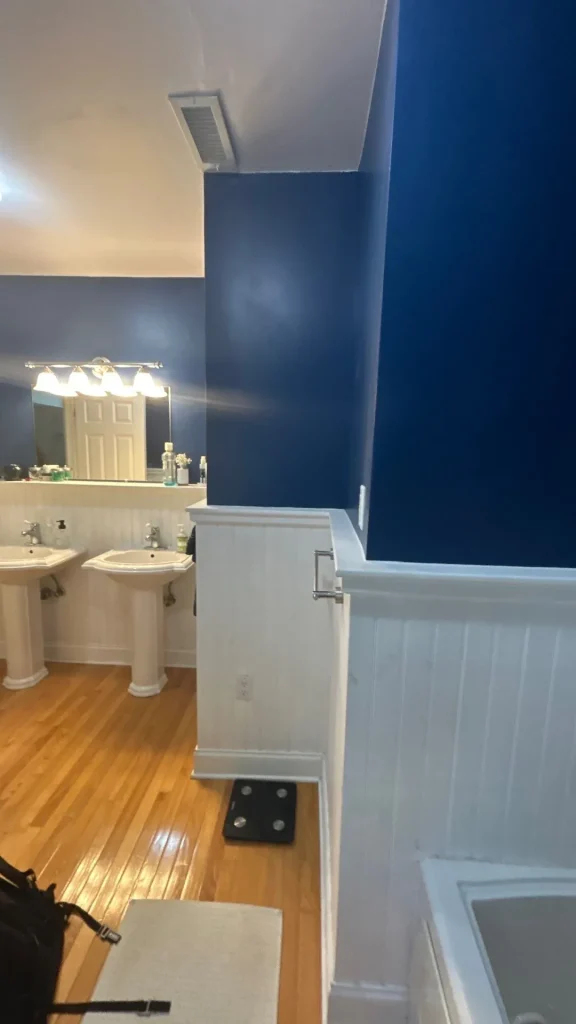
Accent walls in a single deep, saturated color, navy, forest green, deep burgundy, charcoal are the current dominant interior design direction on the Main Line. We execute accent walls with precision edge work at the ceiling line and adjacent walls, and we discuss color selection to ensure the accent color works with the room’s natural light and furnishings before any paint is committed. Beyond solid accent colors, we offer limewash painting (an ancient technique that creates a distinctive soft, layered look increasingly popular in Wayne and Gladwyne’s design-forward interiors), color washing, and specialty texture finishes on request.
Cabinet Painting and Refinishing
Kitchen and bathroom cabinet painting is one of the most cost-effective interior transformations available. Repainting the cabinets alone in the right color, with the right preparation and the right topcoat produces a result that buyers and guests perceive as a kitchen renovation. Our process:
- Remove all doors and drawer fronts and take them to a controlled environment for spray application (eliminates brush and roller marks).
- Clean all surfaces with TSP-equivalent degreaser kitchen cabinets accumulate cooking oil and grease that prevents paint adhesion if not fully removed.
- Sand all surfaces with 120 then 220-grit sandpaper to scuff the existing finish and create mechanical adhesion.
- Apply BIN shellac-based or Zinsser primer for maximum adhesion and stain blocking.
- Apply two coats of Sherwin-Williams Emerald Urethane Trim Enamel or Benjamin Moore Advance in the selected color.
- Reinstall doors and drawers. Adjust hinges. Install new hardware if specified.
The most requested cabinet color transformation on the Main Line: oak or honey maple cabinets from the 1990s to Benjamin Moore White Dove OC-17 or Sherwin-Williams Alabaster SW 7008 transformations that buyers read as contemporary kitchen renovations. Benjamin Moore Hale Navy is our most requested two-tone cabinet lower color paired with upper cabinets in White Dove.
Drywall Repair and Plaster Repair
Professional-quality interior painting begins with properly prepared surfaces. Cracks, holes, dents, and nail pops are addressed before any paint is applied. On Main Line homes with original plaster walls common in pre-1950 Colonials, Victorians, and Craftsman homes in Ardmore, Bryn Mawr, and Narberth, plaster repair requires different techniques than standard drywall patching. Plaster is harder, denser, and bonds differently than drywall compound. We assess surface condition at the estimate and scope all repair work as part of the interior painting project.
Wallpaper Removal
Wallpaper removal, particularly the strippable vinyl wallpapers installed in Main Line homes throughout the 1980s and 1990s, is provided as part of an interior painting scope. Our process: score the wallpaper with a scoring tool, apply fabric softener solution or commercial wallpaper remover to saturate the adhesive, remove paper in sections, wash walls to remove remaining adhesive, allow to dry completely, and prime before painting. Improper removal or painting directly over wallpaper or adhesive residue produces a surface that looks terrible under any light angle.
About Hynes Interior Painting: Hynes Construction provides professional interior painting for residential and commercial properties across the Main Line, PA. Services include room painting (walls, ceilings, and trim), cabinet painting and refinishing, accent walls, drywall repair, and wallpaper removal. Using Sherwin-Williams Emerald, Cashmere, and Benjamin Moore Aura exclusively. All low-VOC options available. Free estimates – Call 610-896-6388.
Paint Finishes Guide – What to Use in Each Room
The finish (sheen level) of interior paint determines how the surface reflects light, how easy it is to clean, and how many wall imperfections are visible. This is one of the most commonly misunderstood choices in interior painting.
| Finish / Sheen< | Light Reflection | Cleanability | Best Room Applications |
|---|---|---|---|
| Flat / Matte | No sheen. Absorbs light. | Low, not washable. Marks show. | Ceilings. Low-traffic bedrooms. Adult dining rooms. Hides wall imperfections best. |
| Eggshell | Very slight sheen. | Moderate; it can be wiped gently. | Most popular for living rooms, bedrooms, and hallways in Main Line homes. Hides imperfections while allowing gentle cleaning. |
| Satin | Soft luster. | Good, can be cleaned with mild detergent. | High-traffic living areas, family rooms, children’s bedrooms, hallways. Most versatile finish. |
| Semi-Gloss | Noticeable sheen. | Very good; it resists moisture and grease. | Trim, doors, window casings, bathrooms, and kitchens. Standard for all woodwork. |
| Gloss / High-Gloss | High reflection. | Excellent, most durable and washable. | Cabinets, trim in formal rooms, furniture painting. Shows every imperfection requires flawless prep. |
The most common mistake: Using flat paint in bathrooms and kitchens because it hides imperfections. Flat paint in moisture-prone rooms promotes mold and cannot be cleaned. Always use at minimum satin in bathrooms and kitchens. The second most common mistake: using the same finish for walls and trim. Walls in eggshell and trim in semi-gloss is the standard professional specification.
Interior Paint Products – What We Use and Why
| Product | Best Use | Why We Specify It |
|---|---|---|
| Sherwin-Williams Emerald Interior | All rooms, premium choice | Stain-resistant, scrubbable. Available in all sheens. Low-VOC. 10-year guarantee from SW. |
| Sherwin-Williams Cashmere Interior | Walls in living rooms and master bedrooms | Ultra-smooth, velvety finish. Outstanding hide. Reads beautifully in natural light. |
| Benjamin Moore Aura Interior | Premium interiors, rooms where color depth matters most | Color Lock technology maintains true color on the wall. Exceptional coverage often 1-coat. Low-VOC. The top-performing interior wall paint available. |
| Sherwin-Williams Emerald Urethane Trim Enamel | Trim, doors, and cabinets | Hardens to extremely durable finish. Resists yellowing. Ideal for painted trim and cabinets where durability is critical. |
| Benjamin Moore Advance Interior Alkyd | Cabinet painting | Self-leveling formula virtually eliminates brush marks. Alkyd hardness with water cleanup. Our primary cabinet paint. |
| Zinsser BIN Shellac Primer | Stain blocking, knots, and cabinet prep | Best stain and bleed-through blocker available. Essential under white and light colors over stained cabinets and wood with tannin bleed. |
Color Consultation – What’s Working in Main Line Homes in 2025-2026
Color selection is where many homeowners feel uncertain and where professional guidance has real value. Here is what we observe performing well in Main Line interiors right now:
Living Rooms and Dining Rooms
Benjamin Moore Chantilly Lace OC-65: The clean, crisp white that reads bright without going blue or gray in any light. Dominant in Wayne, Gladwyne, and Villanova interiors.
Benjamin Moore White Dove OC-17: Warmer than Chantilly Lace with a slightly creamy undertone. Works in rooms with warm flooring (natural oak, warm walnut).
Sherwin-Williams Accessible Beige SW 7036: The workhorse neutral of the Main Line for a decade and still performing well in open-plan spaces where warm flooring and warm furnishings are present.
Bedrooms
Benjamin Moore Night Train: Deep navy. The dominant primary bedroom accent direction, color drenching (walls, ceiling, and trim all the same deep navy) in primary bedrooms is the leading edge of the Main Line luxury interior market.
Soft sage and olive greens: Rising strongly. Sherwin-Williams Rosemary SW 6187 and Benjamin Moore October Mist 1495 are the most requested green tones.
Warm whites for secondary bedrooms: BM Simply White OC-117 with SW Alabaster trim.
Kitchens
Greige on walls: Sherwin-Williams Agreeable Gray SW 7029 or Benjamin Moore Revere Pewter HC-172 as the transition-era neutral that works with both warm wood tones and cool appliances.
Cabinet colors: BM White Dove and SW Alabaster for upper cabinets, BM Hale Navy HC-154 for lower cabinets in two-tone kitchens.
Emerging trend: Warm green on island cabinets – Farrow and Ball Mizzle or similar muted sage – paired with cream perimeter cabinets.
Trim and Ceilings
Trim: Sherwin-Williams Extra White SW 7006 in high-gloss or semi-gloss remains the dominant trim choice. On historic Main Line homes with original wood trim, a warm white (BM White Dove) vs a cool white (SW Extra White) should be evaluated against the wall color and the wood floor tone.
Ceilings: White ceiling in eggshell or flat for most rooms. In primary bedrooms pursuing the color-drenching look, ceiling matches the wall in the same color and sheen.
Low-VOC and Zero-VOC Paint Options
VOC (Volatile Organic Compound) is the chemical off-gassing from paint that creates the characteristic paint smell and can contribute to indoor air quality issues during and after application. Modern premium paint formulations have dramatically reduced VOC levels:
- Benjamin Moore Aura: Zero VOC. Our most requested choice for nurseries, children’s bedrooms, and homeowners with chemical sensitivities.
- Sherwin-Williams Emerald Interior: Low VOC (less than 50 g/L for most sheens). Meets or exceeds LEED and GREENGUARD certification thresholds.
- Water-based (latex) paints generally: Far lower VOC than oil-based (alkyd) products. Our standard for all interior wall and ceiling painting.
For cabinet painting where maximum durability is required, Benjamin Moore Advance Alkyd does contain higher VOC than latex alternatives. We discuss ventilation requirements when this product is specified and always recommend adequate ventilation during application and the first 24 to 48 hours of cure.
Interior Painting Cost Guide for Main Line PA (2026)
| Project Scope | Cost Range | Key Variables |
|---|---|---|
| Single bedroom, walls only | $350 to $650 | Room size, ceiling height, surface condition |
| Single bedroom, walls, ceiling, and trim | $550 to $1,000 | Same plus trim linear footage |
| Living room or dining room | $600 to $1,400 | Size, ceiling height, architectural detail, finish type |
| Kitchen walls (tile adjacent) | $400 to $900 | Careful masking at tile, cabinet-adjacent surfaces |
| Bathroom | $300 to $650 | Small area but detail work at fixtures and tile |
| Full house interior (3-4 bedroom Main Line home) | $3,500 to $9,000 | Number of rooms, ceiling heights, trim detail, drywall prep |
| Foyer and staircase | $800 to $2,500 | Height, railings, spindles, multiple surfaces |
| Cabinet painting, full kitchen (20-25 doors) | $1,500 to $4,000 | Doors and drawers count, finish type, degree of prep, spray vs brush |
| Drywall repair (per room, minor) | $150 to $400 added to painting scope | Crack count, hole size, surface complexity |
| Wallpaper removal (per room) | $300 to $900 in addition to painting | Layers, adhesive type, wall condition beneath |
Interior painting in the Main Line market runs approximately $2 to $6 per square foot for walls depending on product selection, surface condition, and finish complexity. Cabinet painting is priced by door and drawer count plus prep scope. Free written estimate. Call 610-896-6388 or request online.

Seasonal Considerations for Interior Painting
Interior Painting: Year-Round With Best Availability in Winter Unlike exterior painting, interior painting is not constrained by outdoor temperature. Walls, ceilings, and trim can be painted in any season. The practical considerations for interior painting timing:
Fall (September-November): Most popular season. Pre-holiday refresh and making homes ready for winter entertaining. Schedule books fastest.
Winter (December-February): Best scheduling availability. Fastest turnaround. Exterior crews are less active, making interior crews more available. If the budget is flexible, winter interior projects often book within 1-2 weeks vs. 4-6 weeks in busy seasons.
Spring (March-May): Second most popular. Pre-sale refresh timing. Book early.
Humidity note: Keep windows closed during and 24 hours after interior painting in humid summer weather. High humidity extends dry time and can affect sheen uniformity.
Interior Painting and Pre-Sale Preparation on the Main Line
Interior painting is one of the top two investments buyer’s agents recommend before listing a Main Line home (alongside landscaping). The reasoning is straightforward: buyers form their strongest impression in the first 60 seconds inside a home. Fresh, neutral interior paint in a current color palette signals a well-maintained home, makes rooms appear larger and brighter, and removes the negotiating point that dated or damaged paint creates in inspection reports.
For pre-sale interior painting, we recommend:
- Repaint all high-traffic rooms in current neutral tones (BM Chantilly Lace, SW Agreeable Gray, BM Simply White).
- Paint all trim and doors in crisp white semi-gloss – nothing reads as fresh and well-maintained as bright white trim against neutral walls.
- Paint over any bold, personalized, or dated accent wall colors that will limit buyer appeal.
- Address any drywall repairs, water stains, or damage visible in the rooms before listing.
- Cabinet painting in the kitchen if cabinets are significantly dated (oak cabinets from 1995 in a beige finish, for example), the transformation is immediate and dramatic for buyers.
Areas We Serve for Interior Painting
We provide interior painting services across all 30+ Main Line communities from our Ardmore office. See our full service area and photo gallery for completed interior painting projects.
Get Your Free Interior Painting Estimate
WINTER IS THE BEST TIME TO BOOK: Interior painting is available year-round and our winter availability is typically our best. If you want fresh interior paint for spring or for an upcoming event, book now. Call 610-896-6388 or request online.
Popcorn Ceiling Removal – Common in Pre-1990 Main Line Homes
Acoustic (popcorn) textured ceilings were installed in homes from the 1960s through the late 1980s as a cost-effective way to hide ceiling imperfections and provide some sound dampening. They are now universally regarded as dated and inconsistent with modern interior standards. Many Main Line homeowners painting interior spaces opt to have popcorn ceilings removed and replaced with smooth, flat ceilings as part of the painting project.
For homes with non-asbestos popcorn ceilings (post-1978 construction), the removal process: wet the texture with water to soften, scrape carefully with a broad knife, skim coat the ceiling surface smooth with joint compound, sand, prime with PVA primer to seal, and paint with ceiling flat paint. The result is a modern, flat ceiling that reads as architecturally updated. Most Main Line homeowners who have their popcorn ceilings removed report it as the single most impactful visual update they’ve made to their interior.
Monday through Saturday | Free Estimates | Fully Insured Crews
Plaster Repair vs Drywall Repair – Understanding the Difference
Main Line homes built before 1950 – the pre-war Colonials, Victorians, and Craftsman bungalows of Ardmore, Bryn Mawr, Narberth, and Wayne – have original plaster walls rather than drywall. Understanding the difference matters for painting preparation:
- Traditional plaster walls: Three-coat lime or gypsum plaster applied over wood lath. Dense, hard, and acoustically superior to drywall. Cracks over time as the house settles (hairline cracks are normal; wide or stair-step cracks may indicate structural movement). Plaster repair requires specific materials: setting-type joint compound, bonding agent for adhesion to the plaster substrate, and skim coating techniques that match the existing plaster’s surface profile.
- Drywall (gypsum board): Standard 1/2 or 5/8 inch panels screwed to studs. Nail pops, holes, and cracks repair quickly with standard joint compound and mesh tape. Does not require bonding agent. Repairs dry faster than plaster.
- Why it matters for painting: Plaster walls that have been patched with standard drywall compound without a bonding primer will show the patch as a shiny, differently-textured area under any raking light after painting. Correct plaster repair that is properly primed produces invisible repairs under all light conditions.
We assess wall type and condition during every interior painting estimate and scope all repair work correctly for the specific material.
Garage and Basement Floor Epoxy Coating
Epoxy and polyaspartic floor coatings transform plain concrete garage floors and basement floors into durable, attractive, professional-looking surfaces. The process:
- Diamond grinding of the concrete surface to open the concrete profile and remove any existing sealers or contamination.
- Crack and spall repair with appropriate epoxy filler.
- Application of 100% solid epoxy primer/basecoat.
- Full broadcast of decorative flake system (or solid color) into the wet basecoat.
- Application of polyaspartic clear topcoat – UV-stable (unlike standard epoxy which yellows in sunlight), extremely durable, and driveable within 24 hours of application.
Epoxy garage floor coatings on the Main Line run $2,500 to $5,000 for a standard two-car garage depending on square footage and the extent of surface preparation needed. Basement floor coatings run $1,500 to $3,500 for a standard basement.
IMPORTANT – ASBESTOS IN PRE-1978 POPCORN CEILINGS: Acoustic ceiling texture applied before 1978 commonly contained asbestos as a fire-retardant binder. Disturbing an asbestos-containing ceiling without proper abatement procedures releases asbestos fibers into the air. We do NOT scrape popcorn ceilings in pre-1978 homes without a certified asbestos inspection and clearance report first. If your home was built before 1978, we coordinate certified asbestos testing before any ceiling removal work begins.
Limewash Painting – The Leading Edge of Main Line Interior Design
Limewash (also called whitewash or kalsomine) is an ancient painting technique that applies diluted, slaked lime-based paint in multiple layered coats to produce a soft, textured, aged finish with depth and natural variation. The result is categorically different from flat or eggshell latex paint. It has the quality of aged European plaster, with visible brush strokes, tonal variation, and a chalky, organic texture that reads as both historic and contemporary.
Why it’s growing on the Main Line: The pre-war Colonials, stone Tudors, and Craftsman bungalows of Ardmore, Bryn Mawr, Narberth, and Wayne have architectural character that standard paint flattens. Limewash respects the age and texture of these homes. In the premium market of Wayne, Gladwyne, and Villanova, limewash dining rooms and living rooms are becoming a distinguishing feature that buyers respond to.
Color range: Traditional limewash reads as white to off-white with subtle color variation. Tinted limewash in warm stone tones, warm grays, and sage greens is available for more color-forward applications. We use Portola Paints Lime Wash and Roman Clay products, which achieve the limewash aesthetic with modern application reliability.
Designer Wallcovering Installation on the Main Line
Installing designer wallcoverings like grasscloth, sisal, linen weave, specialty wallpapers requires a different skill set than standard painting. We install wallcoverings in dining rooms, powder rooms, foyers, and accent walls throughout the Main Line. Currently the most requested: natural woven grasscloth in warm tan or sage tones for dining rooms of Colonial and Craftsman homes in Ardmore, Bryn Mawr, and Narberth. Specialty papers from Phillip Jeffries, Schumacher, York, and comparable manufacturers are available through design showrooms or brought to us directly by the homeowner or their designer.
The installation process: proper wall preparation and priming, correct paste or paste-the-wall adhesive selection for the specific product, precise seam alignment and pattern matching, and correct handling of natural fiber products that can expand when wet. Incorrect installation of grasscloth in particular produces visible seams and dimensional inconsistency that is nearly impossible to correct without removing and reinstalling the material.
Get Your Free Interior Consultation
Painting Hub Services
GET FREE ESTIMATE
Gallery
Frequently Asked Questions
Interior painting in the Main Line market runs $2 to $6 per square foot for walls. Per room: bedrooms from $350 to $650 (walls only) to $550 to $1,000 (walls, ceiling, and trim). Living and dining rooms run $600 to $1,400. A full-house interior painting project for a standard 3-4 bedroom Main Line home runs from $3,500 to $9,000. Cabinet painting runs $1,500 to $4,000. Free written estimate. Call 610-896-6388.
We use Sherwin-Williams and Benjamin Moore premium lines exclusively. Sherwin-Williams Emerald Interior, Cashmere, and Benjamin Moore Aura for walls. Sherwin-Williams Emerald Urethane Trim Enamel and Benjamin Moore Advance for trim and cabinets. We do not substitute lower-grade products without homeowner knowledge. All products are low-VOC or zero-VOC.
Flat or matte: ceilings and low-traffic adult rooms. Eggshell: bedrooms and living rooms the most popular Main Line interior wall finish. Satin: high-traffic family rooms, children’s rooms, hallways. Semi-gloss: all trim (doors, window casings, baseboards), bathrooms, and kitchen walls. Gloss: cabinets and select trim in formal applications. The most common mistake: using flat paint in bathrooms where it will not withstand moisture or cleaning.
A single room (walls only) typically takes 1 business day. A full-house interior painting project for a standard 3-4 bedroom Main Line home takes 3 to 5 business days. Cabinet painting for a full kitchen takes 3 to 5 business days. Drywall repair and wallpaper removal add additional time depending on scope.
We move standard furniture away from walls and cover it with canvas drop cloths as part of our setup. For very heavy items like large sectionals, pianos, and significant antique furniture. We ask that you arrange to have them moved before we arrive. All floors are fully covered with professional canvas drop cloths, not plastic sheeting. The painting area is cleaned at the end of every working day.
Yes. Cabinet painting with proper preparation and the right products produces results that buyers perceive as full cabinet replacement at 20 to 30 percent of the cost. Our process: degreasing, sanding, shellac primer, and two coats of Sherwin-Williams Emerald Urethane or Benjamin Moore Advance in the specified color. Doors and drawer fronts are removed for spray application to eliminate brush and roller marks. The most common transformation: 1990s oak cabinets painted Benjamin Moore White Dove.
Living rooms and bedrooms: Benjamin Moore Chantilly Lace OC-65 (crisp cool white), Benjamin Moore White Dove OC-17 (warm white), and Sherwin-Williams Agreeable Gray SW 7029 (warm greige).
Accent walls: deep navy (BM Hale Navy HC-154), forest green (SW Rosemary SW 6187), charcoal. Cabinet colors: BM White Dove upper cabinets, BM Hale Navy lower cabinets for a two-tone kitchen.
Emerging: color drenching in deep tones for primary bedrooms in Gladwyne, Wayne, and Villanova high-end properties.
Yes. Benjamin Moore Aura is zero VOC and is our standard recommendation for nurseries, children’s bedrooms, and homeowners with chemical sensitivities. Sherwin-Williams Emerald Interior is low VOC. We use water-based (latex) products for all interior wall and ceiling painting as standard. For cabinets where maximum durability is required, Benjamin Moore Advance Alkyd contains higher VOC, and we discuss ventilation requirements when it is specified.
Accent walls: deep navy (BM Hale Navy HC-154), forest green (SW Rosemary SW 6187), charcoal. Cabinet colors: BM White Dove upper cabinets, BM Hale Navy lower cabinets for a two-tone kitchen.
Emerging: color drenching in deep tones for primary bedrooms in Gladwyne, Wayne, and Villanova high-end properties.
Yes. Wallpaper removal is a service we provide as part of an interior painting scope. We score, wet, and remove wallpaper, wash walls to remove adhesive residue, allow complete drying, prime, and then paint. We do not paint directly over wallpaper; it creates a surface that will peel and look poor under any raking light. The cost of removal depends on the number of layers and the adhesive type, typically $300 to $900 per room.
Accent walls: deep navy (BM Hale Navy HC-154), forest green (SW Rosemary SW 6187), charcoal. Cabinet colors: BM White Dove upper cabinets, BM Hale Navy lower cabinets for a two-tone kitchen.
Emerging: color drenching in deep tones for primary bedrooms in Gladwyne, Wayne, and Villanova high-end properties.
Yes. Both Sherwin-Williams and Benjamin Moore have advanced color-matching systems that can match virtually any existing color from a paint chip, paint lid, or even a chip of the painted surface itself. Aging paint that has faded will produce a slightly different result than matching to the original formula. We discuss whether matching the current faded color or refreshing to the original is the better approach for your situation.
Accent walls: deep navy (BM Hale Navy HC-154), forest green (SW Rosemary SW 6187), charcoal. Cabinet colors: BM White Dove upper cabinets, BM Hale Navy lower cabinets for a two-tone kitchen.
Emerging: color drenching in deep tones for primary bedrooms in Gladwyne, Wayne, and Villanova high-end properties.
Yes, popcorn ceiling removal is a service we provide as part of an interior painting scope. For homes built before 1978, we coordinate certified asbestos testing before any ceiling texture removal, because acoustic ceiling texture from that era commonly contained asbestos. For post-1978 homes, we wet, scrape, skim coat, prime, and paint the ceiling smooth. Most Main Line homeowners report popcorn ceiling removal as the single most impactful interior update they’ve made. Add $400 to $1,200 per room for removal and skim coat depending on ceiling area.
Accent walls: deep navy (BM Hale Navy HC-154), forest green (SW Rosemary SW 6187), charcoal. Cabinet colors: BM White Dove upper cabinets, BM Hale Navy lower cabinets for a two-tone kitchen.
Emerging: color drenching in deep tones for primary bedrooms in Gladwyne, Wayne, and Villanova high-end properties.
Original plaster walls in pre-1950 Main Line homes require different repair techniques than drywall. We use setting-type joint compound with bonding agent for adhesion to the hard plaster substrate. Hairline cracks are filled with flexible joint compound. Larger areas use fiberglass mesh tape and multiple skim coat passes to blend the repair into the surrounding plaster profile. All repairs are primed with PVA primer before painting – this is the critical step that produces invisible repairs under all light angles. Without correct priming, patches show through any paint as shiny spots.
Accent walls: deep navy (BM Hale Navy HC-154), forest green (SW Rosemary SW 6187), charcoal. Cabinet colors: BM White Dove upper cabinets, BM Hale Navy lower cabinets for a two-tone kitchen.
Emerging: color drenching in deep tones for primary bedrooms in Gladwyne, Wayne, and Villanova high-end properties.
Kitchen cabinet painting on the Main Line runs $1,500 to $4,000 for a standard kitchen with 20 to 25 cabinet doors. Variables: number of doors and drawers, whether doors are sprayed (smoother finish, higher cost) or brush-applied, the degree of prep required (degreasing, sanding, and priming), and the specific paint product. The most common transformation, 1990s oak cabinets to Benjamin Moore White Dove runs $2,000 to $3,200 for a standard Main Line kitchen. This produces a result buyDove,ers perceive as a kitchen renovation at 20-30% of the cost of cabinet replacement.
Accent walls: deep navy (BM Hale Navy HC-154), forest green (SW Rosemary SW 6187), charcoal. Cabinet colors: BM White Dove upper cabinets, BM Hale Navy lower cabinets for a two-tone kitchen.
Emerging: color drenching in deep tones for primary bedrooms in Gladwyne, Wayne, and Villanova high-end properties.
Deck stain penetrates the wood grain. It cannot peel because it soaks into the wood rather than forming a surface film. Transparent and semi-transparent stains maintain wood grain visibility. Solid-color stains are opaque but still penetrate. Stains are easier to maintain (no full stripping needed for reapplication) and are better for decks in good condition where wood grain is an aesthetic asset. Deck paint forms an opaque surface film. It hides the grain completely and produces a uniform color, but it can peel and requires complete stripping before recoating. Paint is appropriate for worn, weathered decks where grain visibility is no longer a goal. For most Main Line decks in good condition, a penetrating semi-transparent stain is our recommendation.
Accent walls: deep navy (BM Hale Navy HC-154), forest green (SW Rosemary SW 6187), charcoal. Cabinet colors: BM White Dove upper cabinets, BM Hale Navy lower cabinets for a two-tone kitchen.
Emerging: color drenching in deep tones for primary bedrooms in Gladwyne, Wayne, and Villanova high-end properties.




TESTIMONIALS
-
C
I highly recommend Peter from Hynes Construction. He did work on the flat roof of my house and did a fabulous job. He is a very professional guy, great with follow up, answers your questions and gives great suggestions based on his experience, and Hynes construction is reasonably priced. Services: Power/pressure washing, Roof repair, Roof installation, Window cleaning.
Candance Prvitt
-
C
Krissy helped me and provided a competitive quote for a new roof. After going through with 4 different quotes from other roofing companies, I decided Hynes Construction was the perfect company for the job. The roof looks beautiful and I am happy working with Hynes Team and I would recommend them to anyone doing a roof replacement! Services: Roof inspection, Roof installation, Roof repair
Marlain Tassone
-
B
Hynes Construction did a fantastic job on my roof. Krissy was professional and easy to work with. They completed my large roof in a day. The crew worked very hard and cleaned up every bit of it. I am extremely happy with my decision of choosing Hynes Construction... Thanks a lot for a wonderful job well done. Services: Roof inspection, Roof installation, Skylight installation
Brigid Goon
-
N
They are quick. Handled everything in a proper way. Hynes Team did an amazing job and were very professional and friendly. They did a great job in cleaning. The work quality is fabulous and they offer competitive pricing. Professional and on time, I would definitely recommend Hynes Construction. Service: Window cleaning
Nancy Brown
-
M
Hynes is undoubtedly the best roofing company around! Professional and experts in what they do, they are clear and will guide you in a right way. I had a leak in my kitchen which another company told me I needed to replace the whole roof which I was too scared off. Later I called Hynes Team for second opinion and they were able to repair the roof and save me from spending thousands of dollars! So thankful for their honesty Services: Roof inspection, Storm / wind damage roof repair, Roof repair
Michael Reilly
-
S
Ridge and Peter both were wonderful and easy to work with. They took the time telling me about the work required and they both were very knowledgeable. I am sure Hynes Team and the company really take good care about the people they work with. I would highly recommend Hynes for any Roof replacement projects! Services: Roof inspection, Roof installation, Roof repair
Stantec
-
J
Contacted Hynes Construction for some minor roof repairs. Hynes had someone out in no time and the repairs were done right after, they were really quick and delivered on time as they promised. I would definitely recommend them for your roofing needs! Thanks to Dan for getting our roof repaired and giving us peace of mind Service: Roof repair
Jeffer Punzalan