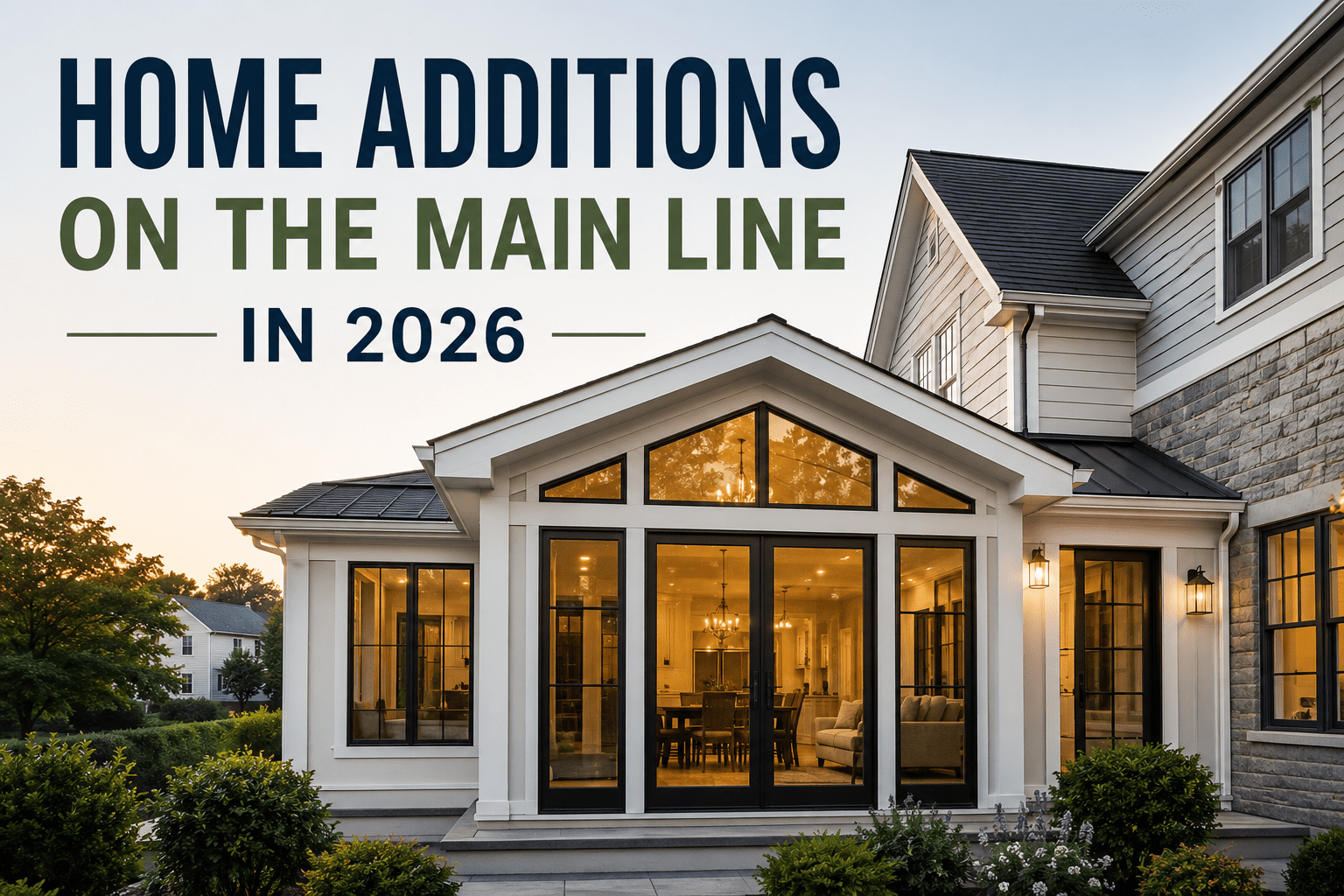
Home Additions Main Line homeowners choose are often driven by one simple challenge: needing more space without leaving the neighborhoods, schools, and communities they love. With housing inventory across Chester, Delaware, and Montgomery Counties remaining tight in 2026, expanding an existing home has become a practical alternative to buying a larger property. Understanding the costs, permits, timelines, and planning requirements involved in a home addition can help homeowners make a more informed decision before starting their project.
Housing inventory in Chester and Delaware Counties remains tight in 2026. Homes in the most desirable communities across Ardmore, Wayne, Bryn Mawr, and Havertown are selling at prices that reflect the combination of neighborhood quality, school districts, and established community character that the Main Line has built over generations. Moving to get more space means leaving that context, paying current market prices for a larger property, and starting over in a new neighborhood.
For families who love where they live but need more space, a well-designed and professionally built home addition is often the most rational solution available. You keep the school district, the commute, the yard, the community, and the property that has appreciated significantly over your ownership period. You gain the space your household needs and add functional square footage that increases appraised home value.
Thinking About Expanding Instead of Moving?
Before you commit to buying a larger home, find out whether a home addition is the smarter investment. Hynes Construction helps Main Line homeowners evaluate their property, discuss expansion options, review potential costs, and identify any zoning or structural considerations before construction begins.
Schedule your free home addition consultation or call us today at (610) 896-6388 to discuss the best way to add space while staying in the neighborhood you love.
This guide covers everything Main Line homeowners need to understand before starting a home addition project: the types of additions available, what each one costs in the current market, the permit and zoning process in Chester and Delaware County municipalities, realistic construction timelines, and how to evaluate contractors and financing options. Hynes Construction provides home addition services for Main Line homeowners across Chester, Delaware, and Montgomery Counties.
Is a Home Addition Right for You? Making the Buy vs Build Decision
The first question to answer before planning a home addition is whether adding onto your existing home makes more financial and practical sense than purchasing a larger property. The calculus varies by homeowner situation, but several factors consistently favor the addition option for Main Line homeowners:
Property Value and Equity
Main Line homeowners who purchased five or more years ago have typically accumulated substantial equity. A home purchased for $500,000 in 2018 in a strong Main Line community may have an estimated value of $700,000 to $800,000 or more in 2026. That equity is available through a HELOC or cash-out refinance to fund an addition project. Using accumulated equity to add value to a property you own is often more financially efficient than using it as a down payment on a new, more expensive property that would require a larger mortgage at current interest rates.
Moving on the Main Line is expensive in a way that is often underestimated. Real estate agent commissions on a $700,000 home sale run $21,000 to $42,000. Transfer taxes on a Main Line purchase run 2 percent of the purchase price. Moving costs, carrying costs during transition, and the cost of any work needed on a new home all add up. The total transaction cost of buying and selling on the Main Line often runs $60,000 to $100,000 or more, money that could fund a meaningful addition instead.
School Districts and Community Context
The Main Line’s school districts are among the strongest in Pennsylvania. Haverford Township, Radnor Township, Lower Merion, and Tredyffrin-Easttown school districts consistently rank at or near the top of Pennsylvania school rankings. For families with school-age children, the value of remaining in a strong district and maintaining established friendships and community connections is a real factor in the buy vs build decision that does not show up in a spreadsheet but matters enormously in practice.
Types of Home Additions: What Each One Involves and What Each Costs
Bump-Out Additions
A bump-out is a small extension of an existing room, typically extending one wall outward by two to eight feet to add usable floor area without creating an entirely new room. Common bump-out applications on the Main Line include expanding a kitchen into an adjacent dining area, extending a primary bathroom into an adjacent closet or dressing area, or expanding a bedroom by pushing a rear wall outward. Bump-outs are particularly popular on the Main Line because many homes were built with floor plans that work well but have one specific space that is frustratingly close to being functional without being quite large enough.
Bump-outs can sometimes use cantilever or pier foundations rather than a full conventional foundation, which keeps costs lower than a full addition. For bump-outs extending more than four feet, a conventional foundation is typically required.
Typical bump-out addition cost on the Main Line in 2026: $25,000 to $75,000, depending on extension depth, what the new space requires (a bathroom bump-out with plumbing rough-in relocation costs more than a bedroom bump-out), and finish level. A simple bedroom bump-out extending two to four feet might be completed for $25,000 to $40,000. A kitchen bump-out that adds a bay window and extends the kitchen’s working area runs $40,000 to $75,000.
Single Room Additions
A single room addition creates a new room that is added to the home’s existing footprint. Common room additions on the Main Line include a primary bedroom suite, a family room, a home office, a sunroom, and in-law suites. These additions require a full foundation, new exterior walls, new roofing where the addition meets the existing structure, and integration of all mechanical systems, including HVAC, electrical, and plumbing, if applicable.
The structural complexity of a single-room addition is significantly greater than that of a bump-out. The roof connection between the addition and the existing home requires careful flashing and waterproofing details that are among the most common sources of long-term problems when additions are not built correctly. Hynes Construction’s approach to roofing and flashing quality on addition projects is informed by our 50-plus years of roofing work on Main Line homes, and we apply that same standard to all addition roofwork.
Typical single-room addition cost on the Main Line in 2026: $80,000 to $250,000 depending on room size, finish level, and whether plumbing or HVAC work is involved. A basic home office addition of 200 to 300 square feet might run $80,000 to $130,000. A primary bedroom suite of 400 to 600 square feet with an ensuite bathroom and walk-in closet typically runs $150,000 to $250,000. In-law suite additions with a separate entrance, living area, bedroom, and bathroom run $150,000 to $300,000 on the Main Line depending on size and specification.
Second-Story Additions
A second-story addition is the most complex and expensive home addition type. It adds an entirely new floor level to an existing one-story structure, requiring engineering assessment of the existing foundation and first-floor framing to confirm they can support the additional load, substantial structural work to create the new floor and wall system, a complete roof replacement to accommodate the new structure, and full mechanical, electrical, and plumbing rough-in throughout the new level.
Second-story additions are transformative in both impact and cost. They can double a home’s living square footage, create a distinct private sleeping level above a social ground floor, and fundamentally change a home’s architectural character and value. They are also the addition type with the most significant permit and engineering requirements, the longest construction timeline, and the largest budget.
Typical second-story addition cost on the Main Line in 2026: $150,000 to $450,000+ depending on the footprint of the new level, finish specification, bathroom count, and the condition of the existing foundation and first-floor structure. A second story over a modest single-story rancher runs $150,000 to $250,000. A full second story over a substantial one-story home with multiple bedrooms, a primary suite, and bathrooms runs $300,000 to $450,000 or more.
Sunrooms and Three-Season Rooms
Sunrooms and three-season rooms are a distinct addition category popular among Main Line homeowners who want to extend the usability of their outdoor living season without the full cost and complexity of a conditioned room addition. A three-season room typically uses a thermally broken aluminum frame with glass or screen panels that can be interchanged seasonally, creating a space that is comfortable from April through October but is not designed for Pennsylvania winter conditions. A four-season sunroom is a fully conditioned room addition that happens to have a large glass wall area, requiring the same foundation, insulation, HVAC, and construction quality as any other conditioned addition.
Typical three-season sunroom cost on the Main Line in 2026: $30,000 to $75,000. Four-season sunroom: $65,000 to $150,000 depending on size and specification.
Permits and Zoning for Home Additions on the Main Line
Every home addition on the Main Line requires permits, and the permitting process is one of the most commonly underestimated aspects of addition planning. Main Line municipalities are among the most active in Pennsylvania in terms of zoning enforcement, setback requirements, lot coverage restrictions, and historic district review where applicable.
What Permits Are Required
A home addition in Chester, Delaware, or Montgomery County typically requires a building permit covering the structural work, an electrical permit for any electrical rough-in or panel upgrades, a plumbing permit if plumbing is involved, an HVAC permit if new HVAC work is included, and potentially a zoning permit if the addition affects setbacks, lot coverage, or other zoning compliance elements. Total permit fees across these categories typically run $700 to $3,000 for a standard addition on the Main Line.
Setbacks, Lot Coverage, and Zoning
Setback requirements define how close a structure can be built to property lines. Many Main Line properties were built close to their setback limits at the time of original construction, meaning there is limited room to extend the building footprint without bumping into a setback boundary. Lot coverage limits restrict the total percentage of a lot that can be covered by impervious surfaces and structures. Both of these requirements can constrain where and how large an addition can be, and they must be assessed before any design work proceeds.
In some cases, additions that cannot comply with current setback or coverage requirements require a variance from the local zoning hearing board. Variance applications take additional time, typically two to four months, and are not guaranteed to be approved. Hynes Construction assesses zoning constraints during the initial project consultation and advises homeowners on whether their planned addition is straightforwardly permitted or likely to require variance proceedings.
Historic District Considerations
Several Main Line communities have historic district overlays that impose additional design requirements on exterior modifications, including additions. If your home is located within a historic district or on a property that is historically listed, additions must be designed in a manner consistent with the character of the historic district and must receive approval from the relevant historic review body before permits are issued. This adds time to the pre-construction phase and may constrain certain design choices on exterior materials and massing.
Not Sure if Your Addition Is Even Allowed?
Every township across the Main Line has different setback, lot coverage, and permitting requirements. Before investing in plans or drawings, let our team evaluate your property and explain what can realistically be built based on your home’s location and local regulations.
Schedule your free consultation or call us at (610) 896-6388 for expert guidance on permits, zoning requirements, and planning your home addition the right way from the start.
Construction Timeline: From First Call to Move-In
Home addition timelines on the Main Line are longer than most homeowners initially expect, and understanding why helps avoid frustration during the process:
- Initial consultation and estimate: Two to four weeks from first contact to receiving a detailed written estimate from Hynes Construction.
- Design and engineering: Four to ten weeks depending on project complexity. Larger and structurally complex additions require structural engineering review and stamped drawings before permit submission.
- Permit processing: Four to twelve weeks in most Main Line municipalities. Zoning variance proceedings, if required, add two to four months to this phase.
- Material ordering and subcontractor scheduling: Two to four weeks after permits are received.
- Construction: Four weeks for a bump-out. Eight to sixteen weeks for a single room addition. Four to six months for a second-story addition.
A homeowner who begins the process in June 2026 and is planning a single-room addition should realistically target a construction completion in spring 2027. A homeowner planning a bump-out who begins in June can realistically target fall 2026 completion if permitting proceeds without complications.
Financing a Home Addition on the Main Line
Home additions are among the largest residential construction investments, and most homeowners fund them through one of four financing structures:
- Home equity line of credit (HELOC): The most common financing structure for addition projects in 2026. A HELOC allows you to borrow against your home’s equity at a variable interest rate, drawing funds as construction progresses rather than borrowing a lump sum upfront. For Main Line homeowners with substantial accumulated equity, a HELOC is typically the lowest-cost and most flexible financing option available.
- Cash-out refinance: Replaces your existing mortgage with a new, larger mortgage and provides the difference as a lump sum. In a higher interest rate environment, this option must be evaluated carefully against your existing mortgage rate.
- Construction loan: Short-term loans specifically designed for construction projects that convert to a permanent mortgage upon project completion. These are more appropriate for very large addition projects or new construction than for most residential addition scopes.
- Savings and cash: For homeowners with sufficient liquidity, cash funding eliminates financing costs and simplifies the project financially.
Hynes Construction offers our own financing options for qualifying homeowners, and our team can discuss the available programs during your consultation. All addition projects are backed by our comprehensive workmanship warranty.
What to Look for in a Home Addition Contractor on the Main Line
A home addition is one of the most significant investments a homeowner can make in their property, and the contractor you choose determines the quality of the result, the accuracy of the estimate, and the smoothness of the construction process. When evaluating home addition contractors near you on the Main Line, these are the factors that matter most:
- Pennsylvania Home Improvement Contractor license: Required by law for any contractor performing residential home improvement work over $500 in Pennsylvania. Verify the license number through the Pennsylvania Attorney General’s website.
- Full insurance coverage: General liability insurance and workers’ compensation insurance both must be current and in force. Request certificates of insurance naming you as an additional insured before signing a contract.
- Local Main Line experience: A contractor who has worked extensively on Main Line homes understands the specific older housing stock conditions, the township permitting processes, the setback and zoning constraints common in this area, and the material quality expectations appropriate for this market.
- Written estimates and contracts: A verbal estimate is not a commitment. Before any work begins, you should have a written scope of work, a written estimate covering every line item, and a written contract that specifies payment milestones tied to completed work phases.
- References from similar projects: Ask for references specifically from home addition projects of similar scope and ask to see the finished work if possible.
Hynes Construction meets all of these criteria and has served the Main Line community for more than 50 years. Our certifications and affiliations reflect our commitment to professional standards. You can review completed projects in our project gallery and see current work on Facebook and Instagram.
We serve homeowners in Ardmore, Wayne, Bryn Mawr, Havertown, Villanova, and communities throughout our service area. To schedule your free home addition consultation, call 610-896-6388 or visit our contact page.
Frequently Asked Questions
How much does a home addition cost on the Main Line in 2026?
Home addition costs on the Main Line vary significantly by type. Bump-out additions run $25,000 to $75,000. Single room additions run $80,000 to $250,000 depending on room type and finish level. Second-story additions run $150,000 to $450,000 or more. Three-season sunrooms run $30,000 to $75,000. Four-season sunrooms run $65,000 to $150,000. These ranges reflect current Main Line market conditions, including Philadelphia metro labor rates and the material quality appropriate for this property market. A free in-home consultation with Hynes Construction is the only way to get an accurate estimate for your specific project.
Do I need a permit to build a home addition on the Main Line?
Yes, without exception. Any home addition that increases the footprint or adds a new level to your home requires a building permit in Chester, Delaware, and Montgomery County municipalities, along with applicable electrical, plumbing, and HVAC permits. Unpermitted additions create serious problems at resale, with insurance, and in some cases with mortgage lenders. Hynes Construction manages all permit applications as part of every addition project.
How long does a home addition take from start to finish?
The total time from initial consultation to project completion depends on the addition type. For a bump-out addition begun in June, fall completion is realistic if permitting proceeds without complications. For a single-room addition begun in June, spring 2027 completion is a realistic target. For a second-story addition, plan on eight to twelve months from initial consultation to move-in. Design and permitting phases add two to six months before construction even begins, regardless of addition type.
Is a home addition worth the investment on the Main Line?
For most Main Line homeowners who want more space and value their current location, yes. The combination of tight housing inventory, high transaction costs of buying and selling, and the premium value of established Main Line school districts and community connections makes staying and adding a compelling financial and practical case. Well-built home additions on the Main Line typically recover 50 to 70 percent of project cost at resale, and they deliver daily quality-of-life improvement throughout your ownership.
What are the zoning restrictions I need to know before planning an addition?
The two most commonly relevant zoning restrictions for Main Line home additions are setback requirements and lot coverage limits. Setback requirements define how close your addition can be to property lines, and many older Main Line homes were built close to these limits, leaving limited room for footprint expansion. Lot coverage limits restrict the total percentage of your lot that can be covered by structures and impervious surfaces. Hynes Construction assesses these constraints during the initial consultation so you understand what is permissible before committing to a design.
What is the difference between a home addition and a home renovation?
A renovation updates the existing space within the current footprint of your home. A home addition expands the home by increasing its footprint or adding a new level. Many Main Line projects combine both: an addition that creates new square footage alongside a renovation that updates the existing spaces into which the addition connects. Hynes Construction handles both as coordinated projects under a single team.
Can my existing foundation support a second-story addition?
This requires a structural engineering assessment before any commitments are made. Many Main Line homes have robust original foundations that can support additional loads. Others, particularly concrete block foundations or homes with older rubble stone foundations, may require reinforcement or underpinning before a second story can be safely added. Hynes Construction coordinates structural engineering review as part of the design phase for second-story addition projects.
How do I finance a home addition on the Main Line?
The most common financing path for Main Line addition projects in 2026 is a home equity line of credit, which allows you to borrow against your home’s accumulated equity at a competitive interest rate. Cash-out refinancing, construction loans, and cash savings are also used depending on the homeowner’s financial situation. Hynes Construction offers in-house financing options for qualifying projects. Details are on our financing options page.
Will a home addition trigger a property tax reassessment?
Yes. Any addition that increases your home’s finished square footage will trigger a reassessment in Chester, Delaware, and Montgomery County. The tax increase varies by township, the assessed value methodology used, and the amount of square footage added. Most Main Line homeowners find that the increase in resale value from a well-built addition significantly exceeds the capitalized cost of the tax increase. Your contractor cannot predict the exact reassessment amount, but your township assessor’s office can give you guidance on the typical assessment rate for new construction in your area.
How do I get started with a home addition estimate from Hynes Construction?
Call us at 610-896-6388 or use our contact page to schedule a free in-home consultation. Our team will walk your property, discuss your space needs and goals, review any obvious zoning considerations, and provide a detailed written estimate. There is no obligation. Given the design and permitting lead times involved in home addition projects, homeowners who want to begin construction before the end of 2026 should start the consultation process as soon as possible.
Ready to Add More Space to Your Home?
Whether you’re planning a kitchen expansion, family room, in-law suite, second-story addition, or sunroom, Hynes Construction provides complete design-build solutions backed by over 50 years of experience serving Main Line homeowners. We’ll help you create an addition that blends seamlessly with your existing home while maximizing comfort, functionality, and long-term value.
Schedule your free in-home consultation or call us today at (610) 896-6388 to receive a detailed assessment, discuss your ideas, and get a written estimate for your home addition project.

(President, Hynes Roofing and Siding)
With over 35 years experience in the roofing and siding industry, Michelle Hynes has built a business from 2 people into over 45 people and 19 trucks!