- Home
- Gutters
Gutter Installation, Replacement and Repair in Main Line, PA
Gutters are the channel system attached along the edge of your roof that collect rainwater as it runs off the roof surface and direct it away from your home through downspouts. They are one of the most important components of your home’s exterior, yet one of the most overlooked until something goes wrong.
Every time it rains, a typical residential roof sheds hundreds of gallons of water. Without gutters, that water falls directly off the roof edge and lands at the base of your home. Over time, this uncontrolled runoff saturates the soil against your foundation, erodes landscaping, stains siding, rots fascia boards, and creates the conditions for basement flooding and structural damage. A properly installed and maintained gutter system intercepts that water at the roof edge, channels it safely through downspouts, and discharges it well away from your home’s foundation.
A complete gutter system has four main parts. The gutter trough runs horizontally along the roofline and catches runoff. Downspouts run vertically down the side of the house and carry water from the trough to the ground. Hangers and brackets secure the system to the fascia board along the eave. End caps and outlet connectors close the ends and connect the trough to the downspout. Every one of these components matters. A failure in any single part allows water to escape where it should not.
Gutters come in three primary styles. K-style gutters are the modern standard, with a flat back and a decorative ogee profile on the face that resembles crown molding. They hold more water than other styles and attach directly to the fascia board, making them the most common choice for post-1940s construction. Half-round gutters have a semicircular cross-section and are the historically correct choice for homes built before 1940, including Main Line’s Tudor, Victorian, and Colonial Revival properties. Box gutters are built into the roof cornice and hidden from view, common on many of the pre-war estates in Gladwyne, Bryn Mawr, and Haverford. Gutters are most commonly made from seamless aluminum, galvanized steel, or copper, each with different lifespans, costs, and appropriate applications depending on the home’s architecture and the homeowner’s priorities.
Gutter services fall into three categories. “Installation” means building a new system on a home that lacks adequate gutters or adding new guttering where none existed. Replacement means removing an existing system that has reached the end of its serviceable life and installing a new one in its place. Repair means fixing specific identified problems on a system whose overall structure remains sound. Understanding which of these three services your home actually needs is one of the most important questions any Main Line homeowner faces when the gutters start showing problems. The rest of this page addresses each service in depth, explains the specific gutter challenges that are unique to Main Line properties, and gives you the practical information to make the right decisions for your home.
Quick answer: Hynes Construction provides seamless gutter installation, full gutter replacement, and targeted gutter repair across all Main Line communities. We assess fascia condition as part of every estimate, handle both Lower Merion Township and Haverford Township work, and offer copper gutters, gutter guards, and gutter covers as part of a complete drainage system. Call for a free inspection.
Quick Links
Why Main Line Homes Have a Harder Gutter Problem Than Most
Philadelphia Receives Over 47 Inches of Rain Per Year — More Than Seattle
Most people are surprised to learn that Philadelphia receives more annual rainfall than Seattle. The Main Line sits in the wettest corridor of eastern Pennsylvania. Summer convective storms can dump 2 to 3 inches in under an hour. When a Main Line home’s gutters are clogged, undersized, or pulled away from the fascia, that volume of water does not politely wait. It cascades directly against foundation walls, saturates landscaping, and drives behind siding within minutes.
Properly sized, properly functioning gutters are the first line of defense for a Main Line home. The cost of addressing foundation damage from chronic gutter overflow can reach $7,500 to $30,000 in serious cases. Compare that to a complete gutter replacement costing $1,575 to $2,800. The investment decision is not complicated. If you need to understand what complete water damage remediation involves when gutters fail for years, see our insurance claims support page.
The Oak and Maple Canopy: The Number One Driver of Gutter Failure on the Main Line
The mature oak, maple, London plane, and sweetgum trees that line Lancaster Avenue, Old Gulph Road, and nearly every residential street from Bala Cynwyd to Paoli are one of the defining characteristics of this community. They provide shade, privacy, and natural beauty that are central to why people choose to live here. They also produce a debris load that overwhelms standard residential gutter maintenance schedules.
Main Line gutters face:
- April to May oak catkins (tassels): Dense, fine, sticky clusters that pack tightly into gutter channels and do not wash out easily. Catkin season is the single most problematic debris event of the year for Main Line gutters.
- Late April to May maple samaras (helicopters): The winged seeds produced by silver and red maple trees collect at downspout openings in quantities that can completely block drainage within a single storm event.
- October through November leaf fall: Heavy volume from oaks and maples dropping simultaneously. A typical Main Line property under a significant canopy can deposit enough leaf mass to fill a gutter in a single autumn storm.
- Year-round small debris: Bark fragments, insect debris, pollen accumulation from spring through summer, and seed pods from sweetgum and London plane trees create near-continuous low-level clogging between major cleaning events.
No other local gutter company addresses this by name. Every Main Line homeowner knows it. The tree canopy is not a nuisance. It defines the community. But a gutter system designed for average suburban conditions is simply not adequate here.
80 Percent of Main Line Homes Have Aging Gutter Systems That Are Overdue for Assessment
Over 47 percent of Main Line homes were built before 1939. Another 30 to 35 percent were built between 1940 and 1980. Most of the aluminum gutter systems installed in the 1970s and 1980s are now at or past the end of their 30-year service life. They are failing at seams, pulling away from aging fascia boards, and sitting at incorrect pitches from decades of hanger fatigue. The failure is gradual and usually invisible from the ground until a heavy rain event reveals it dramatically.
Stucco, Stone, and EIFS: How Gutter Overflow Destroys Main Line Home Exteriors
This is a localized problem that almost no competitor discusses. A large number of Main Line homes, particularly in Wayne, Gladwyne, Bryn Mawr, and Villanova, feature exterior stucco, stone, or EIFS (Exterior Insulation Finish System) cladding on some or all facades. These materials are fundamentally moisture-sensitive. When gutters overflow against a stucco or stone facade, water infiltrates the wall assembly, creates conditions for mold and rot behind the finish, and eventually requires stucco remediation at costs ranging from $15,000 to $50,000 or more.
Main Line stucco remediation has been a growing issue for the past two decades precisely because gutters failing against stucco walls were not caught and corrected early enough. Addressing a gutter that overflows against your home’s stucco or stone exterior is urgent, not optional. See our stucco remediation page and siding services for what happens when gutter overflow reaches the wall assembly.
Box Gutters on Historic Main Line Properties: A Special Maintenance Challenge
Many of the pre-1940 estates and historic homes in Gladwyne, Bryn Mawr, Wayne, and Haverford were originally built with box gutters, also called built-in gutters, that are integrated into the roof cornice architecture rather than attached to the fascia board. These gutters are made from wood lined with copper or lead-coated copper sheet.
Box gutters are architecturally significant and worth preserving on historic properties. They are also the highest-maintenance gutter type on the Main Line because they are hidden, making clogging and deterioration harder to detect, and because water infiltrating from a leaking box gutter travels directly into the roof structure before becoming visible inside. Many significant water damage and structural rot issues on Main Line historic homes trace directly back to deferred box gutter maintenance or improper box gutter relining.
Hynes Construction has 50 years of experience with the historic construction methods used on Main Line pre-war properties. If you have box gutters, we assess their condition as part of any gutter consultation and can advise on repair, relining, or conversion to a modern system. This connects directly to our roof repair services and roofing expertise, because box gutter failure is always a roofing issue as much as a gutter issue.
The Slate Roof and Gutter Compatibility Question
A significant number of the higher-value Main Line properties in Wayne, Gladwyne, Bryn Mawr, and Haverford have original slate roofs that have been on the home for 80 to 100 years. Slate is an outstanding roofing material, but it creates specific gutter considerations:
- Slate is significantly heavier than asphalt shingles and creates higher impact loads on the gutter edge during rain runoff. Standard aluminum gutter hangers may not be sufficient for the water mass coming off a steep slate roof.
- Replacing gutters on a home with a slate roof requires careful attention to the gutter edge attachment method to avoid cracking or dislodging slate tiles during installation.
- Copper gutters are the historically correct and most architecturally appropriate choice for mainline homes with original slate roofs. The combination of slate and copper is standard on historic Main Line estates for good reason.
Hynes Construction is a certified roofing contractor with deep experience in Main Line slate roofs. We understand how to assess gutter attachment on slate homes and recommend the appropriate system. See our roofing materials pages and our copper gutters page for details.
Downspout Discharge and Foundation Risk: A Persistent Main Line Problem
Many older Main Line homes have original downspouts that discharge directly against the foundation wall or into underground drain lines that have not been inspected or maintained in decades. When these underground lines collapse or back up, the downspout becomes a pressure hose pointed directly at the foundation. When downspouts discharge into splash blocks too close to the foundation, chronic saturation of the soil against the foundation wall creates the hydrostatic pressure that leads to basement water intrusion and foundation cracking.
Hynes Construction assesses downspout discharge locations and extension needs as part of every gutter estimate. We recommend downspout extensions that carry water at least 4 feet from the foundation, and we evaluate whether underground drain line connections are functional or present a hidden drainage risk.
Gutter Installation in Main Line, PA
Seamless vs. Sectional: Why Seamless Is the Only Answer for Main Line Homes
Sectional gutters are sold in pre-cut 10-foot lengths and joined by connectors. Every connector is a seam. Every seam is a point of weakness that freezes, separates, and leaks as Pennsylvania’s freeze-thaw cycles stress the joints over time. On a Main Line home with 150 to 200 linear feet of guttering, a sectional system may have 15 to 20 seam connections, each of which will deteriorate and eventually fail.
Seamless gutters are fabricated on-site from a continuous coil cut to the exact length of each gutter run. Zero seams except at corners and downspout outlets. On a Main Line home with a complex roofline, dormers, valleys, and architectural projections, seamless installation eliminates the failure points that cause sectional systems to degrade year after year.
5-Inch vs. 6-Inch Gutters: The Sizing Conversation Every Main Line Homeowner Should Have
The standard residential gutter is 5 inches. Many contractors install 5-inch gutters on every home without asking. For most simple suburban homes, a 5-inch is adequate. For Main Line homes, the case for 6 inches is often compelling and worth a conversation:
- Philadelphia rainfall intensity: During severe convective storms, Philadelphia-area rainfall can reach 3 to 6 inches per hour. 6-inch gutters handle approximately 40 percent more water volume than 5-inch.
- Complex Main Line rooflines: Steep pitches, multiple valleys, dormers, and complex architectural profiles concentrate runoff into short gutter sections at high velocity. This is exactly the condition where 6-inch systems prevent overflow that 5-inch systems cannot handle.
- Heavy debris load: A partially clogged 5-inch gutter in the Main Line catkin or leaf season has virtually no reserve capacity. A 6-inch gutter under the same partial clogging condition still maintains meaningful drainage.
The cost difference on a typical Main Line home between a 5-inch and a 6-inch installation is typically $200 to $400. The performance difference in a severe storm is not proportional to that small cost gap. Hynes Construction recommends the appropriate size for your specific home and explains the reasoning.
Material Options for Main Line Gutters
- Seamless aluminum (standard): Rust-resistant, lightweight, available in 25 or more factory-applied colors, 25 to 30-year service life. The right choice for most Main Line installations.
- Galvanized steel: Greater strength for homes with heavy snow accumulation zones or locations subject to falling branches. Used on properties where aluminum is too light for the site conditions.
- Copper: The premium choice for historic and high-value Main Line properties. 50 to 100-year lifespan, architecturally appropriate for Tudor, Victorian, Colonial Revival, and Georgian homes. Covered in full depth on our copper gutters page.
Installation Costs for Main Line, PA
Philadelphia-area gutter installation averages $737 to $1,998 for a complete residential system, according to Angi’s 2025 data. Seamless aluminum in Pennsylvania: $9 to $16 per linear foot installed. A typical Main Line home with 175 linear feet: $1,575 to $2,800 for complete seamless aluminum. Homes with complex rooflines, multiple stories, or difficult access tend toward the upper end. Fascia board work, when needed, runs an additional $6 to $20 per linear foot.
If the project cost requires support, Hynes Construction offers flexible financing options for gutter installation and replacement projects. Ask about current terms when you request your free estimate.
What to Expect During Installation: The Full Process
- Free site assessment: We measure the full gutter run, inspect fascia condition, assess downspout placement needs, and confirm sizing recommendations before any commitment.
- Old gutter removal: Complete removal of the existing system, including all hangers and hardware. Debris removed from your property.
- Fascia inspection: We physically assess the fascia board condition before attaching anything new. If rot is found, we address it before installation.
- On-site seamless fabrication: A seamless gutter machine arrives at your property and fabricates each gutter run to the exact required length from a continuous coil.
- Hanger installation: Hangers are spaced at correct intervals for Pennsylvania’s snow and ice loads, typically every 24 to 30 inches.
- Pitch setting: Each gutter run is set to the correct slope to drain to the downspout outlet. Pitch errors are the most common cause of standing water and premature gutter failure.
- Downspout installation: Correctly sized downspouts at appropriate locations, with extensions to discharge water away from the foundation.
- Water test and walkthrough: We run water through the completed system and walk the property with you before we leave.
See examples of completed gutter projects in our project gallery, and learn about the material and workmanship warranties that come with every Hynes installation.
How Long Does Gutter Installation Take?
For most Main Line homes, a complete seamless gutter installation is a single-day project. A small to medium single-story home typically takes 1 to 4 hours from setup to water test. A larger two- or three-story main line property with a complex roofline, multiple dormers, and 200 or more linear feet of guttering runs a full day. Two situations reliably extend the timeline beyond one day: fascia board replacement discovered during assessment, which is common on older Main Line homes, and copper gutter installation with soldered joints, which requires additional time per connection for proper craftsmanship. Hynes Construction provides a realistic timeline with every estimate so you can plan accordingly.
Gutter Pitch: The Technical Requirement That Determines Everything
Every gutter run must be installed at a slope toward the downspout outlet. The standard pitch requirement is 1/4 inch of drop per 10 feet of gutter length. On a 40-foot gutter run, that means 1 full inch of total drop from the high end to the downspout. This slope sounds minor, but it is the mechanical principle that makes the entire system work. Too flat and water pools, adding weight, breeding mosquitoes, accelerating rust, and eventually pulling hangers out of the fascia. Too steep and water rushes past the downspout entry rather than flowing into it, causing overflow at the outlet connection. On complex Main Line rooflines with multiple valleys and varying eave heights, setting the correct pitch on every run requires experience and a level. It is one of the most commonly done incorrectly on DIY and lower-quality installations.
Hynes Construction sets the pitch precisely on every run and verifies it with a water test before leaving the property. We also address existing pitch problems as a standalone repair service for homes where the original installation was done incorrectly.
How Many Downspouts Does Your Main Line Home Actually Need?
The standard rule is one downspout for every 600 to 800 square feet of roof drainage area. A typical Main Line home of 2,500 square feet with a standard gable roof configuration needs a minimum of 4 downspouts. Homes with steep pitches, complex multi-valley rooflines, or large roof areas concentrated into short gutter runs need more. Main Line properties also benefit from additional downspouts at roof valleys where two slopes meet and concentrate high volumes of water into a single collection point during heavy storms. Undersized downspouts are a common hidden cause of gutter overflow on older Main Line homes where original builder installations used the minimum possible number.
Downspout size matters too. The standard residential downspout is 2×3 inches. On Main Line homes with 6-inch gutters or steep rooflines, Hynes Construction recommends 3×4-inch downspouts for the additional drainage capacity, particularly at valley collection points. Every downspout discharge also needs an extension carrying water at least 4 feet from the foundation, which Hynes assesses and addresses as part of every installation.
Do You Need a Permit for Gutter Installation in Main Line, PA?
For standard gutter replacement or installation on most Main Line properties, no building permit is required by Lower Merion Township or Haverford Township. Gutter installation falls under routine exterior maintenance rather than structural alteration in most circumstances. The exception is historic district properties. If your home is on the National Register of Historic Places, in a designated historic district, or subject to review by the Lower Merion Township Historic Preservation Board, exterior modifications, including gutter replacement, may require board review and approval to ensure the new system is architecturally consistent with the original construction. Hynes Construction has 50 years of experience navigating both municipalities and can advise you on whether your specific property requires any review process before work begins.
Best Time of Year to Schedule Gutter Installation or Replacement
The most practical time to schedule gutter installation is whenever your current system is actively failing or your home is at risk. Do not wait for an ideal season if your gutters are overflowing against your foundation right now. That said, for homeowners with flexibility in timing, late fall and early winter, from November through February, offer genuine advantages. Contractor availability is higher, scheduling is easier, and some contractors offer off-peak pricing during slower months. The weather concern most homeowners have about winter installation is manageable: seamless aluminum installation does not require specific temperature conditions, and sealant applications are done at appropriate temperatures by experienced crews. Summer and early fall are peak demand periods when scheduling can be 2 to 4 weeks out on quality contractors.
Should You Replace Gutters at the Same Time as a Roof Replacement?
This is one of the most common questions Hynes Construction hears from Main Line homeowners planning a roof project. The honest answer depends on the condition of the existing gutters. If your gutters are less than 15 years old, in sound condition, correctly sized, and properly attached, there is no functional reason to replace them during a roof project. If they are aging, failing at seams, incorrectly sized, or pulling away from the fascia, replacing gutters during a roof project is the right time for three practical reasons.
- Single mobilization: Roofing crews are already on-site with equipment and staging. Adding gutter work eliminates a second visit, a second setup, and the associated costs. Some contractors offer combined project discounts.
- Correct sequencing: Gutters should always be installed after the roofing work is complete, not before. Installing new gutters before a roof replacement exposes them to debris, foot traffic, and potential damage during the roofing project. When both are done together, the gutter installation happens after the drip edge is set on the new roof, ensuring correct integration between the two systems.
- Fascia access: Roofing work often requires access to or repair of the fascia board. If fascia repair is already in the project scope, installing new gutters while the fascia is fresh is the logical combined scope.
As a GAF Master Elite certified roofing contractor who also installs gutters in-house, Hynes Construction can assess both systems in a single inspection and recommend the combined scope that makes sense for your specific property, with no pressure to replace gutters that do not need replacing.
Gutter Color Selection: More Important Than Most Homeowners Realize
Modern seamless aluminum gutters are available in 25 or more factory-applied baked enamel colors, and the color you choose stays for the 25 to 30-year life of the system. The right choice complements the home’s trim, soffit, fascia, and exterior palette in a way that looks intentional. The wrong choice creates a visual mismatch that is visible from the street for decades. On architecturally significant Main Line homes where exterior aesthetics matter, color selection deserves real attention. Hynes Construction provides color samples and consultative recommendations as part of every estimate. Common Main Line choices include aluminum that matches the fascia color for a seamless look, darker tones that recede visually on homes with light stone or stucco facades, and bronze or aged copper finishes that complement brick and stone Tudor properties.
Warranties on New Gutter Installation: What You Should Receive
Every new gutter installation should come with two distinct warranty types. The manufacturer’s warranty covers the material itself against defects, corrosion, and finish failure. For quality seamless aluminum products, this typically runs 20 to 30 years for the aluminum and 10 to 20 years for the paint finish. The workmanship warranty, provided by the installing contractor, covers installation errors, including improper pitch, inadequate hanger spacing, seal failures at joints, and incorrect downspout attachment. Hynes Construction provides both, documented in writing with every project. Before accepting any gutter estimate, always confirm what warranty terms are offered and ask specifically what is and is not covered. A contractor who cannot clearly describe their workmanship warranty is a contractor who does not stand behind the work.
Gutter Repair vs. Replacement in Main Line, PA: Making the Right Call
This is the question every Main Line homeowner with aging gutters needs answered honestly. The wrong answer in either direction wastes money. Replacing gutters that could have been repaired for $300 is an unnecessary expense. Repairing gutters that should be replaced for $500 only delays a larger problem.
Here is how Hynes Construction thinks through this decision with every Main Line homeowner:
When Gutter Repair Is the Right Answer
Repair is appropriate when the overall gutter system is structurally sound and specific, isolated problems have developed. The key indicator is that damage is localized, not systemic.
- Isolated seam failure: One or two seam joints on a sectional system have separated and are leaking, while the rest of the system is intact and properly attached. Resealing costs $75 to $300 per seam.
- Single hanger failure: A section of gutter is sagging because one or two hangers have pulled out, but the fascia board holds fasteners, and the rest of the system is properly attached. Hanger replacement and re-securing: $150 to $400 per section.
- Downspout damage: A downspout has been dented, separated, or blown away from the wall, but the gutter itself is fine. Downspout repair or replacement: $100 to $300.
- Pitch correction on one run: A single section has settled and is holding standing water, but the rest of the system drains correctly. Pitch reset: $200 to $500 per section.
- End cap or outlet replacement: Specific hardware has failed at an isolated point. $50 to $200 per location.
- Gutter is under 15 years old: A relatively new system with an isolated failure almost always warrants repair rather than replacement.
Standing Water in Gutters: A Repair You Cannot Ignore
If water is sitting in your gutters after rain has stopped, the system has a pitch problem. One of three things is causing it: the original installation was not set to the correct 1/4-inch-per-10-foot slope; the hangers have gradually loosened or fatigued over the years, allowing the gutter to settle flat; or debris weight has pulled a section down. This matters urgently. Standing water adds weight, accelerates hangar fatigue, and on main line properties is a mosquito breeding ground within 7 days of accumulation. Pitch correction is a repair, not a replacement trigger in most cases. Hynes Construction resets hanger placement and gutter slope on affected sections, then runs a water test to confirm correct drainage. Cost: $200 to $500 per affected section.
How Rust Progresses: Repair Window vs. Point of No Return
Rust on metal gutters follows a predictable progression. A small rust spot, up to half an inch of orange discoloration, can be treated: sand it, apply a rust-inhibiting primer, and seal it with gutter sealant or a metal patch. This is a legitimate repair when caught early. Left untreated, the oxidation spreads. Pennsylvania freeze-thaw cycling and the acidic tannins from Main Line oak leaves accelerate the process. Within 2 to 4 seasons, the rust penetrates through to a hole. Patching holes is still viable if the surrounding metal is sound. Once rust has created multiple holes across a section, or when orange staining appears on several sections simultaneously, the system is failing systemically, and replacement costs less than successive patches. The key is acting at the small spot stage rather than waiting for holes.
What Peeling Paint Behind Your Gutters Actually Means
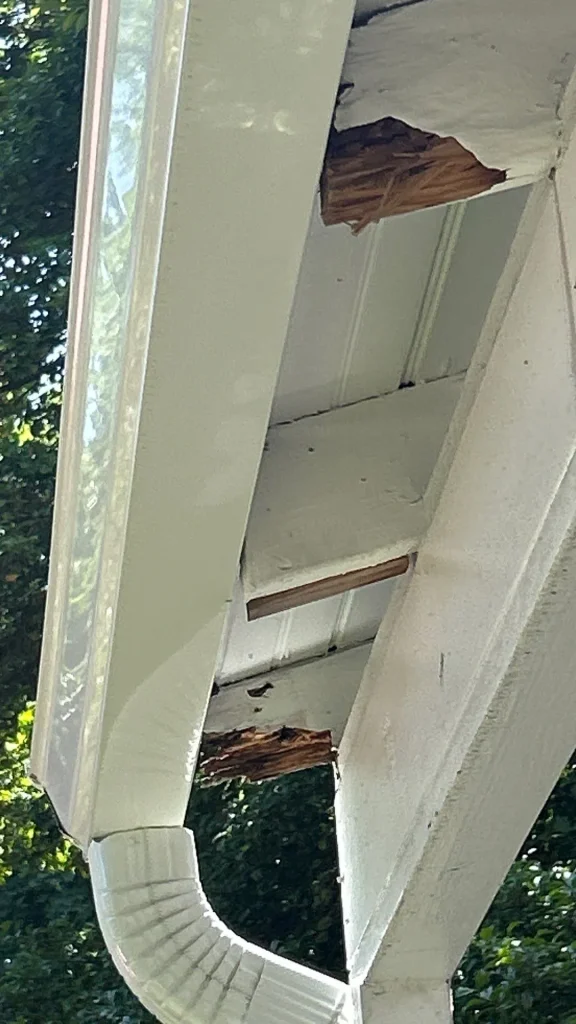
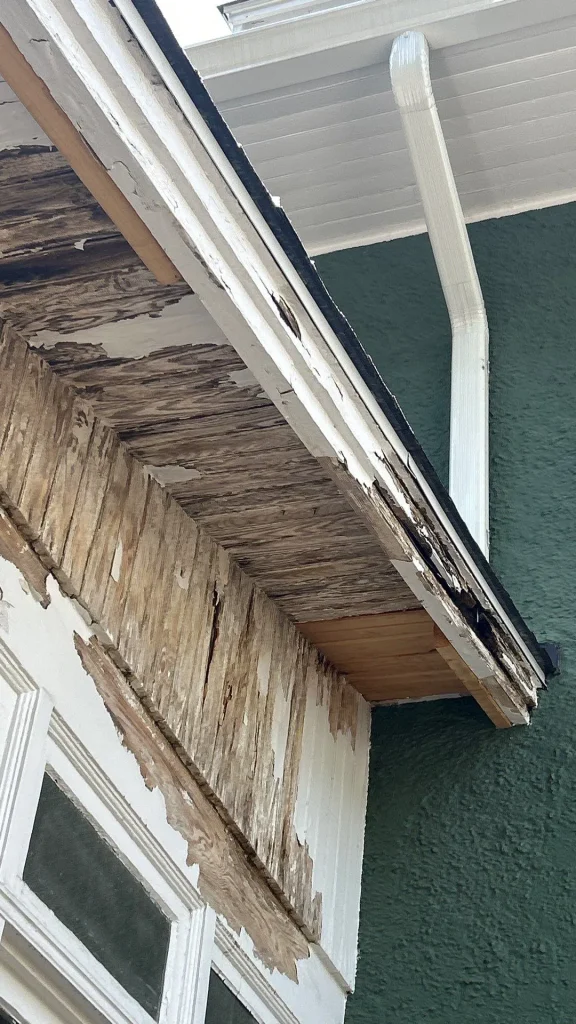
Paint peeling on the fascia board directly behind the gutter is an early warning signal visible from the ground. It means water has been infiltrating behind the back gutter lip and saturating the fascia, cycling wet and dry with every rain. The paint is failing because the wood underneath it is being repeatedly soaked. Caught within the same season, this is usually a repair: reseal the gutter’s back edge, re-secure the gutter in the correct position, and repaint. Wait another year or two, and the wood itself becomes soft, requiring full fascia replacement before any new gutter can attach securely. This is precisely why Hynes Construction inspects fascia condition on every service visit, not just on new installations.
DIY vs. Professional Repair: Where the Line Is
Some repairs are genuinely within reach of a careful homeowner on a single-story home: resealing one leaking seam, tightening a loose hanger, reconnecting a separated downspout bracket, or adding a downspout extension. The line into professional territory is clear: any work on a two- or three-story A Main Line home involves heights where falls cause serious injury. Any repair requiring fascia assessment needs a professional eye. Pitch resets across an entire run require proper technique and tools. Rust holes and cracks require materials that perform differently from hardware store patch kits. Underground drain line issues require a diagnostic assessment that is entirely outside DIY scope. Most Main Line homes are also taller than standard suburban construction, adding effective height to any ladder work. Hynes Construction recommends a professional assessment for any repair on a Main Line home above a single-story level, regardless of the repair type.
Underground Drain Line Assessment: The Hidden Problem
Many older Main Line homes have downspouts that connect to underground drainage pipes, either exiting at a lower point in the yard or connecting to the storm sewer system. These lines are invisible and rarely inspected until a problem develops. When an underground line collapses, fills with root intrusion, or is crushed, the downspout above backs up. Water overflows at the downspout-to-gutter connection, appearing as a gutter drainage problem when the actual failure is underground. Hynes Construction checks downspout discharge and underground connection status on every gutter inspection, specifically looking for this backed-up drainage pattern, which requires a drain line solution rather than gutter repair or replacement.
When Gutter Replacement Is the Right Answer
Replacement is the right call when the problems are systemic, meaning they reflect the overall condition of the system rather than isolated failures. Here are the specific indicators Hynes Construction looks for on Main Line homes:
- Multiple failing seams on a sectional system: Once two or three seam joints fail, the others on the same-age system are close behind. You are not fixing a system. You are delaying its collapse.
- Gutters pulling away from the fascia in multiple locations: When hangers fail repeatedly, or the fascia wood no longer holds fasteners, the system has reached structural end of life. No repair addresses the underlying cause.
- The 50 percent rule: If the total cost of repairing all identified problems approaches or exceeds 50 percent of a full replacement cost, replacement delivers better long-term value. You get a complete warranty on all new materials, no lingering concerns, and often a better-sized system than what was originally installed.
- Visible rust or orange streaking: Aluminum does not rust. Orange streaking on older Main Line gutters indicates original galvanized steel or iron gutters that are oxidizing from the inside. These cannot be meaningfully repaired.
- Sagging or permanently deformed profile: A gutter that has been bent or deformed from ice, debris, or ladder damage cannot drain correctly, regardless of how many hangers are added.
- Fascia rot discovered behind the gutter: When gutters are failing against the back lip and water has saturated the fascia board, replacement of both gutter and fascia is typically the right scope. Installing new gutters on rotted fascia means the same failure mode recurs within 2 to 3 years.
- Any system over 25 to 30 years old with recurring problems: At this age, you are working against economics every time you repair rather than replace.
- Home inspection or pre-sale assessment: If a home inspector has flagged the gutters or you are preparing to list your property, replacement before listing typically returns more than the sale cost.
The Real Cost of Delaying Replacement on a Main Line Home
Water damage insurance claims average $13,954 nationally. Foundation piering costs $7,500 to $30,000. Basement waterproofing systems cost $3,000 to $10,000. Fascia and soffit replacement runs $900 to $6,800. Stucco remediation on a typical Main Line home affected by gutter overflow: $15,000 to $50,000.
Standard homeowner’s insurance policies explicitly exclude damage from maintenance neglect, including gutter failure. The water damage your gutters allow is not covered once an insurer determines it resulted from deferred maintenance. A complete gutter replacement at $1,575 to $2,800 sits in a different financial category than any of the downstream consequences.
If you are not sure which path is right for your specific situation, contact us for a free inspection. We provide a written assessment that clearly defines whether repair or replacement is the right call, with documented reasoning and costs for both options.
What Do Failing Gutters Actually Do to a Main Line Home?
Foundation Damage: The Most Expensive Consequence
When gutters overflow chronically against a Main Line home’s foundation, water saturates the soil at the foundation perimeter. In Pennsylvania’s freeze-thaw climate, that moisture expands by approximately 9 percent in volume with each freeze cycle, creating hydrostatic pressure against the foundation wall. Over the years, this leads to wall cracking, mortar joint deterioration in stone and brick foundations, and differential settlement requiring structural repair.
Basement Flooding: The Direct Connection
Many Main Line homeowners invest in basement waterproofing systems and never address the gutter problem, driving water against their foundation. Properly functioning gutters discharging water at least 4 feet from the foundation are a prerequisite for any basement waterproofing system to work as intended.
Fascia and Soffit Rot: The Silent Structural Problem
When gutters overflow at the back lip, water runs behind the gutter and saturates the fascia board continuously. In pre-war Main Line homes with original board lumber fascia, this moisture leads to rot that can spread to rafter tails and sub-fascia within 3 to 5 years without visible symptoms. By the time soft fascia is noticed, the rot typically extends further than is visible from the outside. This is why Hynes Construction, as a full roofing and exterior contractor, includes fascia assessment with every gutter project.
Stucco and Stone Infiltration: The Costliest Main Line Gutter Consequence
As described earlier, Main Line homes with stucco, EIFS, or stone facades are particularly vulnerable to gutter overflow damage because moisture infiltrates these wall assemblies and causes internal deterioration that is invisible until remediation becomes unavoidable. See our stucco remediation page for what this work involves and costs.
Ice Dams in Pennsylvania Winters
When gutters are clogged going into winter, they retain water that freezes. Pennsylvania’s freeze-thaw cycling expands the ice, deforms the gutter profile, and drives water backward under the shingle edge, creating ice dams. Ceiling staining and attic moisture from ice dams are a direct consequence of deferred fall gutter cleaning and maintenance. See our section on seasonal maintenance below.
Pest Problems That Start in Gutters
Standing water in clogged gutters is a prime mosquito breeding site, particularly relevant in communities where outdoor entertaining from May through October is central to the Main Line lifestyle. Moist, decomposing leaf matter attracts carpenter ants, creates nesting sites for birds and wasps, and introduces moisture pathways to wood framing. Gutters clogged with debris are one of the most overlooked sources of recurring pest problems on older Main Line homes.
Seasonal Gutter Maintenance Calendar for Main Line Homeowners
Given the specific debris patterns of the Main Line’s tree canopy, the standard twice-yearly cleaning recommendation is often insufficient. Here is the schedule Hynes Construction recommends for typical Main Line properties with a significant canopy:
- March to April: Post-winter inspection. Check for ice damage, hanger fatigue from freeze-thaw stress, and any deformation from snow or ice loads. Flush debris accumulated through winter. Verify downspout outlets are clear before spring rains begin.
- Late April to mid-May: Oak catkin and maple samara flush. This is often the most important cleaning of the year for Main Line properties. Oak catkins create dense, wet mats that do not self-clear and can completely block drainage within a single rain event. Clean after peak catkin drop before heavy May rains.
- Late June to August: Post-storm checks following any significant convective thunderstorm. Main Line summer storms are intense and rapid, and partial clogging that was manageable at lower flow rates can cause overflow at summer storm volumes.
- Late October to mid-November: The fall leaf cleaning. Clear after peak leaf fall from oaks and maples, which typically runs through mid-November. Do not leave gutters full of wet leaves going into December. Saturated leaf mass in gutters going into the freeze season is a direct contributor to ice dam formation.
- After any significant hail event: Check for denting of aluminum gutter sections and damage to downspouts. Hail impact can also flush additional shingle granules into gutters, accelerating downspout clogging. See our hail damage page for full context.
Note: Installing quality gutter guards reduces cleaning frequency significantly for most Main Line properties. See our gutter guards page for an honest guide to what guards can and cannot do.
Why Main Line Homeowners Choose Hynes Construction for Gutters
GAF Master Elite Certified — Hynes Construction is among the top 2 percent of roofing contractors nationally to hold this designation. Because gutters connect directly to the roofing system, having a certified roofer assess your gutters means the fascia, soffit, and roof edge are evaluated as a system, not in isolation.
- 50 or more years serving Main Line, PA, with knowledge of pre-war construction, box gutters, slate roofs, stucco facades, and the specific drainage challenges these properties present
- Fascia board assessment included with every gutter estimate
- Seamless gutter fabrication on-site for custom-fit precision on complex Main Line rooflines
- Flexible financing available for installation and replacement projects
- Material and workmanship warranties on every project
- Familiar with both Lower Merion Township and Haverford Township requirements for permitted exterior work
- Full exterior service capability: roofing, siding, chimney, windows, and decks — so a gutter issue that reveals roof or siding damage does not require a second contractor
- Project gallery showing completed work on Main Line properties
Gutter Service Areas Across the Main Line
We provide gutter installation, replacement, and repair across all Main Line communities, including Ardmore, Bryn Mawr, Wayne, Gladwyne, Villanova, Haverford, Lower Merion, Wynnewood, Narberth, Havertown, Bala Cynwyd, Paoli, Devon, and Newtown Square. See all areas we serve.
Also see
Get Your Free Gutter Inspection in Main Line, PA Today
Most Main Line gutter problems are invisible from the ground until they become expensive. A free Hynes Construction gutter inspection gives you a written assessment of your system’s condition, a clear repair versus replacement recommendation with costs for both, and a fascia evaluation included at no charge. No pressure, no obligation.
Gallery
Frequently Asked Questions
More often than the standard twice-per-year recommendation. For Main Line properties with significant oak and maple canopy, we recommend four cleaning events: late April or early May after catkin drop, late summer after convective storm season, late October or early November after peak leaf fall, and a post-winter inspection in March. Oak catkins in April and May are the most problematic debris event of the year and are often missed by homeowners who clean only in the fall.
Overflow without visible clogging usually means one of three things: the gutters are incorrectly pitched, and water is pooling rather than flowing to the downspout, the gutters are undersized for your roof area and rainfall intensity, or the downspout itself is clogged at a bend or underground connection, even if the gutter channel looks clear. All three are common on older Main Line homes. Hynes Construction checks all three as part of a free gutter assessment.
It is almost certainly both, with the gutter being the cause and the stucco wall being the affected material. Gutter overflow against a stucco exterior is one of the primary drivers of stucco remediation on Main Line homes. The gutter must be repaired or replaced first, and then the stucco damage assessed for the remediation scope. Ignoring the gutter and addressing only the stucco means the problem recurs. Hynes Construction handles both services and can assess the full scope in a single visit.
The core decision comes down to whether the problems are isolated or systemic. Isolated failures, one leaking seam, one sagging section, and one failed hanger are repair situations if the rest of the system is intact and under 15 years old. Systemic problems, multiple failing seams, the system pulling away in multiple locations, visible rust, deformed profiles, or any system over 25 years old with recurring issues are replacement situations. If repair costs exceed 50 percent of replacement cost, replacement almost always delivers better long-term value. Call us for a free written assessment that defines clearly which path is right for your home.
Water running behind the gutter means the back lip seal between the gutter and the fascia board has failed, or the gutter has pulled away from the fascia sufficiently to create a gap. This is both a gutter problem and a warning about the fascia condition. Once water has been running behind the gutter, the fascia may already be saturated and beginning to rot. Hynes Construction assesses fascia condition as part of every gutter estimate because replacing gutters on rotted fascia just restarts the failure cycle.
Every roofline that sheds water toward a foundation, walkway, landscaping, or wall assembly needs gutters. Some small shed roofs, secondary overhangs, and garage roof sections are sometimes left unguttered by original builders and later cause problems when drainage runs against a foundation or saturates a planting bed year after year. We assess the full drainage picture of your property and identify any guttered sections that should be addressed.
At 50 years, the honest answer for most systems is yes. Aluminum gutters have a 25 to 30-year service life under good conditions. A 50-year-old aluminum system has almost certainly exceeded its practical lifespan many times over. The fasteners have fatigued, the seams have been sealed and re-sealed multiple times, the pitch has shifted from decades of hanger movement, and the profile may have deformed from ice loads. The cost to properly repair such a system typically approaches or exceeds replacement. A new seamless system with a proper fascia inspection and pitch setting will perform dramatically better.
Directly, gutters are not typically called out as a value driver in appraisals. Indirectly, they have a significant value impact in two ways. First, failing gutters are flagged by home inspectors and become negotiating points for buyers, often resulting in price reductions or seller credits that exceed what repair or replacement would have cost. Second, new gutters protect the foundation, siding, fascia, and structural elements that directly affect appraisal value on higher-end Main Line properties.
Yes, Hynes Construction can handle both roofing and gutter work together, ensuring your entire system works seamlessly to protect your home. This saves time, avoids multiple contractors, and delivers better long-term performance.







TESTIMONIALS
-
C
I highly recommend Peter from Hynes Construction. He did work on the flat roof of my house and did a fabulous job. He is a very professional guy, great with follow up, answers your questions and gives great suggestions based on his experience, and Hynes construction is reasonably priced. Services: Power/pressure washing, Roof repair, Roof installation, Window cleaning.
Candance Prvitt
-
C
Krissy helped me and provided a competitive quote for a new roof. After going through with 4 different quotes from other roofing companies, I decided Hynes Construction was the perfect company for the job. The roof looks beautiful and I am happy working with Hynes Team and I would recommend them to anyone doing a roof replacement! Services: Roof inspection, Roof installation, Roof repair
Marlain Tassone
-
B
Hynes Construction did a fantastic job on my roof. Krissy was professional and easy to work with. They completed my large roof in a day. The crew worked very hard and cleaned up every bit of it. I am extremely happy with my decision of choosing Hynes Construction... Thanks a lot for a wonderful job well done. Services: Roof inspection, Roof installation, Skylight installation
Brigid Goon
-
N
They are quick. Handled everything in a proper way. Hynes Team did an amazing job and were very professional and friendly. They did a great job in cleaning. The work quality is fabulous and they offer competitive pricing. Professional and on time, I would definitely recommend Hynes Construction. Service: Window cleaning
Nancy Brown
-
M
Hynes is undoubtedly the best roofing company around! Professional and experts in what they do, they are clear and will guide you in a right way. I had a leak in my kitchen which another company told me I needed to replace the whole roof which I was too scared off. Later I called Hynes Team for second opinion and they were able to repair the roof and save me from spending thousands of dollars! So thankful for their honesty Services: Roof inspection, Storm / wind damage roof repair, Roof repair
Michael Reilly
-
S
Ridge and Peter both were wonderful and easy to work with. They took the time telling me about the work required and they both were very knowledgeable. I am sure Hynes Team and the company really take good care about the people they work with. I would highly recommend Hynes for any Roof replacement projects! Services: Roof inspection, Roof installation, Roof repair
Stantec
-
J
Contacted Hynes Construction for some minor roof repairs. Hynes had someone out in no time and the repairs were done right after, they were really quick and delivered on time as they promised. I would definitely recommend them for your roofing needs! Thanks to Dan for getting our roof repaired and giving us peace of mind Service: Roof repair
Jeffer Punzalan