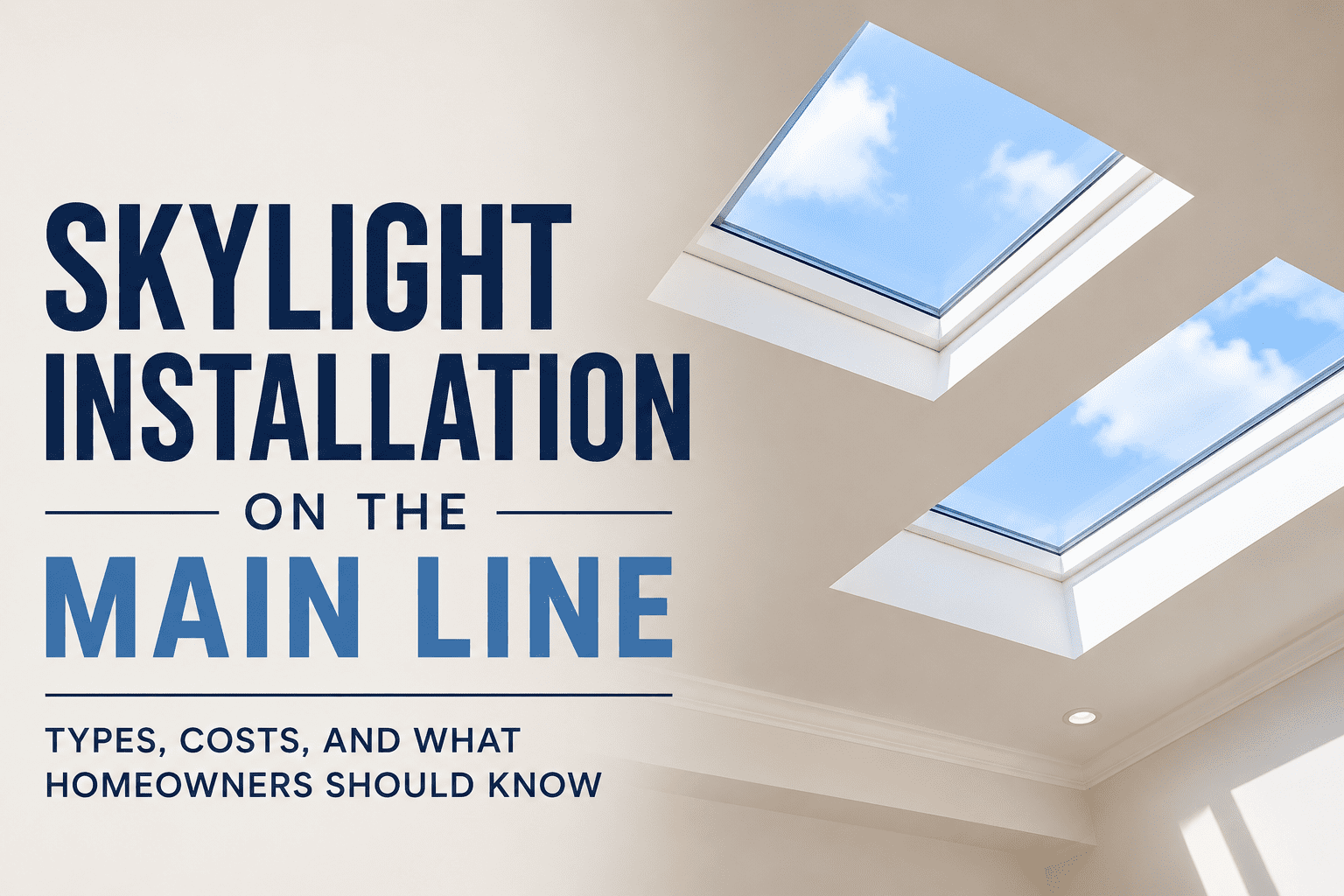
A well-installed skylight installation Main Line transforms a room in a way that no light fixture can replicate. Natural light entering from above changes the color rendering of a space, the apparent size of a room, and the daily experience of the people living in it. On the Main Line, where older colonial and craftsman homes often have smaller windows and darker interior spaces than contemporary construction, a properly installed skylight is among the highest-impact improvements available in terms of the immediate quality-of-life difference it produces.
The challenge is that skylights are one of the most technically demanding residential installations a homeowner can have done. They penetrate the roof structure. They require precise flashing integration with the surrounding roofing system. They must maintain a watertight seal through Pennsylvania’s full annual weather cycle, including heavy summer thunderstorms, ice and snow loading in winter, and 50 to 70 freeze-thaw cycles that stress every penetration in a roof. When skylights are installed correctly, they perform for 20 to 30 years with minimal maintenance. When they are installed poorly, they leak. And a leaking skylight causes ceiling, attic, and structural damage that compounds quickly.
This guide covers everything Main Line homeowners need to know before adding or replacing a skylight: the types of skylights available, what each one costs in the current market, how to recognize when an existing skylight needs replacing rather than repairing, what makes skylight installation on older Main Line homes more complex than on new construction, and why the contractor you choose determines whether your skylight becomes a premium feature or a persistent problem.
Hynes Construction installs, repairs, and replaces skylights throughout Chester, Delaware, and Montgomery Counties. Our skylights service page covers the products we install and our installation approach.
Planning a Skylight Project for Your Home?
Choosing the right skylight isn’t just about adding natural light; it’s about selecting the right style, location, glazing, and flashing system to ensure years of leak-free performance.
Schedule a FREE Skylight Consultation with Hynes Construction and receive:
- Expert recommendations for fixed, vented, or tubular skylights
- Roof compatibility assessment for your home
- Honest advice on new installation vs. replacement
- Free written estimate with no obligation
Schedule Your Free Skylight Consultation
OR
Call (610-896-6388) to speak with our team today.
Types of Skylights: Which One Is Right for Your Main Line Home
Fixed Skylights
Fixed skylights are sealed units that do not open. They admit natural light, provide a view of the sky, and can be specified with a full range of glass packages, including low-E coatings, argon fill, and acoustic glazing. Fixed skylights are the simplest type to install and maintain, with no moving parts or motorized components that can fail. They are the right choice for spaces where light is the primary objective and ventilation is not needed at the skylight location.
Most skylights installed on Main Line homes in living rooms, dining rooms, hallways, and stairwells are fixed units. They provide the dramatic light effect that skylights are known for at the lowest mechanical complexity.
Vented Skylights
Vented skylights open to allow air circulation, making them particularly effective in kitchens, bathrooms, and other spaces where heat and humidity accumulate. Vented skylights are available in manual operation, where a pole or hand crank opens the unit, and in motorized operation with a wall switch or rain sensor. High-end vented skylights from manufacturers like Velux include integrated rain sensors that automatically close the skylight when precipitation is detected.
Vented skylights cost more than fixed units due to the additional frame complexity, hinge and seal systems, and motorization components. They also require more maintenance attention to keep operating hardware and seals in good condition over time. For a bathroom or kitchen where ventilation is a genuine need, the additional cost and complexity are well justified. For a living area where ventilation is not a priority, a fixed skylight is the more appropriate and more durable choice.
Tubular Skylights and Sun Tunnels
Tubular skylights, also called sun tunnels or light tubes, use a small roof-mounted dome to capture natural light and channel it through a highly reflective tube to a diffuser in the ceiling below. They require a much smaller roof opening than traditional skylights. Typically 10 to 14 inches in diameter and can direct light around obstacles within the attic space. This makes them practical for spaces that cannot accommodate a traditional skylight, including hallways, closets, bathrooms with limited attic access, and rooms where the roof structure above is not positioned conveniently for a standard skylight opening.
The quality of light from a tubular skylight is different from that of a traditional skylight. It is diffused, bright, and even rather than directional. There is no sky view, no sense of architectural volume from above, and limited ability to specify glass performance in the way a traditional IGU-based skylight allows. For the practical purpose of lighting a dark interior space, tubular skylights are effective and cost-efficient. For the architectural impact of a skylight as a design feature, a traditional fixed or vented unit is the right choice.
Roof Windows
Roof windows are a distinct product category that combines the function of a skylight with the ability to open fully for access to the roof in some installations. They are commonly used in finished attic spaces and dormer conversions where the sloped ceiling surface is the primary light and air source for the room. Roof windows must be installed on a roof pitch above a minimum threshold specified by the manufacturer, typically 15 degrees or steeper. On the steeply pitched roofs common on craftsman bungalows and Victorian colonials throughout the Main Line, roof windows are often a practical option for attic conversions.
Skylight Costs on the Main Line in 2026
Skylight installation costs on the Main Line in 2026 are driven by three primary factors: the type and size of the skylight unit; the complexity of the installation, including roof structure and interior finishing; and whether the project is a new installation or a like-for-like replacement. Here are realistic cost ranges for each scenario:
Fixed Skylight Replacement (Like-for-Like)
Replacing an existing fixed skylight in an existing opening, with no structural changes, is the most straightforward and most affordable skylight project. The existing rough opening is used, the old unit is removed, the opening is inspected, and any damaged framing or decking is repaired; a new unit is set with proper flashing, and interior finishing is restored.
Typical cost for a like-for-like fixed skylight replacement on the Main Line: $1,500 to $3,500 depending on skylight size, brand, glass specification, and interior finishing scope. Velux, the most widely specified skylight brand in the Philadelphia market, produces units in this category with 10-year no-leak warranties on the complete flashing system.
Vented Skylight Replacement
Vented skylight replacement follows the same scope as fixed replacement but adds the cost of the more complex venting unit. Manual-vented skylights add $300 to $700 over equivalent fixed units. Motorized vented skylights add $600 to $1,500 or more for the unit, wiring, and any associated electrical work.
Typical cost for a like-for-like vented skylight replacement on the Main Line: $2,000 to $5,000 depending on size, motorization, and interior finishing scope.
New Skylight Installation (No Existing Opening)
Adding a skylight where none previously existed is a more complex and expensive project. It requires cutting through the roof decking and sheathing, modifying roof rafters if the opening falls between rafter bays that are not the right size, framing the rough opening with headers and trimmers, installing the skylight unit with full flashing integration, building a shaft from the skylight through the attic to the ceiling below if the attic is unfinished, and restoring both the interior ceiling finish and the exterior roofing around the new penetration.
Typical cost for a new skylight installation on the Main Line: $2,500 to $6,500 for a standard single fixed or vented unit with a simple straight shaft to a finished ceiling below. Projects involving complex shaft geometries, cathedral ceiling construction, or skylight placement requiring rafter modification cost more.
Tubular Skylight Installation
Typical cost for a tubular skylight installation on the Main Line: $600 to $1,500, including the unit and professional installation. Tubular skylights can sometimes be installed by an experienced crew in a few hours, making them among the most cost-effective ways to bring natural light into a dark space.
Why Skylight Installation Is More Complex on Older Main Line Homes
The majority of Main Line homes where skylights are being added or replaced were built between 1920 and 1970, and these homes have specific structural characteristics that make skylight installation more complex than on newer construction:
Non-Standard Rafter Spacing
Older Main Line homes were often built with rafter spacing that does not conform to contemporary standard dimensions. A skylight unit designed for 24-inch on-center rafter spacing may not fit cleanly between the rafters of a home built with non-standard spacing. When the skylight opening falls within a rafter bay, the rafter must be cut and a header installed to carry the load around the new opening. This structural work adds to the installation scope and must be done correctly to maintain the structural integrity of the roof.
Existing Insulation and Air Sealing Conditions
Older attic spaces on the Main Line frequently have irregular insulation configurations from multiple generations of improvement work. When a skylight shaft is built through an attic space, proper insulation of the shaft walls is essential for thermal performance. An uninsulated or poorly insulated shaft becomes a cold bridge in winter and a heat gain source in summer, undermining the thermal performance of the roof system. Professional installation includes proper shaft insulation as part of the scope.
Roof Condition and Compatibility
A skylight installation on a roof that is approaching the end of its life creates a specific sequencing problem. Flashing a new skylight into an aging roof results in the skylight outlasting the surrounding roofing system, which means the skylight will need to be removed, reflashed, and reinstalled when the roof is replaced. If your roof is more than 15 years old and you are considering adding a skylight, coordinating the skylight installation with a roof replacement saves the cost of the reinstallation and produces the cleanest possible flashing integration because both the roofing and the skylight flashing are new at the same time.
Our roof installation and replacement service page covers the full scope of roof replacement services we provide. Our team regularly coordinates skylight work as part of comprehensive roof replacement projects across the Main Line.
Is Your Skylight Leaking or Showing Signs of Age?
A leaking skylight doesn’t always mean you need a full replacement but waiting too long can lead to costly roof, ceiling, and water damage.
Our specialists can inspect your skylight and help you determine whether a repair, reflashing, or complete replacement is the smartest long-term solution.
1. Skylight Leak Inspection
2. Repair vs. Replacement Recommendations
3. Roof & Flashing Evaluation
4. Free Written Estimate
Book Your Free Skylight Inspection
OR
Call (610-896-6388) to reach out to us directly
Signs Your Existing Skylight Needs Replacing Rather Than Repairing
Not every skylight problem requires full replacement. Understanding which conditions are repairable versus which indicate end-of-life helps you avoid both unnecessary replacement expense and the false economy of repairing a skylight that will continue to fail:
Active Leaking Around the Skylight Frame
Water entry around the perimeter of a skylight frame, manifesting as ceiling staining, interior trim damage, or visible water during and after rain events, most commonly originates from failed flashing rather than from the skylight glass unit itself. The flashing that integrates the skylight with the surrounding roofing is under continuous thermal and weather stress and typically has a shorter service life than the glass unit. Flashing repair or replacement is a targeted scope that can extend a skylight’s service life if the unit itself is in good condition.
However, on skylights that are more than 15 to 20 years old, the economics of flashing repair versus full replacement require careful evaluation. A new flashing system on a 20-year-old unit buys limited time before the unit itself fails. If the glazing system, frame condition, or hardware is also showing age, full replacement is often the more economical choice on a lifecycle basis.
Condensation Between the Panes
Condensation visible between the panes of a skylight’s insulated glass unit indicates a failed seal, identical to the same condition in a window. The insulating gas has escaped, and the glass is now performing at or near single-pane thermal efficiency. There is no repair for a failed IGU short of replacing the glass unit or the complete skylight. On newer skylights where the frame and flashing are in good condition, replacing just the glazing unit is sometimes cost-effective. On older skylights, full replacement is typically more economical.
Visible Cracks or Hazing in the Glazing
Acrylic skylight domes, which were commonly used before the widespread adoption of tempered and laminated glass in residential skylights, develop hazing and yellowing from UV exposure over time. Hazing blocks light transmission, creates an aesthetically unpleasant appearance, and indicates that the material has aged to the point where replacement is appropriate. Modern skylights use glass glazing systems that do not develop hazing or yellowing from UV exposure, making replacement with a current unit a significant functional improvement.
Skylight Is More Than 20 Years Old and Showing Any Performance Issues
A skylight that is more than 20 years old and showing any combination of the above symptoms is almost always more economically handled through full replacement than through repair. Modern skylight technology has improved significantly in the past two decades: better glass coatings, better flashing systems, better sealing materials, and better thermal performance. Replacing an aging unit with a current product resets the performance baseline and typically comes with a manufacturer’s warranty that repairs to an older unit cannot provide.
The Importance of Professional Skylight Installation on the Main Line
Skylight installation is not a project where the quality of the contractor is a secondary consideration. It is the primary consideration. A skylight installed by an experienced roofing contractor who understands flashing integration, structural considerations, and shaft construction will perform for 20 to 30 years. A skylight installed by a general handyman who does not have deep roofing expertise will likely leak within three to five years, causing interior damage that costs more to repair than the installation saved.
The specific expertise required for quality skylight installation on the Main Line:
- Roofing competency: The installer must understand how water moves across a roof surface and how to integrate flashing into the existing roofing system to create permanent water management rather than temporary sealing.
- Structural knowledge: Cutting roof rafters requires understanding of load paths and appropriate header sizing. An installer who does not understand structural framing may create a condition that causes ongoing movement and seal failure at the skylight opening.
- Interior finishing: A shaft that is framed, drywalled, taped, and painted by a crew that understands finished carpentry produces a clean, professional result. A shaft constructed as an afterthought produces a result that looks incomplete regardless of the quality of the skylight unit itself.
Hynes Construction’s team handles all aspects of skylight installation, including structural framing, roofing integration, shaft construction, and interior finishing as a complete and coordinated project. We carry all applicable Pennsylvania contractor licenses and full liability and workers’ compensation insurance. See our certifications and affiliations page for our professional credentials.
Coordinating Skylight Installation With Other Projects
Skylight projects on Main Line homes are most efficiently and cost-effectively executed when coordinated with other concurrent work:
- Roof replacement: The best possible time to add or replace a skylight is during a full roof replacement. The roofing is already off, access to the structure is at its simplest, and the flashing integration between the skylight and roofing can be executed as a single coordinated system. See our roofing service page for full roof replacement services.
- Window replacement: If you are replacing your home’s windows and considering adding a skylight, combining both projects allows coordination of glass specifications, scheduling, and interior finishing work. Our complete windows service page covers all window and skylight replacement services.
- Interior renovation: Skylight installation during an interior renovation of the receiving room eliminates the need to disturb finished ceilings and wall surfaces after the renovation is complete.
Financing and Warranty Coverage for Skylight Projects
Hynes Construction offers flexible financing options for qualifying projects, including skylight installations. All installation work is backed by a workmanship warranty, and Velux skylights carry a 10-year product warranty. Full warranty details are on our warranties page.
To see completed skylight installations, browse our project gallery and follow recent projects on Facebook and Instagram. We serve homeowners in Ardmore, Wayne, Villanova, Havertown, Bryn Mawr, and communities throughout our service area. Call 610-896-6388 or use our contact page to schedule a free consultation.
Frequently Asked Questions
How much does skylight installation cost on the Main Line in 2026?
A like-for-like fixed skylight replacement in an existing opening typically runs $1,500 to $3,500 on the Main Line. Vented skylight replacement runs $2,000 to $5,000. A new skylight installation with no existing opening, including shaft construction, runs $2,500 to $6,500 for a standard unit. Tubular skylights run $600 to $1,500 installed. These ranges reflect Main Line market conditions and the older home construction that adds complexity. Hynes Construction provides free written estimates for all skylight projects.
Will a skylight cause my roof to leak?
A properly installed skylight by an experienced roofing contractor will not cause your roof to leak. Skylight leaks are almost always installation deficiency issues rather than product failures. The flashing system that integrates a skylight with the surrounding roofing is the critical element. When flashing is executed correctly using factory-engineered flashing kits and proper roofing technique, the skylight penetration is as watertight as any other properly detailed roof component.
Is it better to add a skylight during a roof replacement?
Yes, strongly. Adding or replacing a skylight during a full roof replacement is the optimal sequencing for several reasons: the roofing is already off the deck, making access and structural work more efficient; the flashing integration between skylight and new roofing can be executed as a single coordinated system; and both the skylight and the new roofing start their service lives together, avoiding the situation where a new skylight must be removed and reflashed when the surrounding aging roof is eventually replaced.
What type of skylight is best for a bathroom on the Main Line?
A vented skylight is ideal for a bathroom because it provides both natural light and the ability to exhaust humidity and odors naturally. Motorized venting with a humidity sensor that automatically opens the skylight when humidity reaches a threshold is a premium option for bathrooms where moisture management is a priority. Fixed skylights also work well in bathrooms where ventilation is handled by a standard exhaust fan and the primary objective is light.
How long do skylights last in Pennsylvania’s climate?
Quality skylights from established manufacturers, including Velux, Andersen, and Fakro, have documented service lives of 20 to 30 years in Pennsylvania’s climate when properly installed and maintained. The glass unit typically outlasts the flashing system, which means reflashing may be required at the 15- to 20-year mark, even on a skylight with a sound glass unit. Annual inspection of the skylight seal and flashing condition extends service life and catches potential issues before they become active leaks.
What is the difference between a skylight and a roof window?
A traditional skylight is installed in the roof plane and accessed from below only. A roof window is designed to open fully and can be used for roof access or emergency egress in finished attic spaces. Roof windows are installed on roof pitches above a minimum threshold and are the appropriate choice for converted attic bedrooms where egress requirements apply and where the occupants need both light and ventilation from the sloped ceiling surface.
Do I need a permit to install a skylight on the Main Line?
Yes. Skylight installation that involves cutting roof framing requires a building permit in virtually all Main Line municipalities. Hynes Construction manages permit applications as part of every skylight project. Unpermitted structural roof modifications create problems at resale and with insurance.
Can a tubular skylight reach rooms that are far from the roof?
Yes, to a practical extent. Flexible tubular skylight systems can navigate around obstacles in the attic space and extend the light tube over distances of up to 10 to 20 feet, depending on the manufacturer and tube diameter. Beyond this distance, light output diminishes significantly. For rooms with limited attic access or long distances from the roof to the ceiling, a traditional skylight located as directly above the desired room as possible is a more effective solution.
My skylight is leaking. Do I need a full replacement, or can it be repaired?
This depends on the source and age of the leak. Leaks from failed flashing around the perimeter of a skylight in otherwise good condition can often be repaired by reflashing without replacing the unit. Leaks from a failed glass seal (indicated by condensation between panes) require replacing the glass unit or the complete skylight. On skylights that are more than 15 to 20 years old and showing multiple issues, full replacement is typically more economical than repair. Hynes Construction inspects and diagnoses skylight issues and provides an honest assessment of whether repair or replacement is the appropriate solution.
How do I get a skylight estimate from Hynes Construction?
Call us at 610-896-6388 or use our contact page to schedule a free consultation. Our team will assess your roof structure, discuss your skylight options and objectives, and provide a written estimate. We serve homeowners throughout the Main Line, including Ardmore, Wayne, Bryn Mawr, Havertown, Villanova, West Chester, Radnor, Lower Merion, and all communities across Chester, Delaware, and Montgomery Counties.
Bring More Natural Light Into Your Main Line Home
Whether you’re replacing an aging skylight, adding natural light to a dark room, or planning a skylight installation alongside a new roof, Hynes Construction delivers professional installation designed for long-term performance.
Our experienced team helps homeowners throughout the Main Line choose the right skylight solution with proper flashing, expert craftsmanship, and dependable warranty protection.
Why Homeowners Choose Hynes Construction
- Free In-Home Skylight Consultations
- Expert Installation & Replacement Services
- Quality Products from Trusted Manufacturers
- Financing Options Available for Qualified Projects
- Serving Ardmore, Wayne, Bryn Mawr, Villanova, Havertown & Surrounding Main Line Communities
Request Your Free Skylight Estimate
OR
Call (610-896-6388) to schedule your consultation today.

(President, Hynes Roofing and Siding)
With over 35 years experience in the roofing and siding industry, Michelle Hynes has built a business from 2 people into over 45 people and 19 trucks!