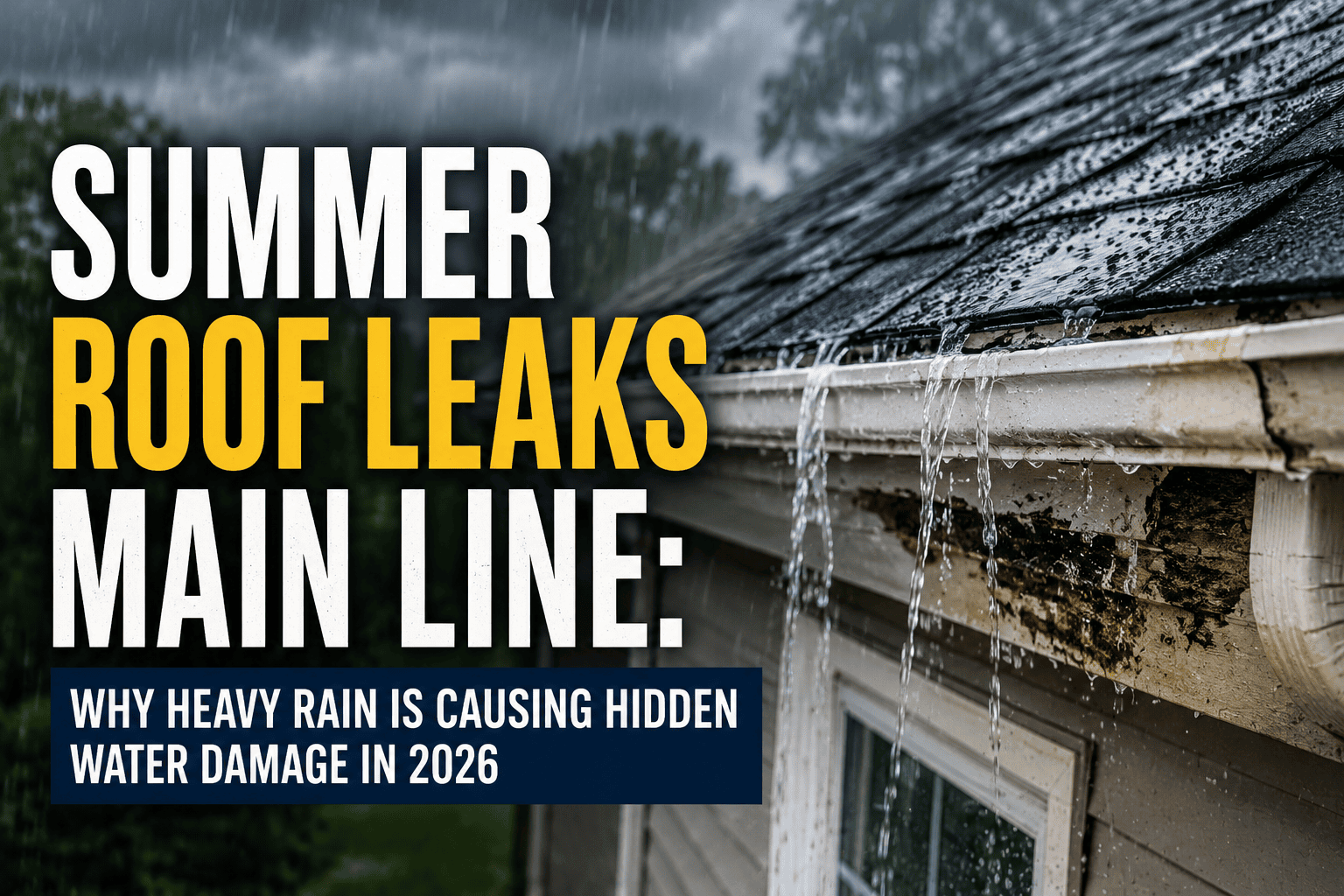
The summer of 2026 has been one of the wettest on record for the Main Line and Delaware County. Many homeowners are noticing summer roof leaks in Main Line homes that are causing hidden water damage in attics, ceilings, and walls. Repeated heavy rainstorms, combined with the preceding winter’s freeze-thaw stress, are creating a dangerous pattern: roofs that previously held up under moderate conditions are now experiencing water intrusion that bypasses the visible exterior, resulting in hidden damage inside attic spaces, ceiling cavities, and wall assemblies.
The most problematic aspect of summer roof leaks on older Main Line homes is how slowly and quietly they develop before becoming impossible to ignore. A homeowner in Ardmore may go through three consecutive weeks of heavy afternoon thunderstorms before noticing the first ceiling stain in the master bedroom. By the time that stain appears, water has typically been entering the attic and saturating insulation for multiple rain events. The insulation masks the drip until the saturation reaches a critical point and gravity brings the water through the ceiling drywall.
This guide covers why summer conditions on the Main Line create a specific hidden water damage risk, the nine signs most homeowners miss before a roof leak becomes visible, why the attic is the most important place to look for early warning, and what a professional roof inspection in Ardmore and across Delaware County can find that a homeowner cannot see from the yard.
Hynes Construction provides roof repair and professional roof inspection services throughout Ardmore, Delaware County, and the Main Line. Call 610-896-6388 or visit our contact page to schedule your free roof assessment.
The 2026 summer storm pattern on the Main Line is producing a specific risk combination that experienced roofing contractors are seeing consistently across Chester and Delaware Counties. Two factors are converging:
Cumulative Winter Damage That Was Never Assessed
The 2025 to 2026 winter produced more than 60 freeze-thaw cycles across the Main Line between November and March. Each cycle expanded any existing micro-cracks in shingles, worked open any failing caulk around flashing, and stressed the seals around every roof penetration from pipe boots to chimney bases. Homeowners who did not schedule a spring roof inspection after the winter are now heading into their second summer with accumulated wear that has not been assessed or addressed. When the summer’s heavy rain events hit, these pre-existing weak points become active entry paths.
Back-to-Back High-Intensity Rain Events
A single heavy rain event tests a roof’s primary water management systems: the shingles, the valley flashing, and the gutters. When the same weakened roof goes through three or four such events in two weeks, without time to dry out between them, water that was stopped by secondary barriers in the first event begins to find its way past them in subsequent events. The cumulative exposure is what turns a marginal roof condition into an active leak. Main Line homeowners who noticed no interior evidence after the first June storm but then found ceiling staining after the third or fourth storm are experiencing exactly this cumulative pattern.
Warning Sign 1: Ceiling Staining That Appears After Rain Events but Fades When Dry
The classic presentation of an active but hidden roof leak is a ceiling stain that appears or darkens during and after heavy rain events, then fades to a lighter ring shape as the ceiling dries between events. Many homeowners dismiss the dried ring as an old stain or an inconclusive indicator. The ring is actually reliable evidence of ongoing water infiltration. Each wet event adds new staining, and the dried salt rings from evaporated water accumulate over multiple events. Any ceiling stain near an exterior wall or beneath a roof penetration should be treated as evidence of an active leak until a professional inspection proves otherwise.
Warning Sign 2: Musty or Earthy Odor in Upper Rooms or the Attic
Mold colonies establish within 24 to 48 hours on consistently damp organic materials at summer temperatures. In an attic where an undiscovered roof leak has repeatedly wetted insulation or wood sheathing, mold growth can become significant before any visual evidence appears in the living space below. The first indicator is often a musty, damp-earth odor that is perceptible in upper-floor rooms or when the attic access hatch is opened. This odor does not go away through ventilation because the source, wet organic material with active biological growth, is ongoing. A musty attic smell in summer on the Main Line should be treated as a presumptive indicator of roof moisture intrusion.
Warning Sign 3: Unexplained Spikes in Summer Cooling Costs
A roof leak that saturates attic insulation reduces the insulation’s effective R-value. Wet insulation may retain 30 to 50 percent of its rated R-value depending on the degree of saturation. For a Main Line home running central air conditioning through July and August, this insulation loss means the HVAC system is working harder to compensate for heat gain entering through the attic. If your cooling costs in July 2026 are measurably higher than the same period in prior years without changes in usage patterns or thermostat settings, compromised attic insulation from a roof leak is one of the most common underlying causes.
Warning Sign 4: Peeling or Bubbling Interior Paint Near Exterior Walls
Interior paint that is peeling, bubbling, or showing a grayish discoloration near exterior walls or ceiling edges is showing the effect of moisture migrating through the wall or ceiling assembly. This is a secondary symptom that appears after water has already been present in the assembly for a meaningful period. Paint failure near exterior walls should trigger an exterior inspection of the corresponding roof section above and a professional assessment of the wall cavity moisture condition.
Warning Sign 5: Soft or Spongy Roof Decking Observed from the Attic
During an attic inspection after a heavy rain event, press upward gently on accessible sections of the roof decking from below. Sound, dry decking is rigid and firm. Decking that has been repeatedly wetted by a slow leak will feel softer, may show dark discoloration at the saturation area, and may have visible moisture droplets on the underside during or shortly after active rain. Soft spots in decking indicate deterioration that will continue to accelerate with each subsequent rain event. Decking that has reached this condition typically requires replacement as part of the roof repair scope.
Concerned about a possible roof leak in Ardmore or Delaware County? Hynes Construction provides free roof inspections with written assessments. Call 610-896-6388 or request your inspection online. Serving Chester, Delaware, and Montgomery Counties for over 50 years.
Warning Sign 6: Granule Accumulation in Gutters
After every significant rain event, check your gutters and downspout splash areas for granule accumulation. A small amount of granule loss from gutters is normal over the life of an asphalt shingle roof, particularly for newer roofs in the first year of installation. Significant dark sand-like granule accumulation after a storm event indicates widespread granule displacement from hail impact or advanced shingle aging. Granule loss accelerates UV degradation of the exposed asphalt mat and shortens the roof’s effective remaining service life.
Warning Sign 7: Visible Flashing Separation or Rust Around Chimneys and Pipe Boots
From ground level using binoculars, inspect the base of your chimney and all pipe penetrations through the roof for visible signs of flashing separation, rust, or caulk failure. Even small visible gaps at these locations can be significant water entry points under the wind-driven rain conditions of a summer thunderstorm. Flashing that has pulled away from the chimney masonry by even a quarter inch creates a direct path for water to enter the roof assembly at the most vulnerable structural intersection.
Warning Sign 8: Sagging or Water-Filled Areas of Ceiling Drywall
A ceiling area that appears to bulge downward or feel soft when pressed indicates that water has accumulated behind the drywall surface. This is an urgent condition. Water pooling behind ceiling drywall puts structural stress on the drywall and the fasteners holding it to the ceiling joists. A waterlogged ceiling section can fail suddenly rather than progressively, releasing the accumulated water into the room below. If you notice any ceiling area that looks or feels as though it is holding water behind the surface, the water should be released in a controlled manner by an experienced contractor, not ignored until failure occurs.
Warning Sign 9: Daylight Visible Through the Roof Deck When Inspecting the Attic
On a sunny day, enter the attic after turning off any artificial lighting and allow your eyes to adjust for a few minutes. Any visible pinpricks or lines of daylight penetrating through the roof deck indicates openings in the sheathing that are active water entry paths during rain events. This is a definitive indicator of a condition requiring immediate repair. Even small openings allow significant water entry under the driving force of wind-blown summer rain.
How to Conduct Your Own Summer Attic Inspection in Delaware County
A 15-minute attic inspection by a homeowner can identify evidence of roof moisture intrusion that would not be apparent from any ground-level observation. Here is what to look for:
- Enter the attic within 24 to 48 hours after a significant rain event, when any recent moisture intrusion will still be visible or detectable
- Look for water stains on rafters and roof sheathing: dark discoloration or actual wet areas indicate recent or ongoing water entry at those locations
- Check insulation batt condition: insulation that has been wet will often show compression, discoloration, or visible mold growth on the facing material
- Smell for mustiness in areas near penetrations, at the eaves, and around chimney bases
- Trace any stains to their highest point on the roof sheathing, as water travels down from the actual entry point before appearing at the lowest accessible location
- Note the location of any attic evidence relative to exterior features: roof penetrations, valleys, chimneys, and skylights are the most likely entry point locations corresponding to attic moisture evidence
Whatever you find, take photographs before leaving the attic and note the locations relative to the attic access hatch or exterior landmarks. This documentation assists the professional contractor in identifying the relevant roof sections to inspect from above.
When a Summer Roof Leak Requires Immediate Professional Response
Some summer roof leak scenarios require emergency professional response rather than a routine inspection appointment:
- Active water dripping into living spaces during or immediately after rain events
- Any ceiling area showing bulging or softness indicating water accumulation behind drywall
- Water intrusion near electrical fixtures, wiring, or panels
- Visible structural sagging of the roof surface from exterior observation
- Any evidence of mold odor or visible mold growth in the attic or upper floors
For these conditions, call Hynes Construction at 610-896-6388 for a same-day response. Our emergency roof repair service covers the Main Line and Delaware County with prompt assessment and tarping to stop active water entry.
What a Professional Roof Inspection Finds That You Cannot See from the Ground
A professional roof inspection in Ardmore or across Delaware County in 2026 goes significantly beyond what a homeowner can assess from the yard or from the attic. Here is what a qualified inspector does that ground-level observation cannot accomplish:
- Physical shingle inspection: Walking every square of the roof surface and physically checking shingle seal strip adhesion, granule coverage, sealant condition around penetrations, and the integrity of each flashing connection
- Flashing probing: Physically checking each flashing connection for movement, separation, or compromised sealant that would not be visible from below
- Valley condition assessment: Inspecting valley flashing for debris accumulation, membrane condition, and any compromised overlaps that allow water movement under the field shingles
- Chimney and skylight cap inspection: Checking the top of chimney structures for failed mortar caps, deteriorated chimney crowns, and improper flashing detail at the chimney base
- Decking condition from above: Identifying soft spots in the decking that indicate moisture saturation from below, which may not be visible from the attic side
All of this inspection work is documented in writing and supported by photographs that provide a clear baseline of current roof condition and any storm-related damage. See our GAF Master Elite certification and professional standards page for information on our inspection standards. All Hynes Construction repair work is covered by our workmanship warranty.
We serve homeowners in Ardmore, Havertown, Springfield, Conshohocken, Lower Merion, Narberth, Gladwyne, and throughout Delaware and Chester Counties. Call 610-896-6388 or use our contact page to schedule your inspection. Follow us on Facebook and Instagram for recent project updates.
Do not wait for a ceiling stain to confirm your roof has a summer leak problem. Call Hynes Construction at 610-896-6388 for a free professional roof inspection in Ardmore and across Delaware County. Written assessment included.
Frequently Asked Questions
Why do some roof leaks only appear during heavy summer thunderstorms and not during lighter rain?
Light to moderate rainfall flows down the roof surface and into gutters under gravity, following the intended drainage path. Heavy summer thunderstorms produce intense rainfall volumes that can exceed the designed drainage capacity of gutters and valleys, creating ponding and backflow at areas that were not tested in normal conditions. Wind-driven rain also pushes water horizontally into flashing gaps and shingle edges that would not be reached by vertical rainfall. A roof that appears dry after moderate rain but shows interior evidence after a severe storm has marginal conditions that are only revealed by high-intensity events.
How much damage can a small, slow roof leak cause before it is discovered?
Significant damage. A slow roof leak entering the attic can saturate insulation across a broad area, create conditions for extensive mold colonization on wood sheathing and rafters, and eventually degrade the ceiling drywall beneath the affected area, all before a ceiling stain appears in the living space. Water damage restoration after a long-term undiscovered leak in an attic can cost $5,000 to $25,000 or more in insulation replacement, mold remediation, and structural drying. Early discovery through regular inspections prevents this escalation.
How often should a Main Line home in Delaware County have a professional roof inspection?
Twice per year is the professional recommendation for most Main Line homes: once in spring after winter freeze-thaw stress to assess winter accumulation and once in late summer or early fall to assess summer storm damage before the next cold season begins. Homes with roofs older than 15 years, homes that have recently experienced significant storms, and homes with multiple roof penetrations or complex rooflines benefit most from consistent biannual inspections.
Can a summer roof leak cause mold growth inside the home?
Yes. Mold begins colonizing damp organic materials within 24 to 48 hours at summer temperatures. Insulation, wood sheathing, rafters, and ceiling drywall are all organic materials that support mold growth when kept damp by an ongoing roof leak. Mold in attic spaces can spread to living areas through ventilation pathways and HVAC systems. Professional mold remediation is significantly more expensive and disruptive than the cost of prompt roof repair that stops the moisture source before mold establishes.
What is the most common entry point for summer roof leaks on Main Line homes?
The most common entry points on Main Line homes, based on Hynes Construction’s field experience across Chester and Delaware Counties, are in order: failed pipe boot sealants around plumbing penetrations, deteriorated or separated chimney flashing at the base of the chimney, valley flashing failures at the intersection of two roof planes, and shingle seal strip failures at roof edges and ridgelines. All of these locations require close-up inspection and cannot be adequately evaluated from street level.
My ceiling stain appeared in a room that is not directly below the roof. How is that possible?
Water entering a roof does not always fall straight down. Once water penetrates past the shingles and underlayment, it follows the path of least resistance across the roof decking, along rafters, and along ceiling joists before finding a drip point. The interior stain can appear several feet or even across a room from the actual entry point on the roof. This is one of the most common reasons homeowners incorrectly identify the source of a roof leak. A professional inspection traces the water path from the interior stain backward to the likely entry point.
Should I attempt to seal a roof leak myself as a temporary measure?
For minor, accessible situations such as applying roofing caulk around a pipe boot that is visibly separating, a confident homeowner can provide temporary relief while scheduling professional repair. In most cases, DIY roof sealant applications on an actively wet or recently wet roof do not bond adequately and provide only a few rain events of temporary protection. They also sometimes cover the symptom without addressing the underlying cause, which can complicate the professional repair. Emergency tarping by a professional stops active water entry more reliably than DIY sealant applications.
How do summer roof leaks affect my homeowners insurance coverage in Delaware County?
A summer roof leak caused by a specific storm event is typically covered under standard Pennsylvania homeowners insurance as sudden and accidental storm damage. A roof leak caused by gradual wear, deferred maintenance, or an aged and deteriorated roof is typically excluded as maintenance neglect. The critical factor is documentation that ties the leak to a specific storm event rather than to ongoing neglect. Prompt professional assessment and documentation after a storm is the most reliable way to support a coverage claim.
How do I know if my summer roof leak requires repair or full replacement?
If the roof is less than 15 years old and damage is localized to one area or one system such as flashing, targeted repair is typically the appropriate response. If the roof is more than 20 years old and the summer leak reveals widespread underlying wear, including granule loss, brittle shingles, and multiple compromised flashing points, replacement is often more economical than ongoing repair. Our guide on roof replacement vs. repair covers the decision framework in detail.
Does Hynes Construction provide free roof inspections in Ardmore and Delaware County?
Yes. Hynes Construction provides free professional roof inspections with written assessments throughout Ardmore, Delaware County, and the broader Main Line area. Our inspection includes a close-up evaluation of all shingle surfaces, flashings, penetrations, and gutters, plus an attic walkthrough when accessible. Written findings and photographs are provided following every inspection.
Call 610-995-6309 or use our contact page to schedule an appointment with Hynes Construction.

(President, Hynes Roofing and Siding)
With over 35 years experience in the roofing and siding industry, Michelle Hynes has built a business from 2 people into over 45 people and 19 trucks!