Choosing the right deck design Main Line, PA, is one of the most important decisions homeowners can make when creating an outdoor living space that complements their home’s architecture. A stark modern deck with cable railings on the back of a federal-style colonial in Wayne reads as wrong to almost everyone who sees it. A heavy pressure-treated lumber deck with traditional post caps on a clean-lined transitional home in Ardmore has the same problem in reverse. The most successful decks on the Main Line are designed with one eye on function and one eye on architectural context, and the result is an outdoor space that feels like it belongs to the house rather than something that was bolted on afterward.
This guide covers how to approach deck design in Main Line PA, based on your home’s architectural style. The Main Line is defined by a specific and recognizable range of home types: colonial revivals, stone farmhouses, craftsman bungalows, transitional new construction, and contemporary infill homes. Each style creates different opportunities and constraints for deck design, and understanding those relationships helps you make decisions that add lasting value to your property.
Which Deck Design Fits Your Home’s Architecture?
Not every deck design complements every home. Whether you own a Colonial in Wayne, a Craftsman in Ardmore, or a stone farmhouse in Villanova, the right layout, materials, and railing style can dramatically improve both curb appeal and long-term property value.
Schedule your FREE Deck Design Consultation today or call (610) 896-6388 to receive expert recommendations tailored to your home’s architecture, lifestyle, and budget.
Why Deck Design Decisions Matter More Than Most Homeowners Realize
Many homeowners approach deck design primarily as a materials decision: wood or composite, what color, and what railing type. These are important choices, but they follow from a more fundamental design decision: what configuration, layout, and visual vocabulary fit the home it will serve.
A deck is one of the most visible elements of your home’s exterior when viewed from the rear of the property. It determines how the yard relates to the house, how people move between indoor and outdoor spaces, how much usable outdoor space is available for different activities, and how the back of your home reads to anyone who can see it. Getting these larger decisions right produces an outcome that feels architecturally intentional. Getting them wrong produces an outdoor space that functions acceptably but looks and feels added on.
On the Main Line, deck design decisions also have a direct impact on property value. In a market where comparable homes are sold within the same neighborhoods, a well-designed deck that complements the home’s architecture is a positive differentiator. A deck that looks mismatched is sometimes noted negatively in buyer feedback. Our complete guide to deck cost on the Main Line covers how deck design quality affects both project cost and resale return.
Deck Design for Colonial and Traditional Main Line Homes
Colonial architecture dominates the Main Line’s residential landscape. Georgian colonials, Dutch colonials, Cape Cods, and Federal-style homes define the character of communities from Ardmore through Wayne and into Devon and Berwyn. These homes share specific visual characteristics: symmetrical facades, classical proportion, formal entry features, and a preference for clean, structured geometry.
Design Principles for Colonial Decks
Colonial homes respond best to deck designs that honor their formal geometry. This means:
- Symmetrical layouts where the deck composition is balanced, either centering on the rear door or creating balanced zones on either side of a central axis.
- Classical railing profiles using turned balusters, traditional post caps, and white or painted finishes that echo the home’s existing trim palette.
- Defined steps with symmetrical stair configurations rather than sweeping or curved stair designs that feel contemporary.
- Built-in planters, pergolas, and benches that reinforce the structured, formal character of the home.
- Material choices in natural pressure-treated wood or composite products in warm earth tones and classic profiles that do not compete with the home’s traditional palette.
Colonial homes on the Main Line frequently work well with multilevel deck configurations when the rear yard has a grade change, which is common on older Main Line properties. A lower-level ground patio connected to an upper-level deck with formal steps creates a structured progression from house to yard that suits colonial architecture well.
Colors that work particularly well for colonial decks include warm brown composites, natural cedar tones, and painted white or soft gray railings. Avoid highly contemporary finishes, cable railings, and minimalist profile boards on colonial homes, as these create an architectural conflict that is difficult to resolve without redesigning the deck entirely.
Deck Design for Craftsman and Bungalow-Style Homes
Craftsman-style homes appear throughout the older neighborhoods of Ardmore, Haverford, and Havertown, as well as in the craftsman revival construction that has been built across the Main Line over the past 20 years. Craftsman architecture is defined by its emphasis on handcraft, natural materials, horizontal emphasis, and structural detail. Exposed rafter tails, tapered columns, deep overhangs, and warm natural material palettes are characteristic.
Design Principles for Craftsman Decks
Craftsman decks should extend the material language and detail level of the home:
- Heavy timber posts and beams with visible structural connections rather than hidden or minimized structural elements. The structure of the deck is meant to be seen.
- Natural wood materials, particularly cedar or redwood, rather than composite products. Where composite is used, choose profiles and colors that mimic natural wood grain closely.
- Pergola structures with exposed rafter tails and decorative bracket details at post-and-beam connections.
- Horizontal emphasis in railing design, either through horizontal rail panels or through closely spaced horizontal boards rather than vertical balusters.
- Stone or masonry elements at the base of posts and in step structures that connect to the home’s masonry character.
- Warm, earthy color palettes: deep browns, rich tans, warm grays, and natural cedar tones.
Craftsman decks benefit from integration with landscaping. Planted beds surrounding the base of the deck, connecting the structure to the yard organically, suit the craftsman’s philosophy of integrating built elements with the natural environment.
Deck Design for Stone Farmhouses and Historical Homes
The Main Line has a significant number of stone farmhouses and historically influenced homes, particularly in communities like Gladwyne, Villanova, and older sections of Bryn Mawr. These homes present particular design challenges because natural stone is a visually dominant material that can overpower deck structures that do not respond to it with appropriate weight and character.
Design Principles for Stone Farmhouse Decks
Decks on stone farmhouses should match the visual weight and material gravity of the stone they attach to:
- Heavier structural members and thicker deck boards rather than lean, minimal profiles.
- Natural materials that age gracefully alongside stone, including cedar, ipe, or mahogany, rather than composite products that can look plasticky against natural stone.
- Stone, bluestone, or brick used in step risers, base walls, and transition elements to create continuity between the home’s stone exterior and the deck structure.
- Wrought iron or flat bar steel railing elements that reference traditional Pennsylvania ironwork rather than aluminum or vinyl systems.
- Avoid overly finished or contemporary materials. Stone farmhouses look best when deck additions feel old enough to have always been there.
For many stone farmhouse decks on the Main Line, the most successful approach is a bluestone patio at grade with the deck structure kept as simple and natural as possible. The complexity and character come from the stone elements rather than from the wood deck structure itself.
Deck Design for Transitional Homes
A significant portion of the Main Line’s housing stock built between 1990 and 2015 falls into the transitional category: homes that blend traditional architectural features with cleaner contemporary lines and larger glass areas. These homes are neither rigidly traditional nor fully contemporary, which gives deck designers real flexibility.
Design Principles for Transitional Decks
- Composite decking in warm gray or brown tones that work across both traditional and contemporary palettes.
- Clean-profile aluminum railings with simple square balusters that do not read as either traditional or aggressively modern.
- Multi-level configurations that create definition between dining, seating, and transition zones.
- Pergola structures in white or light gray painted wood that connect to the home’s trim palette.
- Built-in seating and planting areas that add function and reduce the deck’s reliance on outdoor furniture.
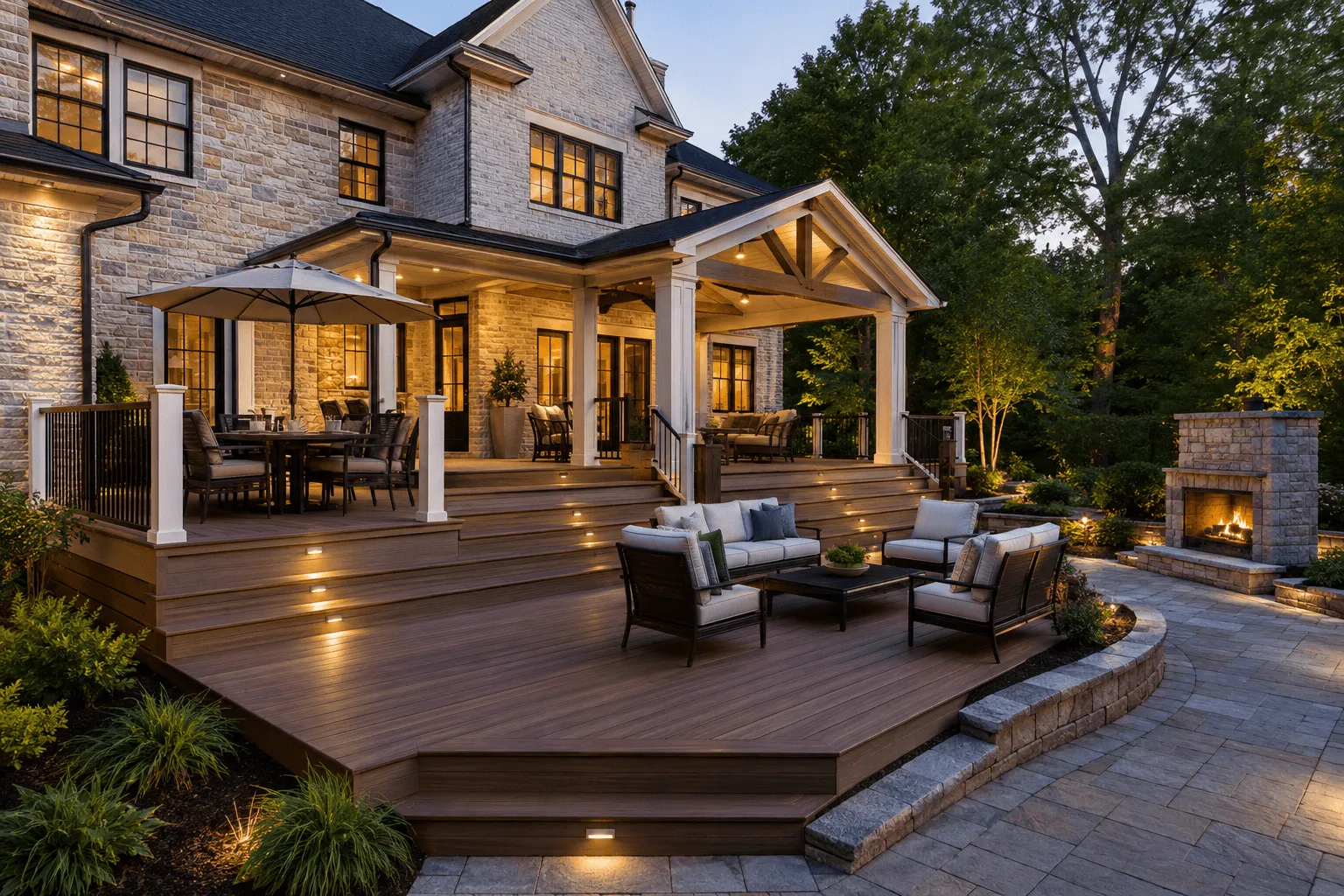
Transitional homes give deck designers the most latitude for mixing materials. A composite deck surface with a natural wood pergola, or a clean-profile composite deck with a stone fire feature on an adjacent ground-level patio, all work well within the transitional aesthetic.
Deck Design for Contemporary Homes
Contemporary homes on the Main Line, including infill construction in Ardmore and newer homes in Wayne and Devon, have clean lines, large glass walls, and minimal ornamentation. Decks on contemporary homes should extend this visual language rather than fighting against it.
Design Principles for Contemporary Decks
- Low-profile composite or hardwood decking in large-format board widths that emphasize horizontal lines.
- Cable or glass panel railing systems that minimize the visual weight of the railing and maximize the view from the deck.
- Hidden fastener systems for a clean, uninterrupted board surface.
- Integrated LED strip lighting in deck boards and post bases rather than traditional post-cap lights.
- Simple, rectilinear deck footprints without curved edges or multilevel complexity.
- Powder-coated aluminum or stainless steel hardware and railing components rather than painted wood.
Contemporary decks are the configuration where premium composite products like Trex Transcend and TimberTech Terrain truly shine, as their clean surfaces and color consistency suit the unforgiving geometry of modern architecture.
Multi-Level Deck Design for Main Line Properties
Many Main Line properties have sloped rear yards, a result of the natural terrain of the Piedmont region that the Main Line occupies. Sloped yards create both a challenge and an opportunity for deck design. A single-level deck on a sloped site either sits high above the yard on tall posts at the low end or loses connection with the yard entirely. A multi-level deck addresses this by stepping down with the grade.
Multi-level decks also allow functional zoning of the outdoor space. An upper level connected directly to the house works as a dining and cooking area close to the kitchen. A lower level connected to the yard works as a casual seating, play, or fire pit area. Steps between levels create transition and visual interest. On larger Main Line properties, a three-level configuration can organize the yard into a sequence of outdoor rooms that extends the home’s living area into the landscape.
The permit implications of multi-level decks with tall posts at the low end of a slope require attention. Delaware County and Chester County municipalities have specific requirements for tall deck posts, post footings, and the structural connections on elevated decks. Our guide on deck permits on the Main Line covers what each township requires.
Covered vs Uncovered Deck Structures
One of the most significant functional decisions in deck design is whether to include a covered structure over all or part of the deck. On the Main Line, where summer afternoons frequently bring intense sun and sudden afternoon thunderstorms, a covered section of the deck extends the number of usable hours per day and the number of usable days per season significantly.
A pergola over a dining area keeps afternoon sun off the table and makes midday outdoor dining comfortable rather than miserable. A solid roof over a portion of the deck allows the deck to be used during rain events without retreating indoors. These are practical improvements that translate into more frequent use of the outdoor space. Our comparison of covered deck vs open deck vs screened porch options for Main Line homes covers the full range of overhead structure options and what each one costs and delivers.
Still Deciding Between a Multi-Level Deck, Pergola, or Covered Outdoor Space?
Every backyard is different, and the best deck design depends on your home’s layout, yard elevation, entertaining needs, and how you plan to use the space throughout the year. Our team helps homeowners compare design options before construction begins so you can invest with confidence.
Schedule your FREE Deck Planning Consultation or call (610) 896-6388 to discuss ideas, layouts, materials, and features that fit your home perfectly.
Deck Design and Materials: Making Them Work Together
Once the design configuration and architectural vocabulary are established, material selection should follow from those decisions rather than leading them. Our complete guide to deck materials for Delaware County and Main Line homeowners covers the full comparison of wood, composite, and PVC options. Our composite deck maintenance guide for Trex, TimberTech, and AZEK is the reference for homeowners who have chosen or are considering composite.
Browse completed deck projects from our team in our project gallery and see recent builds on Facebook and Instagram to get a sense of how different design approaches look on real Main Line properties. To discuss your project, call 610-896-6388 or use our contact page.
Frequently Asked Questions
What deck design works best for a colonial home on the Main Line?
Colonial homes respond best to symmetrical deck layouts with classical railing profiles, turned balusters, painted white or traditional color railings, and formal stair configurations. Natural wood or composite in warm earth tones works well architecturally. Avoid cable railings, minimalist profiles, or contemporary design elements on colonial homes, as these create architectural conflicts that undermine curb appeal and resale value.
How do I choose a deck design for a craftsman-style home?
Craftsman decks should feature heavy timber posts and beams with visible structural connections, natural wood materials, pergola structures with exposed rafter tails, and horizontal railing emphasis. The structural elements of the deck are meant to be celebrated rather than hidden in a craftsman’s home. Warm earth tones and natural material palettes, including cedar and redwood, suit craftsman architecture best.
Should I choose a single-level or multi-level deck?
This depends primarily on your yard’s topography and the functional zones you want to create. On sloped Main Line properties, multi-level decks address grade changes gracefully while creating distinct dining, seating, and transition areas. On flat lots, multi-level decks are a design choice that creates visual interest and functional separation. Single-level decks are simpler to build and maintain and work well when the yard grade is relatively flat, and the intended use is a single functional zone.
What railing type works best for a contemporary home on the Main Line?
Cable railings and glass panel railings are the strongest architectural matches for contemporary homes. Both minimize visual weight, preserve sightlines, and extend the clean-line aesthetic of modern architecture into the outdoor space. Aluminum railings with simple square balusters are an intermediate option that works on both transitional and contemporary homes. Avoid turned wood balusters, traditional post caps, and ornate railing profiles on contemporary homes.
How important is deck design for resale value on the Main Line?
Deck design quality has a measurable impact on resale value in the Main Line market. A well-designed deck that complements the home’s architecture is noted positively by buyers and their agents. A deck that looks architecturally mismatched can actually be a negative at showings. On Main Line properties where buyers are evaluating multiple comparable homes, a thoughtfully designed outdoor space is a differentiator. Our deck cost guide covers the relationship between deck quality, design, and return on investment.
Do I need a permit for a new deck on the Main Line?
Yes. Any new deck construction on the Main Line requires a building permit in virtually all Chester, Delaware, and Montgomery County municipalities. Permit requirements cover the structural design, footings, and railing compliance. Hynes Construction manages the permit application process as part of every new deck project. Our guide on deck permits on the Main Line covers what specific townships require.
Can I add a pergola to an existing deck?
Yes, in most cases. Adding a pergola to an existing deck typically requires a building permit, and the existing deck structure must be assessed to confirm it can support the additional load. Hynes Construction handles pergola additions as part of our deck services, including structural assessment, permit application, and construction.
How long does it take to design and build a custom deck on the Main Line?
From initial consultation to project completion, a standard deck project on the Main Line typically takes four to eight weeks. This includes the consultation and estimate phase, permit processing (typically two to three weeks in most Main Line townships), material ordering, and construction. More complex multi-level decks with pergolas or covered structures take longer. Beginning the process in June or July allows for completion before the end of the outdoor entertaining season.
What deck materials complement stone exteriors?
Natural wood materials, including cedar, ipe, and mahogany, age most gracefully alongside natural stone. Bluestone or brick in step structures and base elements creates material continuity between the home’s stone exterior and the deck. Where composite is used on stone homes, choose profiles and colors that mimic natural wood grain closely. Avoid highly contemporary composite finishes with very clean, plasticky surfaces on stone homes.
How do I get started with a deck design consultation from Hynes Construction?
Call us at 610-896-6388 or use our contact page to schedule a free in-home consultation. Our team will assess your property, discuss your home’s architectural style, understand your functional goals for the outdoor space, and provide a design recommendation and written estimate. We build decks throughout Ardmore, Wayne, Bryn Mawr, Havertown, Villanova, and communities across the Main Line.
Bring Your Dream Outdoor Living Space to Life
Whether you’re envisioning a timeless Colonial deck, a warm Craftsman-inspired retreat, or a sleek contemporary outdoor space, thoughtful design makes all the difference. Hynes Construction designs and builds custom decks that blend seamlessly with your home’s architecture while creating a beautiful, functional space your family will enjoy for years.
✔ Custom Deck Design & Planning
✔ Composite & Natural Wood Decks
✔ Multi-Level Decks & Pergolas
✔ Permit Assistance & Professional Installation
✔ Serving Homeowners Throughout the Main Line
Schedule your FREE Deck Design Consultation today or call (610) 896-6388, and let’s create an outdoor space that’s built specifically for your home.

(President, Hynes Roofing and Siding)
With over 35 years experience in the roofing and siding industry, Michelle Hynes has built a business from 2 people into over 45 people and 19 trucks!