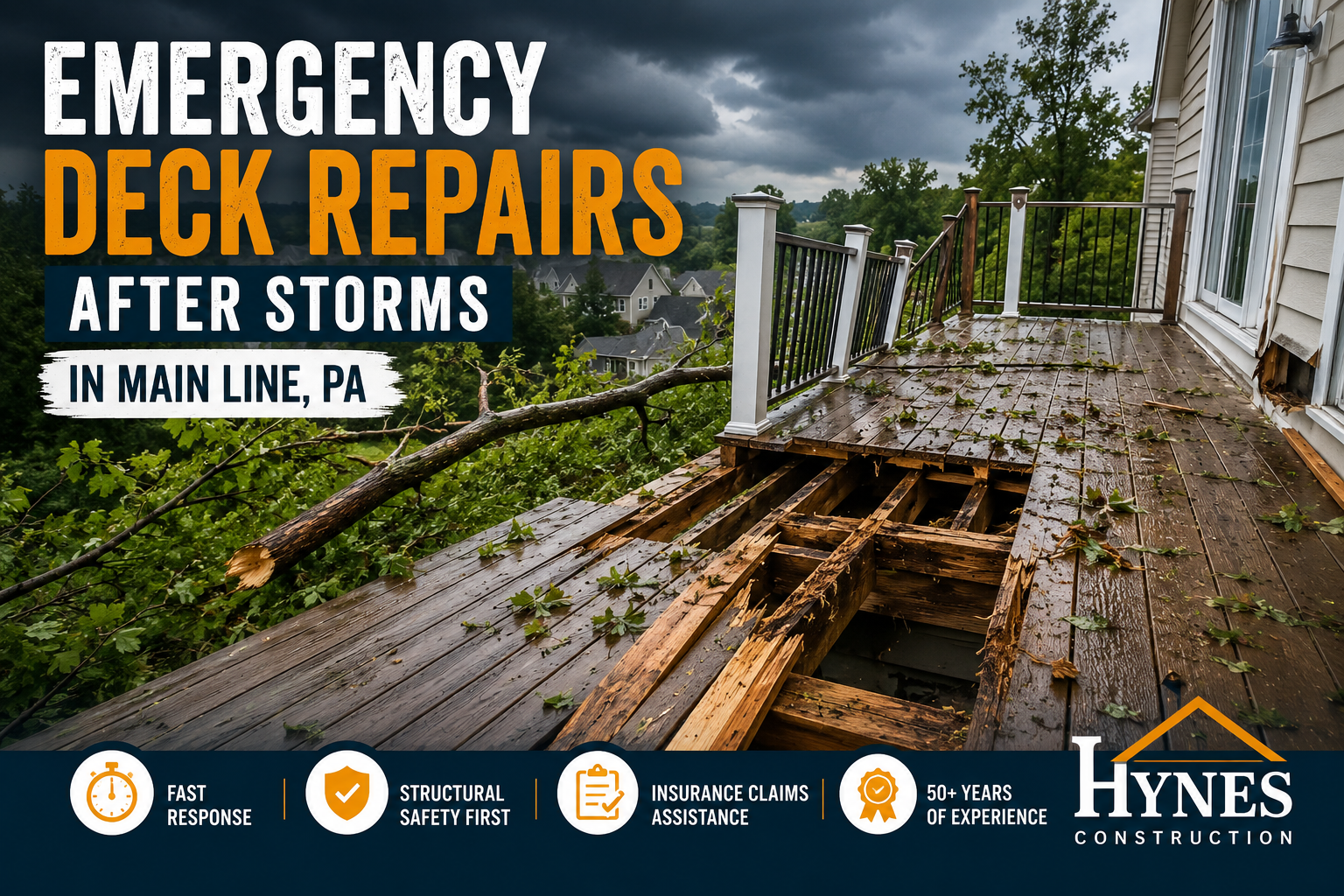
Emergency deck repair in Main Line, PA, often becomes a priority after severe storms, high winds, hail, or falling tree debris damage a deck’s structure. Storms hit the Main Line hard and fast. A nor’easter tracking up the I-95 corridor, a mid-summer squall rolling off the Schuylkill, or a concentrated hail cell over Chester County can transition from a weather alert on your phone to visible structural damage on your deck in under an hour.
Hynes Construction covers everything that Main Line homeowners need to know about emergency deck repair after storms: what to inspect safely, which damage signals an immediate structural problem, when boards need replacing versus when the whole deck needs evaluation, and how to document damage for your insurance company.
Hynes Construction has served homeowners across Chester, Delaware, and Montgomery Counties for more than 50 years. Our deck repair services include structural assessment, insurance documentation, and workmanship warranties.
Has Your Deck Been Through a Recent Storm?
Even if your deck looks fine from the surface, hidden structural damage beneath the boards, around the ledger, or at the footings can create serious safety risks. A professional inspection can identify problems before they become expensive repairs or dangerous failures.
Schedule your storm damage deck inspection today or call us at (610) 896-6388 for a prompt assessment anywhere across the Main Line.
Why Storm Damage to Decks Is More Serious Than It Looks
The most dangerous thing about storm-damaged decks is that the most serious damage is rarely visible from the surface. High winds, driving rain, ice loading, and falling debris cause problems beneath the decking boards, inside the ledger connection to the house, and at the post footings underground, long before anything looks obviously wrong from standing on the deck.
Pennsylvania weather creates a specific damage pattern contractors see repeatedly across the Main Line. Heavy rain saturates wood frame components already near their moisture tolerance. Ice loading stresses connections that held fine through previous winters. Wind-driven debris creates point loads that crack boards and loosen joist hangers. The visible surface often tells only half the story.
The practical danger is that a deck appearing intact can have a compromised ledger connection, a rotted rim joist, or failed post footing, making it unsafe to load. Every year, decks left uninspected after storm events fail during the first gathering of the season. A post-storm inspection by a qualified contractor is the only reliable way to understand the actual deck condition after a major weather event.
For a baseline understanding of deck structural safety, our deck safety inspection guide for Main Line homeowners covers warning signs that indicate a compromised structure.
Immediate Steps After a Storm: What to Do in the First Hour
Step 1: Assess From Below Before Stepping Onto the Deck
Before setting foot on the deck surface, walk around and beneath it, looking up at the understructure. Look for any joist or beam that is visibly broken, displaced, or hanging. Check the ledger board where the deck meets the house for any visible separation. Check post connections at the deck frame. If anything is visibly broken or displaced, treat the deck as unsafe until a contractor has inspected it.
Step 2: Document Everything Before Touching Anything
Before clearing debris, before moving furniture, before sweeping water off the boards, take photographs and video. Capture the overall deck from multiple angles. Photograph specific damage: broken boards, displaced railings, debris impact marks, water pooling. Note the storm date precisely. This documentation is the foundation of your insurance claim. Our insurance claims assistance page explains how we help homeowners document and file.
Step 3: Remove Debris Carefully
Once documented, remove fallen branches and debris carefully. Do not drag heavy material across the deck surface, which causes additional board damage. Move deck furniture inside if additional rain is expected before repairs can be made.
Step 4: Cover Exposed Structural Members
If the impact has broken through decking boards and exposed structural members beneath, cover the area with a heavy-duty tarp secured at the edges. Exposed wood framing that stays wet through multiple rain events deteriorates rapidly. This is especially important in spring and summer, when warm, humid conditions accelerate mold and rot.
Storm Damage Assessment: What to Check on Your Deck
Decking Board Condition
Walk the surface carefully, pressing down with your foot at each board end and middle. Sound boards are firm. A board that flexes, feels soft, or sounds hollow has either lost fastener contact with the joist below or has deteriorated enough that it can no longer carry load. Look for boards that are cracked, split end to end, or have deep dents from debris impact. Wood boards show splits and checks; composite boards can crack cleanly across the width from heavy impact.
Railing Lateral Stability
Push your railings laterally with both hands. Building code requires deck railings to resist a 200-pound lateral load. After a storm, check every railing section. A railing that moves, wobbles, or does not return to plumb when released has either lost its post connection, suffered damage to the post itself, or degraded at the attachment point to the rim joist. Railing failure is one of the most common causes of deck injury. Any railing failing the lateral push test should be taken out of service immediately.
Ledger Board and House Connection
The ledger board is the single most critical structural element in an attached deck. It carries the house-side load and transfers it to the house band joist or foundation. Water infiltration behind the ledger from storm-driven rain getting past inadequate flashing is the primary cause of ledger rot and deck collapse on older Main Line homes.
After a major rain event, inspect the ledger from below. Look for staining, soft spots, or any visible separation between the ledger and the house. Push on the ledger connection from below. It should be completely rigid. Any movement, softness, or visible gap should be treated as an emergency structural condition requiring immediate professional evaluation.
Post and Footing Condition
Check each deck post at its base. Posts showing visible splits should be assessed by a contractor. More importantly, check the base of wooden posts for soft or discolored wood at the grade line. This is where end-grain wood absorbs moisture and begins to rot first. This damage is invisible from the surface and requires a probe to assess accurately.
Joist and Beam Condition
Looking up from beneath the deck, check every visible joist for cracking, splitting, or displacement from its joist hangers. Push up on joists to confirm they are seated in their hangers. A joist that drops or moves when pushed upward has lost its connection and is transferring load unsafely to neighboring members.
Types of Storm Damage and What Each Requires
Fallen Tree or Large Branch Impact
Direct tree impact is the most serious category of storm deck damage. The combination of point-load impact and lateral spreading as the tree comes to rest can break multiple joists, crack ledger boards, and displace posts. Treat the deck as structurally unsafe until a contractor has opened the affected areas and assessed the underlying structure. Do not attempt to remove a large tree from the deck yourself, as tree removal and structural stability are interrelated in these situations.
Wind Damage to Railings and Boards
Main Line nor’easters and summer squall lines routinely reach 50 to 70 miles per hour in exposed areas. Unsecured deck furniture becomes airborne, impacting railings and boards with significant force. Railing sections not properly connected to the rim joist can fail in sustained high winds. After any storm with confirmed high wind speeds, inspect every railing section individually.
Hail Damage
Hail on the Main Line typically runs from marble to golf ball size during spring and summer convective storms. On wood decking, hail leaves characteristic pitting and bruising that may not compromise structural integrity unless the hail is large enough to crack boards. On composite decking, large hail can crack the material’s surface. If your roof or siding shows hail damage from the same storm, have your deck assessed simultaneously, as multi-surface documentation strengthens your overall insurance claim. Our hail damage roof repair page covers hail documentation in detail, and the same principles apply to deck damage.
Water Saturation and Flash Flooding
Extended heavy rain causes boards that lack proper sealing to absorb significant moisture, causing swelling and cupping that can pull fasteners loose. More seriously, standing water pooling against the house below the ledger creates conditions for accelerated ledger rot. If your deck area accumulated standing water during a storm event, inspect the ledger connection particularly carefully.
Not Sure Whether Your Deck Needs a Repair or Full Replacement?
Storm damage isn’t always obvious. Sometimes replacing a few damaged boards is enough. In other cases, hidden structural damage means repairing the surface won’t solve the problem.
Our experienced team will inspect the framing, posts, joists, ledger board, and decking to determine the safest and most cost-effective solution for your home.
Schedule your professional deck evaluation today or call us at (610) 896-6388 for honest recommendations and a detailed written estimate.
Deck Board Replacement vs Full Deck Replacement
After a storm, a key decision is whether damage warrants surface repairs or whether the storm exposed a deck already approaching the end of its service life. Deck board replacement makes sense when the structural frame is sound; damage is confined to surface boards, and perhaps some railing sections; and repair can be completed without replacing structural members. Full deck replacement makes more sense when a storm exposes or accelerates structural damage already present, the deck is over 20 years old with widespread soft spots, or the repair cost approaches the replacement cost.
Our deck replacement vs deck board replacement decision guide walks through these factors in detail. Current pricing is in our deck cost guide for Main Line PA homeowners.
Storm damaged your deck? Call Hynes Construction at 610-896-6388 for a prompt inspection and written estimate. Serving Chester, Delaware, and Montgomery Counties.
Documenting Deck Storm Damage for Insurance
Most homeowners’ insurance policies cover sudden and accidental storm damage, including wind damage, hail damage, and tree impact. For the strongest possible claim, your documentation should show the storm date and weather service confirmation, photographs of damage tied to the storm, evidence that damaged components were in sound condition before the event, and a written assessment from a licensed contractor distinguishing storm-caused damage from any pre-existing conditions.
Hynes Construction provides written storm damage reports in the format insurance adjusters require. We work directly with your adjuster rather than around them. See our insurance claims assistance page for how we handle this process.
How Quickly Does Storm Deck Damage Need to Be Repaired?
Structural damage should be assessed within 24 to 48 hours and repaired as soon as possible. A structurally compromised deck should not be used until the structural issue is resolved. Surface damage without underlying structural compromise should be repaired within two to four weeks to prevent moisture penetration into structural members below. Railing damage that fails the lateral stability test should be taken out of service immediately and repaired within one week.
Preventing Future Storm Deck Damage
Well-maintained decks with sound construction handle Pennsylvania storms significantly better than neglected structures. Annual maintenance tasks that reduce storm vulnerability include: inspecting all railing connections and tightening loose hardware, re-driving raised fasteners, clearing debris from between boards and from below the deck, checking and maintaining ledger flashing, sealing or staining wood decking every two to three years, and securing or storing furniture before forecast high-wind storms.
Our deck water resistance and protection guide covers annual maintenance in detail. For homeowners considering whether a covered deck might better protect their investment, our covered deck vs open deck comparison for Main Line homes is worth reviewing. For permit information, our guide to deck permits on the Main Line covers local requirements.
Frequently Asked Questions: Emergency Deck Repair After Storms
Is my deck safe to use after a storm?
Do not assume a deck is safe just because it appears intact from the surface. Before using the deck, assess from below, check every railing for lateral stability, and look for any visible structural displacement. If you have any doubt, treat the deck as unsafe until a licensed contractor has inspected it.
What types of storm deck damage are covered by homeowners’ insurance?
Most policies cover sudden and accidental storm damage, including wind, hail impact, and tree or branch impact. Gradual deterioration, rot, and poor maintenance are generally excluded. Proper documentation, including photographs, a storm date, and a written contractor assessment, is essential for a successful claim.
How much does emergency deck repair cost on the Main Line?
Board-level repairs for a small section typically run $300 to $1,500. Railing replacement for a damaged section runs $500 to $2,000, depending on material and linear footage. Structural repairs involving joists, ledger work, or posts run $1,500 to $8,000 or more. Full deck replacement for an average Main Line deck runs from $15,000 to $35,000. A free on-site estimate from Hynes Construction provides the only accurate number for your specific situation.
How quickly should I call a contractor after storm deck damage?
For visible structural damage, within 24 hours. For board or railing damage without visible structural compromise, within one week. The sooner you document and begin the repair process, the better your insurance claim position and the less secondary damage accumulates.
Can I repair my deck myself after storm damage?
Minor cosmetic repairs to individual boards are within the capability of a confident DIYer. Structural repairs, ledger work, post replacement, and anything affecting load-bearing connections should be done by a licensed contractor. Pennsylvania requires permits for structural deck repairs in most municipalities, and unpermitted structural work creates problems at resale.
How do I know if my deck needs repair or full replacement after a storm?
If the structural frame is sound and damage is confined to the surface, repair is usually the right call. If the storm reveals or accelerates existing structural deterioration, if the deck is over 20 years old with widespread soft spots, or if the repair cost approaches the replacement cost, full replacement is often the better investment.
Does storm damage to my deck affect my property value?
An unrepaired storm-damaged deck is typically flagged during home inspections and appraisals, which can complicate a sale or refinancing. Prompt, properly permitted repair protects both your property value and your insurance position.
Will Hynes Construction help with the insurance claim for deck damage?
Yes. Hynes Construction provides written damage assessments that document storm-caused damage in the format insurance adjusters require. We distinguish between storm damage and pre-existing conditions clearly in our reports, which helps claims get processed accurately. We work directly with your adjuster.
What permits are required for deck repair on the Main Line?
In most Main Line townships and boroughs, any structural deck repair requires a building permit. Surface-level board replacements using identical materials typically do not require permits. Hynes Construction handles permit applications as part of our project management service.
How does Hynes Construction respond to emergency deck damage calls?
We prioritize emergency calls following major storm events on the Main Line. We conduct free on-site inspections and provide written assessments. For situations where structural compromise makes the deck unsafe, we respond promptly to assess and secure the area.
Follow Hynes Construction on Facebook and Instagram for storm response updates.
Protect Your Deck Before the Next Storm Arrives
Whether your deck needs emergency repairs, structural reinforcement, new decking boards, or a complete replacement, addressing damage now helps prevent bigger problems during the next severe weather event.
Hynes Construction has helped Main Line homeowners restore storm-damaged decks for more than 50 years with quality workmanship, insurance claim assistance, and long-lasting repairs.
Schedule your free deck repair estimate today or call us at (610) 896-6388 to get your deck safely back in service.
Further reading: Deck Cost Guide Main Line PA | Deck Safety Inspection Guide | Deck Board vs Full Replacement Guide | Deck Services

(President, Hynes Roofing and Siding)
With over 35 years experience in the roofing and siding industry, Michelle Hynes has built a business from 2 people into over 45 people and 19 trucks!