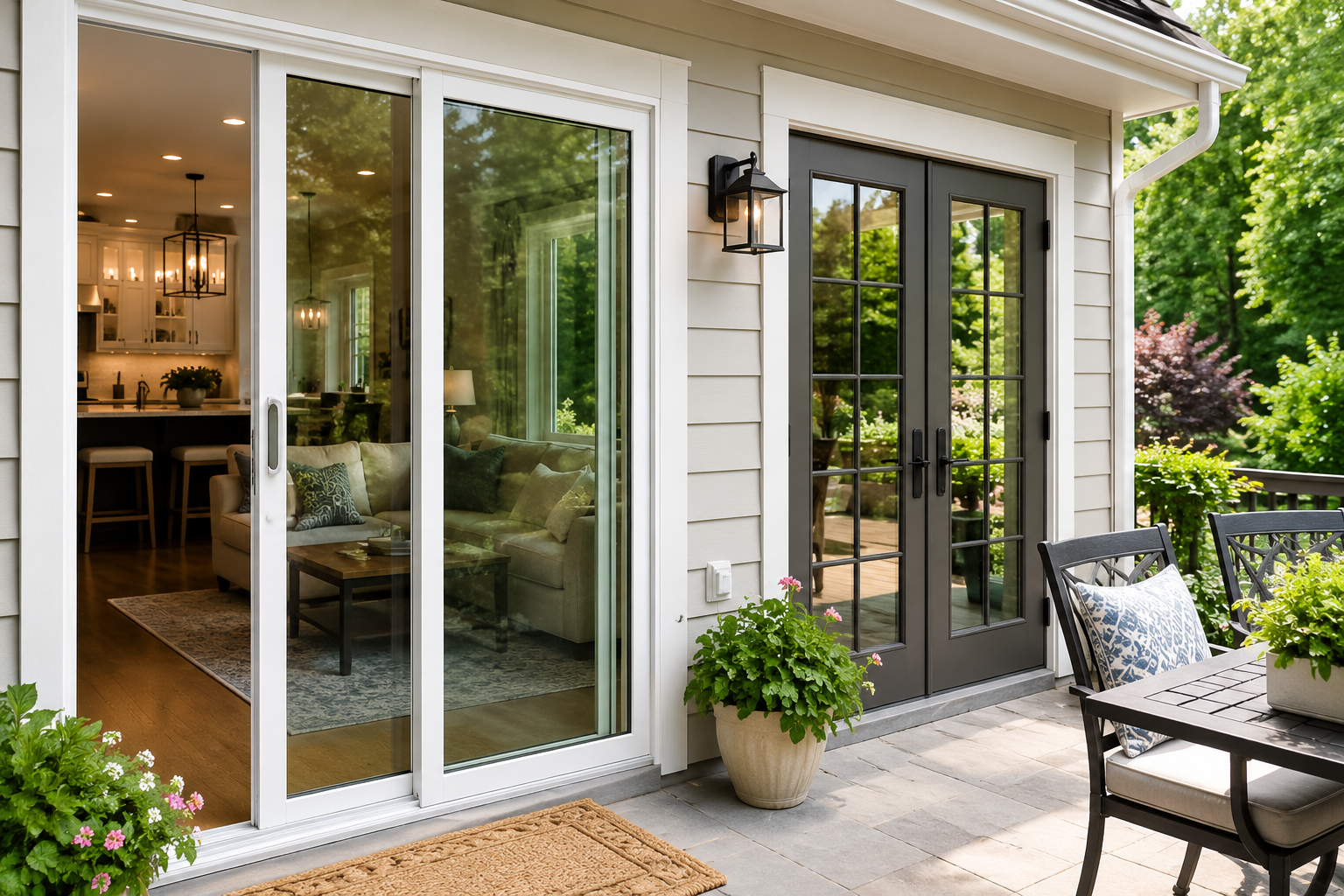
Understanding patio door replacement Main Line, PA is often the first step homeowners take when an aging sliding or French door begins causing daily frustration. There is a specific quality that an aging patio door has in summer that makes its problems unavoidable. You are at a backyard gathering in Wayne or Ardmore, moving between the kitchen and the deck every few minutes, and the door that should be a seamless transition between indoor and outdoor space is instead a daily friction point. The sliding panel drags on a worn track. The frame is drafty even when closed. Condensation forms between the panes on humid mornings. The locking hardware has been repaired twice already.
Thinking About Replacing Your Patio Door This Summer?
If your patio door sticks, lets in drafts, shows condensation between the glass, or no longer locks securely, it may be time for a replacement and not another repair. Our experts can inspect your existing door, explain your best replacement options, and provide honest recommendations based on your home and budget.
Schedule your free patio door consultation today or call us directly at (610) 896-6388.
Summer is the season when Main Line homeowners feel these problems most acutely, because summer is when patio doors are used constantly. It is also the time of year when most homeowners decide to finally replace rather than continue repairing. This guide covers everything you need to know before you call a patio door replacement contractor near you on the Main Line: the four main door types, the frame material options, current cost ranges, energy performance considerations for Pennsylvania’s climate, and the signs that tell you repair is no longer the right answer.
Hynes Construction installs replacement patio doors throughout Chester, Delaware, and Montgomery Counties. Our patio door service page covers the full range of products we install and the pricing ranges for this market.
Signs Your Patio Door Needs Replacement Rather Than Repair
Not every patio door problem requires full replacement. Worn rollers, damaged screens, and failing weatherstripping can often be repaired at modest cost. But there are specific conditions that indicate a full replacement is the more cost-effective and permanently correct solution:
- Condensation between the panes of glass: This indicates a failed insulated glass unit seal. The insulating gas has escaped, and the glass is now a thermal bridge. There is no repair for this condition other than replacing the glass unit or the full door. On an older door where the frame may have other issues, full replacement is almost always the more rational investment.
- Frame warping or dimensional distortion: Vinyl frames that have experienced decades of Pennsylvania freeze-thaw cycling often warp at corners, causing the door to bind in the frame, gaps to form around the perimeter, and air and water infiltration that cannot be corrected with weatherstripping. A warped frame is an unrepairable condition.
- Repeated roller or track failures: A sliding door that has had rollers replaced more than once is telling you that the underlying issue is frame geometry, worn track, or structural misalignment. Continuing to replace rollers on a fundamentally compromised door is spending money in the wrong direction.
- Drafts that cannot be eliminated: Air infiltration around an older patio door dramatically affects heating and cooling costs. Modern replacement doors with multi-point locking systems and compression weatherstripping eliminate the air leakage that older swing-latch sliding doors allow. The energy savings from a quality replacement can offset a meaningful portion of the door’s cost over five to ten years.
- Locking hardware failures: Patio door security matters, particularly for doors that face rear yards on properties where a rear access would be the preferred approach for a break-in. A sliding door with failing multi-point locking hardware or a French door where the mortise lock mechanism is compromised represents a genuine security vulnerability.
For context on planning your exterior upgrade sequence, our guide on whether to prioritize windows or doors first in your exterior upgrade plan helps homeowners think through the sequencing of exterior projects.
The Four Main Patio Door Types: What Each One Is and Who It Is Right For
Sliding Patio Doors
Sliding patio doors remain the most common patio door type installed on Main Line homes, and for good reasons. They require no swing clearance on either side of the door, making them practical for spaces where furniture is close to the door or where a swinging panel would interfere with deck railing or outdoor furniture. They offer large glass panels that maximize the view and the light entering the space. They are typically the most affordable patio door type to purchase and install.
The operating mechanism is simple and reliable when the door is properly installed and maintained. Quality sliding doors with stainless tandem roller assemblies and precision-ground aluminum tracks operate smoothly and quietly for decades. The frame materials available in sliding configurations include vinyl, fiberglass, and aluminum, covering the full range from budget to premium specifications.
Sliding doors are the right choice for homeowners replacing an existing sliding door in the same rough opening, spaces where floor clearance for a swinging door is limited, and any application where simplicity of operation is a priority. They are also the most practical choice for households with young children or elderly family members who benefit from a door that does not require physical force to open against wind pressure.
Typical installed cost for a sliding patio door replacement on the Main Line: $1,200 to $4,500, depending on door size, frame material (vinyl at the lower end, fiberglass at the upper end), glass specification, and hardware selection.
French Patio Doors
French patio doors consist of two hinged panels that swing open, either inward or outward, typically from a center meeting stile. They create a wider usable opening than a sliding door of equivalent total width because both panels move. They are aesthetically associated with traditional and transitional architecture, which makes them a natural fit for the colonial, craftsman, and Federal-style homes that define the Main Line’s residential character.
French doors can swing inward or outward, and this decision has practical implications. Outward-swinging French doors clear the interior floor space and are more secure (the hinge pins are on the exterior, but quality French doors are engineered to prevent hinge removal from outside). Inward-swinging French doors are protected from weather when open and keep the door panels clear of exterior debris, but they require swing clearance inside the room. Both configurations are used on the main line depending on the specific application.
French doors are the right choice for traditional or transitional Main Line homes where the door’s appearance matters as much as its function; applications where a full opening width is needed for furniture moving or large gatherings; and homeowners who prefer the architectural character of hinged doors to the sliding mechanism.
Typical installed cost for a French patio door replacement on the Main Line: $2,500 to $6,500 for fiberglass, which is the recommended material for Pennsylvania’s climate. Vinyl French doors run $1,800 to $4,000. Wood-clad or aluminum-clad premium doors run $5,000 to $9,000 and above.
Multi-Slide Patio Doors
Multi-slide patio door systems use multiple panels, three, four, or more, that slide on parallel tracks. When fully open, they create a dramatically wide opening that connects interior and exterior spaces with an unobstructed span that no standard two-panel door can achieve. These systems are the contemporary design choice for Main Line homes where the outdoor living area is large and the indoor-outdoor connection is architecturally significant.
Multi-slide systems are available in pocket configurations, where the open panels slide into the wall cavity and disappear entirely, and stacking configurations, where the panels stack behind one another at one or both ends of the opening. Pocket systems are more complex to install because the wall must be constructed to receive the panels, but they produce the cleanest visual result.
Multi-slide doors are the right choice for larger main line properties where the rear of the home opens to a significant outdoor living area; contemporary or transitional home remodels where maximizing the indoor-outdoor connection is a design objective; and homeowners who have the budget for a high-impact architectural upgrade. These systems are not the right choice for standard two-panel openings or for any application where simplicity and cost efficiency are the primary goals.
Typical installed cost for a multi-slide patio door system on the Main Line: $5,000 to $20,000+ depending on the number of panels, opening width, frame material, glass specification, and whether a pocket system requires wall modification.
Bi-Fold Patio Doors
Bi-fold patio door systems use hinged panels that fold together accordion-style and stack to one or both sides of the opening. They create the widest possible opening relative to their rough opening size, since all panels fold out of the path rather than stacking on a track. They are closely associated with indoor-outdoor living applications and are increasingly popular on Main Line additions and outdoor living projects.
Bi-fold systems require a clean, level threshold and structural support across the full width of the opening. They are more mechanically complex than sliding or French door systems. Quality is highly variable across manufacturers, and the critical factors are the quality of the hinge and folding hardware and the precision of the installation. A bi-fold system that is slightly out of plumb or square will bind, leak, and frustrate daily use.
Typical installed cost for a bi-fold patio door system on the Main Line: $6,000 to $18,000+ for a standard residential-grade aluminum or thermally broken aluminum system. Premium European-designed systems in aluminum or fiberglass run $15,000 to $30,000 and above.
Frame Materials: Fiberglass vs Vinyl vs Aluminum in Pennsylvania’s Climate
Fiberglass
Fiberglass is the recommended frame material for patio doors in Pennsylvania’s climate, and the reason comes down to how fiberglass behaves across temperature extremes. Fiberglass has a very low thermal expansion coefficient, meaning it does not expand and contract significantly with temperature changes. Across the 50 to 70 freeze-thaw cycles of a typical Main Line winter, fiberglass maintains its dimensional stability and the precision of its weatherstripping contact. It does not warp at corners. It does not develop joint separation from repeated thermal cycling.
Fiberglass also delivers excellent thermal insulation performance when combined with Low-E insulated glass. Quality fiberglass patio doors achieve U-factor ratings of 0.22 to 0.28, which is significantly better than vinyl or aluminum. They require no painting and no structural maintenance for the life of the installation.
The trade-off for fiberglass is cost. A fiberglass patio door costs more than an equivalent vinyl door. For a Main Line home where the investment will be used for decades and where the property value warrants the better material, fiberglass is the correct choice. Our comparison of fiber cement siding vs vinyl siding for Main Line homes covers similar material performance thinking that applies to exterior doors as well.
Vinyl
Vinyl patio doors are the volume-entry option, and they perform acceptably for the first five to ten years in most applications. The concern with vinyl on the Main Line is long-term dimensional stability. Vinyl has a thermal expansion coefficient roughly five times higher than fiberglass, meaning it expands and contracts significantly more with Pennsylvania’s temperature swings. Over 20-plus years of freeze-thaw cycling, vinyl door frames develop corner joint stress, weatherstripping gap formation, and increasingly imprecise operation as the frame geometry gradually distorts. Vinyl that was installed in 2005 is often showing these symptoms clearly by 2025.
Vinyl is an acceptable choice for secondary or less-used door openings or for homeowners with a defined budget constraint who understand the long-term performance trade-off.
Aluminum and Aluminum-Clad
Bare aluminum frames are strong and slim, allowing more glass area within a given rough opening. However, aluminum is thermally conductive and allows heat to transfer across the frame, reducing the door’s overall energy performance. Thermally broken aluminum frames include an insulating barrier within the frame cross-section that dramatically reduces this heat transfer, making thermally broken aluminum an acceptable premium option for contemporary-style homes. Aluminum-clad wood doors combine a wood interior with an aluminum exterior face, providing premium aesthetics and good performance at a premium price.
Not Sure Which Patio Door Is Right for Your Home?
Choosing between sliding, French, multi-slide, fiberglass, or vinyl doors isn’t always straightforward. We’ll help you compare styles, materials, energy efficiency, maintenance requirements, and costs so you can confidently choose the best option for your Main Line home.
Schedule your patio door design consultation or call us today at (610) 896-6388 to discuss your project with our team.
Energy Performance: What to Look for in a Replacement Patio Door
Energy performance matters for patio doors on the Main Line for both comfort and operating cost reasons. A drafty patio door is one of the largest sources of conditioned air loss in a home, contributing to uneven room temperatures, higher heating and cooling costs, and the uncomfortable draft sensation on winter evenings near the door.
- U-Factor: Measures total heat loss through the door system. Target 0.30 or lower for Pennsylvania’s climate. Premium fiberglass doors achieve 0.22 to 0.28.
- Solar Heat Gain Coefficient (SHGC): Measures how much solar heat passes through the glass. Lower SHGC reduces summer cooling load on south-facing patio doors. For south- or west-facing patio doors on the Main Line, choose an SHGC of 0.25 or lower.
- Low-E glass coating: Low-emissivity glass coatings significantly improve both U-factor and SHGC by reflecting infrared radiation while allowing visible light to pass through. Low-E glass is standard on quality replacement patio doors and should not be treated as an upgrade on a mainline replacement project.
For homeowners who installed an Energy Star-qualified door in 2025, the federal Energy Efficient Home Improvement Credit under Section 25C allowed a credit of up to 30 percent of the product cost with a $250 per-door maximum. Doors installed in 2026 are no longer eligible for this credit based on current federal tax law. Consult your tax advisor for confirmation on your specific situation.
What to Expect From the Replacement Installation Process
A standard patio door replacement where the new door fits the existing rough opening takes approximately four to eight hours for a professional installation crew. The existing door is removed, the rough opening is inspected, and any framing adjustments are made; the new door is set and shimmed level and plumb; exterior flashing is installed and integrated with existing weather barriers; interior trim is reinstalled or replaced; and the door is tested for smooth operation and proper weatherstrip contact throughout.
When a homeowner is changing door style, for example, replacing a sliding door with a French door or adding a multi-slide system in place of a standard two-panel opening, the rough opening dimensions may need to change, which requires framing modification. This adds labor time and typically requires a permit. Hynes Construction manages permit applications as part of every project that requires them.
If your patio door opens onto a deck, you may also want to assess the deck condition as part of this project. Our deck safety inspection guide covers what to evaluate, and our deck replacement cost and decision guide provides current cost information if the deck itself needs attention alongside the door project.
Why Choose Hynes Construction for Your Patio Door Replacement
Hynes Construction installs replacement patio doors as part of our comprehensive exterior and home improvement services for Main Line homeowners. Our team handles the full project from permit to punch list, and we carry all applicable Pennsylvania licenses and insurance.
We serve homeowners throughout Ardmore, Wayne, Bryn Mawr, Havertown, and communities across Chester, Delaware, and Montgomery Counties. See our service area page for a complete list. All installation work is backed by our workmanship warranty, details of which are on our warranties page.
Frequently Asked Questions
How much does a patio door replacement cost on the Main Line in 2026?
Installed costs range from $1,200 to $4,500 for a standard vinyl or fiberglass sliding patio door, $2,500 to $6,500 for fiberglass French patio doors, and $5,000 to $20,000 or more for multi-slide or bi-fold systems. The specific cost depends on door type, frame material, glass specifications, opening size, and whether any framing modification is required to accommodate the new door. Hynes Construction provides written estimates after a free in-home assessment.
What is the best patio door material for Pennsylvania’s climate?
Fiberglass is the best-performing frame material for Pennsylvania’s climate. Its low thermal expansion coefficient means it does not warp, bind, or develop weatherstrip gaps from the state’s 50 to 70 annual freeze-thaw cycles the way vinyl does over time. Fiberglass also delivers better thermal insulation performance and requires no maintenance for the life of the installation. For most Main Line homeowners, fiberglass is the right material at a price point that the property value justifies.
Should I choose a sliding patio door or French doors?
This depends on your home’s architecture, the space available, and how you use the door. Sliding doors are more practical for tight spaces where swing clearance is limited and are typically less expensive. French doors suit traditional and transitional Main Line homes architecturally and create a wider usable opening when both panels are open. If you are replacing an existing sliding door in the same rough opening and the opening size is standard, a sliding replacement is the most straightforward project. If you want to change the look or function of the opening, French doors are worth the additional investment and complexity.
How do I know if my patio door needs repair or replacement?
Repair is appropriate for isolated problems like worn rollers, a damaged screen, or failed weatherstripping. Replacement makes more sense when you have condensation between the glass panes (indicating a failed seal), a warped or dimensionally distorted frame, repeated roller or track failures, persistent drafts that weatherstripping cannot eliminate, or locking hardware that cannot be repaired to provide reliable security. When repair costs approach half the price of a new door, replacement is the better long-term investment.
Do I need a permit to replace a patio door on the Main Line?
A like-for-like patio door replacement in the existing rough opening typically does not require a permit in most Main Line municipalities. Projects that involve changing the rough opening size, modifying structural framing, or adding a new door opening where no door existed do require a permit. Hynes Construction advises you on permit requirements for your specific project and manages the permit process when required.
How long does patio door replacement installation take?
A standard like-for-like patio door replacement typically takes four to eight hours for a professional crew. Projects involving rough opening modifications, framing changes, or exterior cladding repair take longer and may span two days. Hynes Construction provides a realistic timeline estimate during the project consultation.
What is a multi-slide patio door, and is it right for my home?
A multi-slide patio door uses multiple sliding panels on parallel tracks. When fully open, it creates a wide, unobstructed connection between indoor and outdoor spaces that a standard two-panel door cannot achieve. Multi-slide doors are architecturally impactful and well-suited to larger Main Line homes with significant outdoor living areas. They cost significantly more than standard sliding or French doors and are not practical for standard-size openings or budget-constrained projects.
Can a patio door replacement improve my home’s energy efficiency?
Yes, significantly. An older patio door with a failed glass seal, degraded weatherstripping, and an aging frame is one of the largest sources of conditioned air loss in a home. A modern replacement door with Low-E insulated glass, a quality frame material, and a multi-point locking system that compresses the weatherstripping uniformly around the perimeter dramatically reduces air infiltration and heat transfer. The operational energy savings over five to ten years contribute meaningfully to the total cost-benefit calculation of a replacement.
Should I replace my patio door and deck at the same time?
If your deck needs attention, coordinating a patio door replacement with deck work often makes sense. The access required for door installation is cleaner without deck furniture, and any flashing integration between the new door and the deck surface can be addressed once rather than disturbing the new installation later. Hynes Construction handles both deck and door work and can coordinate these projects as a combined scope. Our deck services page covers our deck installation and repair capabilities.
How do I schedule a patio door replacement estimate with Hynes Construction?
Call us at 610-896-6388 or use our contact page to schedule a free in-home estimate. We serve homeowners throughout the Main Line and surrounding Chester, Delaware, and Montgomery County communities. Our team will assess your existing door and opening, discuss your preferences, and provide a written estimate covering the full scope of the project with no obligation.
Follow us on Facebook and Instagram to see recent door and window installation projects across the Main Line.
Upgrade Your Home with a Patio Door That Looks Better, Performs Better, and Lasts Longer
Whether you are replacing a worn-out sliding door, upgrading to elegant French doors, or planning a modern multi-slide system, Hynes Construction delivers professional installation designed for long-term performance, energy efficiency, and lasting curb appeal throughout the Main Line.
Schedule your free patio door replacement estimate today or call us directly at (610) 896-6388 to get started.

(President, Hynes Roofing and Siding)
With over 35 years experience in the roofing and siding industry, Michelle Hynes has built a business from 2 people into over 45 people and 19 trucks!