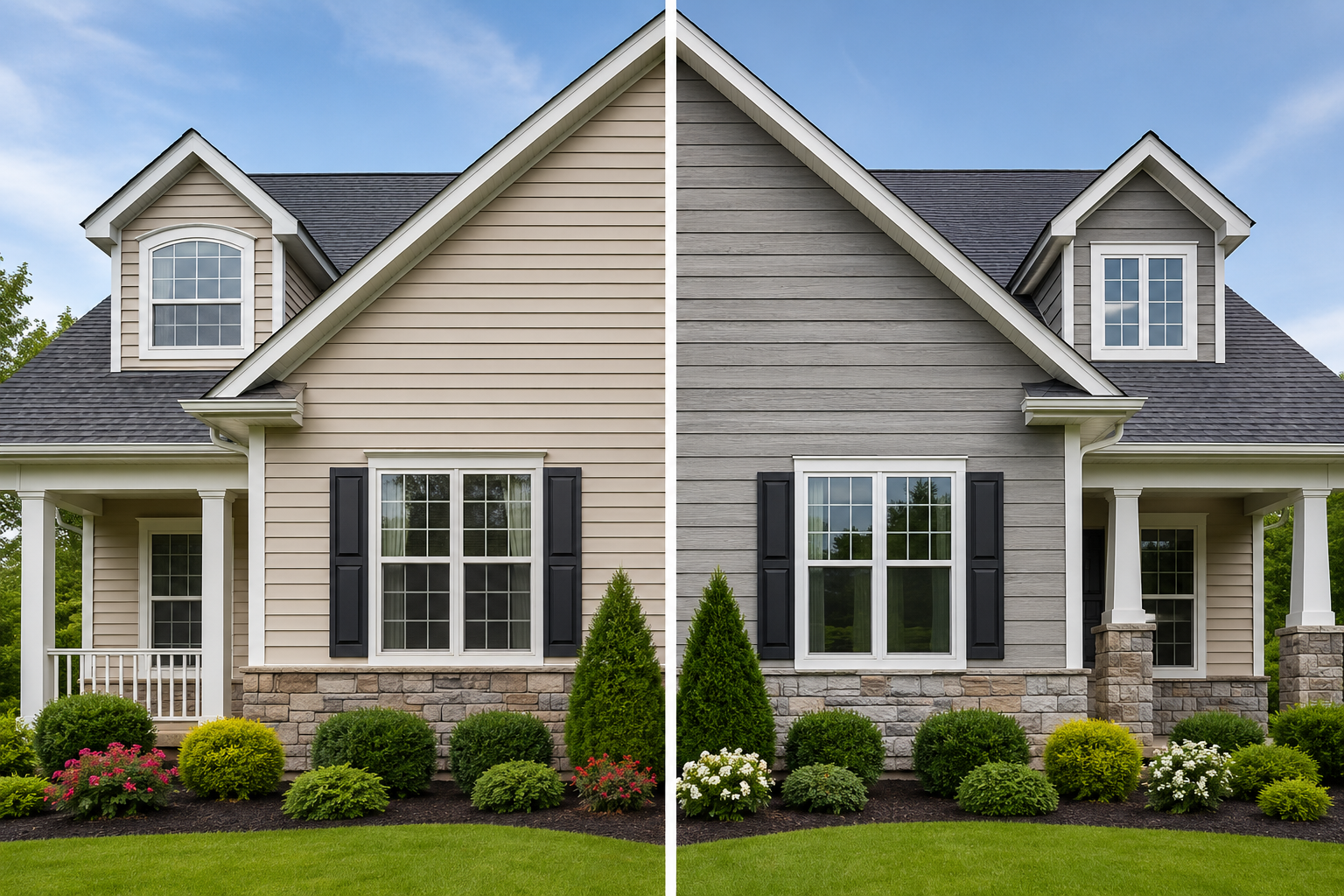
Choosing between vinyl vs fiber cement siding Main Line, PA, is one of the most important decisions homeowners make when planning a siding replacement project. The siding material you select affects your home’s appearance, long-term maintenance requirements, durability, energy performance, and overall property value. While both vinyl and fiber cement siding are popular choices throughout the Main Line, each offers distinct advantages depending on your budget, aesthetic preferences, and how long you plan to stay in your home. Understanding the differences can help you make a confident investment that protects and enhances your property for decades.
The two materials that dominate siding replacement projects across Chester, Delaware, and Montgomery Counties are vinyl and fiber cement. Both are significant improvements over the painted wood siding they typically replace. Both have strong track records in Pennsylvania conditions. But they perform differently, cost differently, and are the right choice in different situations.
Hynes Construction’s guide gives Main Line homeowners a complete, honest comparison: what each material actually delivers, what it costs in 2026, where each is the right choice, and where each falls short.
Not Sure Whether Vinyl or Fiber Cement Is the Better Investment?
Every home is different. Your home’s age, neighborhood, budget, maintenance preferences, and long-term plans all play an important role in choosing the right siding material. We will evaluate your home’s exterior, explain the pros and cons of each option, and recommend the best solution based on your goals and not a one-size-fits-all sales pitch.
Schedule your free siding consultation or call us today at (610) 896-6388 to discuss your project with our team.
What Is Vinyl Siding?
Vinyl siding is a PVC-based exterior cladding that has been the dominant residential siding material in the United States since the 1980s. It is available in dozens of profiles, textures, and colors. It is lightweight, moisture-resistant, and does not require painting. Installation is faster and less labor-intensive than fiber cement because the material is lighter and cuts easily.
Modern vinyl siding is considerably better than the vinyl installed on Main Line homes in the 1980s and 1990s. Premium vinyl products have increased wall thickness, better UV stabilizers, more realistic woodgrain textures, and more substantial trim profiles. Still, vinyl has real limitations in Pennsylvania’s climate that determine whether it is the right choice for your specific home. Our vinyl siding service page provides specific product information.
What Is Fiber Cement Siding?
Fiber cement siding is a composite material made from Portland cement, sand, and cellulose fibers. It is dense, heavy, dimensionally stable, and Class A fire-rated. James Hardie is the dominant brand, holding roughly 90 percent of the North American fiber cement siding market. When Main Line homeowners and contractors refer to Hardie board or HardiePlank, they mean fiber cement, most commonly from James Hardie.
Fiber cement is significantly more labor-intensive to install than vinyl. It must be cut with carbide-tipped blades or fiber cement shears, which slows installation. Achieving quality fiber cement installation requires crews trained specifically for the material. Our fiber cement siding service page and the James Hardie fiber cement siding guide for Main Line homes cover installation and performance details specific to this region.
Performance in Pennsylvania Weather: The Most Important Comparison
Pennsylvania’s climate puts exterior materials through a demanding annual cycle: humid summers, heavy spring and fall rainfall, winter temperatures dropping below zero Fahrenheit, and 50 to 70 freeze-thaw cycles per year. This cycle exposes material weaknesses that do not appear in milder climates.
How Vinyl Performs in Pennsylvania Weather
The primary performance issue with vinyl siding in Pennsylvania is thermal expansion and contraction. Vinyl expands and contracts with temperature changes at a rate significantly higher than fiber cement. Over 50 to 70 annual freeze-thaw cycles, this repeated dimensional movement stresses joints, fasteners, trim attachment points, and corner connections. Vinyl installed in 2005 on homes across Wynnewood, Haverford, and Penn Wynne frequently shows the consequences by 2025: buckling at seams during summer heat, joint separation at corners during cold snaps, and brittleness from UV degradation that makes the material susceptible to impact cracking in winter.
Vinyl also fades with extended UV exposure. The pigments used in vinyl manufacturing are UV stabilized but not UV permanent. Dark colors fade faster than light colors. After 15 to 20 years, color matching for a single panel replacement on an older vinyl installation is often impossible because the existing siding has shifted in color from its original shade.
How Fiber Cement Performs in Pennsylvania Weather
Fiber cement’s thermal expansion coefficient is significantly lower than vinyl’s. James Hardie HardiePlank has an expansion coefficient approximately one-fifth that of vinyl, meaning far less dimensional movement in response to the temperature swings that cause vinyl to buckle and joints to separate. This is the primary reason fiber cement installations on Main Line homes routinely look as good at 25 years as they did at installation, while vinyl installations of the same age often show visible dimensional distortion.
Fiber cement does not crack from freeze-thaw movement or cold-temperature impact in the way aged vinyl does. It is not subject to the UV-driven color degradation that affects vinyl. However, fiber cement is a painted product: pre-painted at the factory (Hardie ColorPlus technology) or field-painted during installation. Pre-painted fiber cement typically maintains its appearance for 15 years before a repaint.
Cost Comparison: What Vinyl vs Fiber Cement Actually Costs in 2026
- Vinyl siding installation: $4 to $9 per square foot installed, depending on product grade, profile complexity, and trim work. A full house re-side on an average of 2,000 to 2,500 square feet. A Main Line home typically runs $10,000 to $22,000.
- Fiber cement siding installation: $9 to $18 per square foot installed, depending on product line, factory finish vs field paint, and trim complexity. The same home typically runs $18,000 to $40,000.
The cost comparison cannot be evaluated on installation cost alone. A quality vinyl installation lasts 20 to 30 years before requiring replacement. A quality fiber cement installation lasts 50 years or more with periodic repainting at 15-year intervals. Over a 50-year ownership horizon, a homeowner who installs vinyl in 2026 will likely face one full replacement and several significant repairs. A homeowner who installs fiber cement in 2026 will likely face only one repaint cycle. Total cost of ownership favors fiber cement significantly in any home owned for more than 15 years.
For current cost ranges specific to the Main Line market, our siding replacement cost guide for Main Line PA homeowners breaks down costs by material, home size, and scope.
Appearance and Curb Appeal
Vinyl Appearance
Premium vinyl siding has improved substantially in visual quality over the past decade. Modern products with embossed woodgrain textures at reasonable thickness levels achieve an appearance that reads well from street level, particularly in light to medium color ranges. Vinyl’s aesthetic limitation on the Main Line is contextual. The Main Line is a high-value residential market dominated by stone, brick, cedar shingle, and fiber cement exteriors. In this context, even premium vinyl can read as a lower-tier material choice compared to fiber cement, and buyers in this market notice.
Fiber Cement Appearance
Fiber cement’s visual strength is its ability to replicate high-quality wood siding appearances with greater dimensional accuracy than vinyl. HardiePlank lap siding in a smooth or woodgrain finish painted with quality exterior paint reads virtually identically to painted cedar lap at street level and at close inspection. Hardie shingle siding in a cedar-shake finish is used extensively on Main Line homes precisely because it provides the premium appearance the neighborhood context demands without cedar’s maintenance requirements. Factory-primed fiber cement that is field-painted can be painted any color at installation and any color during the repaint cycle, which is a meaningful design flexibility advantage over vinyl.
Maintenance Requirements
Vinyl Maintenance
Vinyl requires no painting, which is its most commonly cited advantage. However, it requires periodic cleaning to remove biological growth, dirt, and oxidation. Impact damage to a single panel from a rock, baseball, ladder, or hail requires panel replacement. Because colors discontinue regularly, panel-level replacement on a 10-year-old vinyl installation often requires replacing an entire elevation to avoid visible color discrepancy.
Fiber Cement Maintenance
Fiber cement’s primary maintenance requirement is repainting at approximately 15-year intervals (10 to 12 years for field-painted; 15 to 25 years for factory-finished Hardie ColorPlus). This is a real cost and obligation that vinyl does not have. For homeowners who want to minimize maintenance indefinitely, vinyl has a genuine advantage here. Fiber cement does not rot, does not attract insects, does not crack from impact in normal residential situations, and does not fade. The substrate is essentially permanent.
Return on Investment and Property Value
Industry data shows vinyl siding delivers an average cost recovery of 60 to 70 percent at resale, while fiber cement delivers 70 to 80 percent. On a Main Line property above $800,000, buyers and their agents notice the difference between a vinyl exterior and a fiber cement exterior during showings. In neighborhoods where comparable homes have fiber cement, vinyl can limit your price ceiling. For homes in the $400,000 to $600,000 range in Havertown, Drexel Hill, or Springfield, premium vinyl can be a well-matched choice. For homes in Villanova, Wayne, Radnor, and Bryn Mawr above $800,000, fiber cement is the appropriate material for the neighborhood context.
See Which Siding Option Makes the Most Sense for Your Home
The right siding choice isn’t just about upfront cost. It depends on your home’s value, how long you plan to stay, maintenance expectations, curb appeal goals, and long-term return on investment.
Our experts will walk you through material samples, explain the cost differences, and help you choose the siding that offers the best value for your Main Line home.
Schedule your free in-home siding estimate or call (610) 896-6388 today to compare your options with our experienced team.
Which Should You Choose? A Decision Framework for Main Line Homeowners
Choose Vinyl If:
- Minimizing upfront cost is your primary priority
- You want to eliminate painting indefinitely from your maintenance list
- Your home is in a price range where premium vinyl is contextually appropriate
- You plan to sell within 10 to 15 years and want strong ROI without the fiber cement premium
- The existing siding is vinyl, and you want to maintain consistency
Choose Fiber Cement If:
- Your home is in a higher-value Main Line neighborhood where material quality is expected
- You plan to own the home for more than 15 years
- You want the closest possible match to the painted wood appearance
- Long-term durability and minimizing the frequency of replacement are priorities
- Your current stucco is being remediated, and you are choosing a replacement cladding
- Your home has a cedar shingle or wood exterior; you want to match its character while reducing maintenance
Not sure which siding material is right for your home? Call Hynes Construction at 610-896-6388 for a free on-site estimate and honest material recommendation.
A Note on Installation Quality
Regardless of which material you choose, installation quality determines long-term performance more than any other single factor. Ask specifically: Are you, James Hardie? Preferred Contractor? Do you have crews trained and certified for the specific material you are recommending? Can you provide references from installations of the same material type in my area? Hynes Construction installs both materials to manufacturer specifications with properly trained crews, backed by the workmanship warranties on our warranties page.
Follow Hynes Construction on Facebook and Instagram to see recent siding projects across the Main Line and get a sense of our installation quality across both materials.
Frequently Asked Questions
Which lasts longer, vinyl or fiber cement siding?
Fiber cement lasts significantly longer in Pennsylvania conditions. A quality fiber cement installation should last 50 years or more with periodic repainting. Quality vinyl typically lasts 20 to 30 years before dimensional degradation, color fading, and joint movement require replacement. Over a 50-year ownership period, a vinyl installation will likely require replacement at least once, while fiber cement will require only repainting.
How much more does fiber cement cost than vinyl siding on the Main Line?
Fiber cement typically costs 60 to 100 percent more than vinyl for an equivalent scope. For an average 2,000 to 2,500 square foot home, vinyl runs $10,000 to $22,000, while fiber cement runs $18,000 to $40,000. The gap must be evaluated against fiber cement’s significantly longer service life and the resale value premium it commands in the Main Line market.
Does fiber cement need to be painted?
Yes. Fiber cement is a painted product. Factory-finished James Hardie ColorPlus products are warranted for 15 years on the finish. Field-painted fiber cement typically requires repainting every 10 to 12 years, depending on color, exposure, and paint quality. This maintenance obligation is fiber cement’s primary practical disadvantage compared to vinyl, which requires no painting.
Will vinyl siding crack in cold Pennsylvania winters?
Aging vinyl siding is susceptible to cold-temperature brittleness. As vinyl ages and UV stabilizers deplete, the material becomes more brittle at low temperatures. Below approximately 10 degrees Fahrenheit, even moderate impacts can crack vinyl that would flex at moderate temperatures. New premium vinyl is more resistant, but this brittleness develops over time in all vinyl products exposed to Pennsylvania UV and temperature cycling.
Is fiber cement better for resale value on the Main Line?
In most Main Line neighborhoods, yes. Fiber cement commands higher buyer perception value and delivers 70 to 80 percent cost recovery at resale versus 60 to 70 percent for vinyl. In neighborhoods where comparable homes have fiber cement or premium exteriors, vinyl can limit your price ceiling.
Can fiber cement be used to replace stucco after remediation?
Yes, and this is one of the most common applications we handle on the Main Line. When stucco is remediated and sheathing is replaced, fiber cement is frequently chosen as the replacement cladding because it provides a clean, finished appearance that complements Main Line architecture while delivering proper moisture management. Our stucco remediation vs siding replacement guide covers this decision in detail.
Does James Hardie offer a warranty for their siding products?
Yes. James Hardie offers a 30-year limited transferable warranty on HardiePlank products and a 15-year limited warranty on the ColorPlus factory finish. These warranties are transferable to subsequent homeowners, which is a meaningful benefit at resale.
How do I know if a contractor is qualified to install fiber cement siding?
Ask whether they hold James Hardie Preferred Contractor status. Ask for references specifically from fiber cement projects you can contact. Ask about crew training on fiber cement cutting and fastening requirements. A crew that primarily installs vinyl, applying vinyl techniques to fiber cement, will produce an inferior result that may compromise the product warranty.
How long does siding replacement take on the Main Line?
A full-house vinyl re-side on an average Main Line home takes three to seven business days. Fiber-house cement takes five to ten business days for the same scope due to additional cutting, handling, and detailing time. Both timelines are weather-dependent.
Can I mix vinyl and fiber cement on the same house?
Technically, yes, and some homeowners use fiber cement on primary elevations visible from the street with vinyl on less visible rear or garage elevations to manage cost. The visual difference between the two materials when placed side by side is noticeable in high-value neighborhoods and may be perceived negatively. Our team can advise on material allocation strategies that maximize your return on investment for your specific home and budget.
Ready to Upgrade Your Home’s Exterior?
Whether you are replacing aging vinyl siding, upgrading to premium fiber cement, or deciding which material is the best fit for your home, Hynes Construction provides expert guidance, professional installation, and quality workmanship backed by decades of experience serving Main Line homeowners.
We will help you choose the right siding for your budget, your neighborhood, and your long-term plans so you can invest with confidence.
Schedule your free siding replacement estimate or call us directly at (610) 896-6388 to get started today.
Further reading: James Hardie Fiber Cement Siding Guide for Main Line Homes | Siding Replacement Cost Guide for Main Line PA | Best Siding Materials for Main Line PA Homes | Storm Damaged Siding Repair Guide

(President, Hynes Roofing and Siding)
With over 35 years experience in the roofing and siding industry, Michelle Hynes has built a business from 2 people into over 45 people and 19 trucks!