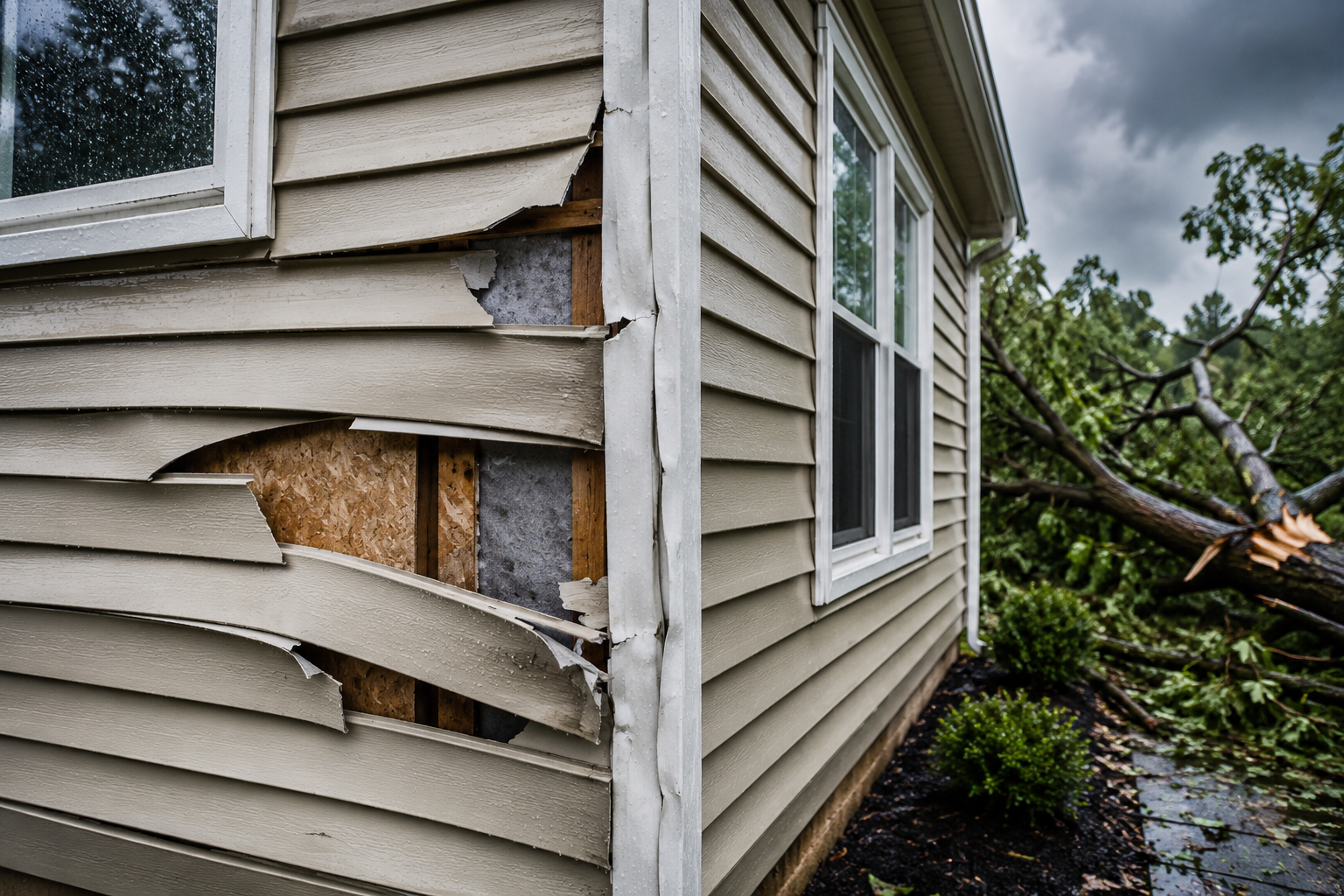
Storm-damaged siding repair Mainline PA is one of the most common concerns homeowners face after severe weather events. A Nor’easter rolls through the Main Line overnight. A spring hailstorm tracks across Bryn Mawr and Wayne for twenty minutes. A summer microburst sends a tree branch into the side of a colonnade in Havertown or Narberth. By the time the sun comes out the following morning, homeowners across Ardmore, Bryn Mawr, Wayne, Radnor, Newtown Square, and Villanova are walking their properties, looking at dented, cracked, loose, or missing siding panels and asking the same question: what should I do next?
Pennsylvania is not a gentle climate for exterior building materials. The Philadelphia suburban area and Main Line corridor experience an average of 44 inches of rainfall per year, 20 to 30 thunderstorm days annually, documented hailstorm events in spring and summer, and 50 to 70 freeze-thaw cycles per winter. Every one of those weather events puts mechanical stress on your siding system. The joints flex. The fasteners work loose. The finish cracks. And when a major storm hits, the accumulated stress of years of weather exposure can turn a minor impact into a significant breach.
This guide tells you exactly what to do after severe weather damages your siding on a Main Line, PA home. We cover how to identify storm damage on every major siding material, what immediate steps to take to prevent further damage, how to decide whether to repair or replace, what the insurance claims process looks like, and how to choose the right contractor for the work. All of it is specific to the architectural types and climate conditions of Chester, Delaware, and Montgomery Counties, where Hynes Construction has been serving homeowners since 1974.
Has your siding been damaged by a recent storm? Don’t wait for the next rainfall to discover hidden moisture behind your walls. Hynes Construction provides free storm damage siding inspections across the Main Line, complete with photo documentation and honest repair recommendations. Call 610-896-6388 today for a prompt inspection.
Why Severe Weather Is Especially Hard on Main Line PA Siding
The Main Line’s weather profile is more punishing than most homeowners realize. The region sits at the intersection of several storm tracks: Nor’easters from the Atlantic coast, cold fronts pushing down the Appalachian corridor, and convective summer storms building over the hotter interior of Pennsylvania and tracking east toward Philadelphia. The result is a climate that delivers:
- Hailstorms: The Main Line receives several documented hail events per year, typically in the April through October window. Hailstones of 0.75 inches and larger cause direct impact damage to vinyl, fiber cement, stucco, and wood siding. Hailstorms are the leading cause of siding insurance claims in the Delaware Valley region.
- High-wind events: Nor’easters and summer microbursts regularly produce sustained wind speeds of 45 to 65 miles per hour across the Main Line. Wind events cause siding to lift at panel edges and corners, create gaps that allow water entry, and, in severe cases, tear panels completely from the substrate.
- Heavy rain and rapid moisture cycles: The Main Line receives its 44 annual inches of rainfall distributed throughout the year, with significant events in spring and fall. Heavy rainfall exposes any gap or crack in the siding envelope immediately, creating water infiltration that damages the building paper, sheathing, and framing behind the cladding.
- Ice and freeze-thaw cycling: Pennsylvania’s winters subject every exterior building material to 50 to 70 freeze-thaw cycles per season. Water that has infiltrated through small cracks or gaps expands as it freezes, widening the breach with each cycle. What begins as a hairline crack in October can become a significant gap by March.
Beyond the weather itself, the Main Line’s housing stock amplifies the risk. The region contains a very high concentration of pre-1978 homes, Colonials, Victorians, Craftsman bungalows, and Tudor Revival properties in communities like Narberth, Lower Merion, and Wayne with original wood siding, historic stucco systems, and aging vinyl installed in the 1980s and 1990s. These materials perform significantly less well under storm stress than properly installed, properly maintained contemporary siding systems. For insight into the most durable options, see our guide to the best siding materials for Main Line PA homes.
What to Do Immediately After Severe Weather Damages Your Siding
The first 24 to 48 hours after a storm event are the most important for protecting your home from compounding damage and building the strongest possible insurance claim. Here are the steps to take in order:
Step 1: Make Sure the Property Is Safe to Inspect
Do not attempt an exterior inspection until downed power lines have been cleared by your utility company, any unstable tree limbs overhanging the structure have been assessed by a tree service, and there is no immediate structural compromise that makes walking near the house hazardous. Safety comes before documentation. If you are in doubt about whether it is safe to approach your home’s perimeter, call a professional for the initial assessment.
Step 2: Photograph Every Inch of Damage – Before Touching Anything
Insurance adjusters need photographic evidence of storm damage in its original, unaltered state. Before you move any debris, peel back any panels, or attempt any temporary repairs, photograph everything. Take wide shots showing the overall damage pattern, then close-up shots of every cracked panel, dented section, missing piece, and gap. Include a reference object (a ruler, a coin) in close-up shots to establish scale. Timestamp all photos using your phone camera’s automatic dating function. The more documentation you have before any intervention, the stronger your insurance claim.
For more on documenting storm damage for insurance purposes, see our blog on hail damage versus wind damage on Main Line roofs: what to document before filing an insurance claim. While that blog focuses on roofing, the documentation principles apply equally to siding claims.
Step 3: Apply Emergency Temporary Protection
Where siding panels have been completely torn off, leaving the building paper or sheathing exposed, temporary protection is essential to prevent water infiltration during the repair scheduling window. Heavy-duty plastic sheeting secured with furring strips or roofing nails can cover exposed wall sections. Do not use duct tape on exposed wood sheathing. It does not provide adequate weather protection and can pull away from the sheathing surface, damaging it further. Contact a professional contractor for emergency tarping and temporary protection if the exposed area is large or involves a second-story elevation.
Step 4: Contact Your Insurance Company
File your storm damage claim as soon as possible after photographing the damage. Most homeowner insurance policies require claims to be filed promptly after a covered event. Delay in filing can complicate your claim or give the insurer grounds to argue that additional damage occurred due to your failure to act. When you call, have your policy number, the date of the storm event, and your photographic documentation accessible.
Hynes Construction has over 50 years of experience working with homeowner insurance claims on Main Line properties. We document storm damage to professional standards, prepare detailed written estimates, and work directly with insurance adjusters throughout the claims process. See our insurance claims assistance page for complete information on how we support homeowners through storm damage claims.
Step 5: Get a Professional Assessment Before Choosing a Contractor
After a major storm, you will likely receive unsolicited visits from out-of-area contractors driving through the neighborhood looking for storm damage work. Be cautious. Verify that any contractor you engage is HICPA registered (Pennsylvania’s Home Improvement Consumer Protection Act), insured, and has a verifiable local presence. See our certifications and affiliations page for our credentials, which you are welcome to verify independently before any contract is signed.
STORM CHASER WARNING
After a significant storm event in the Main Line area, it is common for out-of-area contractors to travel into affected neighborhoods and offer roof inspections, siding inspections, or assistance with insurance claims. While some may be legitimate, many are not. Warning signs include the absence of a Pennsylvania HICPA registration number, no verifiable local business address, pressure to sign a contract immediately, offers to waive or cover your insurance deductible (which is illegal in Pennsylvania), and a refusal to provide a detailed written estimate before work begins. Before hiring any contractor, verify their credentials, confirm they are properly insured, and ensure they have an established local presence. Working with a HICPA-registered, insured, and locally verifiable contractor helps protect you from poor workmanship, insurance complications, and potential scams.
If your siding was damaged during a recent storm, don’t rely on door-to-door contractors. Hynes Construction is a trusted local contractor serving the Main Line since 1974. We provide detailed storm damage assessments, insurance documentation, and transparent estimates with no high-pressure sales tactics. Call 610-896-6388 for a professional inspection or fill out the Contact Us form to share your requirements with us.
How to Identify Storm Damage by Siding Material
Different siding materials fail differently under storm stress. Knowing what to look for on your specific material allows you to conduct a more accurate initial assessment and helps you communicate with your contractor and insurance adjuster. Here is a material-by-material guide to storm damage identification specific to the siding types found on Main Line PA homes.
Vinyl Siding Storm Damage
Vinyl siding is the most common residential siding material in the United States and on many Main Line PA homes built from the 1970s through the present. It is durable under normal conditions, but it has specific vulnerabilities under storm stress:
- Hail impact: Hailstones 0.75 inches and larger can crack vinyl panels on impact. Look for star-shaped fractures, punched-through holes, and surface crazing (a network of fine surface cracks). Older vinyl becomes brittle from UV exposure and is more vulnerable; a hailstone that would leave only a dimple on new vinyl can shatter 20-year-old vinyl on impact.
- Wind damage: High winds cause vinyl panels to lift at the bottom lock edge where they interlock with the panel below. Lifted panels allow water entry immediately. Look for panels that are not lying flat against the wall, visible gaps at the bottom of panels, and panels that have become completely dislodged and blown away from the wall entirely.
- Flying debris: Tree branches, gravel, and other wind-carried debris can punch through vinyl panels or crack them at the point of impact. Look for irregular cracks and holes that do not follow the pattern of thermal expansion cracks (which run along the length of the panel).
- Color matching challenges: Vinyl siding color fades over time due to UV exposure. If you are replacing only the damaged panels, you will likely face a color matching problem; new vinyl in the same manufacturer color may be visibly different from color-matching panels that have weathered for 10 to 15 years. This is a relevant consideration when deciding between repairing individual panels versus replacing a full section or wall elevation.
For information on vinyl siding installation and replacement, see our vinyl siding page.
James Hardie Fiber Cement Siding Storm Damage
Fiber cement siding and James Hardie products, in particular, are increasingly common on Main Line PA homes, particularly those that have been re-sided in the past decade. It is significantly more impact-resistant than vinyl, but it is not immune to storm damage:
- Hail impact: Fiber cement is significantly more resistant to hail than vinyl. Most hail events do not penetrate fiber-cement panels. However, very large hailstones (1.5 inches and larger) or fiber-cement at an angle can chip the surface coating and expose the cement substrate. The surface chip itself may not create a water infiltration risk immediately, but it does allow moisture to begin degrading the cement core over time if not addressed.
- Flying debris: Large debris can crack fiber cement panels. Look for fractures running across the panel face. Unlike vinyl, fiber cement does not splinter or shatter; it fractures more like concrete.
- Wind-lifted panels: Fiber cement panels are significantly heavier than vinyl, so wind-lifted panels are less common. However, if installation was not performed to manufacturer specifications (incorrect fastener type, insufficient fastener count, or missed studs), panels can work loose in high-wind events.
See our fiber cement siding installation page and our blog on James Hardie fiber cement siding for the Main Line region for complete information on fiber cement performance in Pennsylvania’s climate.
Wood Siding Storm Damage
Natural wood siding, cedar clapboard, pine board-and-batten, and cedar shingle are found on many of the historic pre-1940 Main Line homes in communities like Narberth, Wayne, Lower Merion, and Haverford. Wood requires the most careful assessment after storm events:
- Splits and cracks from impact: Wood splits along the grain rather than creating clean holes. Storm impact damage on wood siding often starts as a small split that can rapidly widen as moisture enters and cycles through freeze-thaw. Do not dismiss small splits as cosmetic. They are active water entry points.
- Lifted and missing pieces: Wind can lift and remove wood shingles and individual clapboards, particularly if the paint and caulk system has been compromised over years of weather cycling. Look for gaps in the shingle or clapboard pattern and for individual boards or shingles that are cracked and only partially attached.
- Paint system damage: Even where the wood itself is intact, severe weather can strip or crack the paint film that is the primary moisture protection for the wood. Check for paint peeling, lifting, or complete removal from panel faces and edges, particularly the bottom edges of clapboards, where moisture exposure is highest.
Stucco and EIFS Storm Damage
Stucco, including synthetic stucco (EIFS) systems that were common on Main Line homes built between 1985 and 2005, requires special attention after storm events. EIFS stucco is the siding type most prone to hidden storm damage that is not immediately visible but causes severe structural consequences over time.
- Surface cracks: Any new crack in stucco after a storm event is a potential water entry point. On EIFS systems, where there is no drainage plane behind the stucco, even a hairline crack can allow water to accumulate against the sheathing and framing. Any crack wider than the thickness of a credit card warrants immediate professional assessment.
- Impact damage: Hail and debris impact on stucco create concave indentations in traditional hard-coat stucco and can puncture the surface of the EIFS finish coat. Both types of damage allow moisture infiltration.
- Window and door perimeter failures: Storm-driven rain at high velocity is particularly effective at finding failures in the stucco-to-window-frame and stucco-to-door-frame sealant. After any storm with sustained horizontal rain, probe the stucco immediately around all windows and door perimeters with a blunt tool for softness, which indicates moisture accumulation behind the surface.
If your Main Line home has EIFS stucco, we strongly recommend a professional moisture assessment after any significant storm event, even when visible surface damage appears minor. Hynes Construction performs moisture probe testing that detects hidden moisture accumulation before it becomes structural damage. See our stucco remediation page and our blog on identifying stucco damage signs on Main Line PA homes for complete information.
Hidden moisture damage is one of the biggest risks after a storm, especially with EIFS and stucco systems. Hynes Construction performs professional moisture inspections to detect water intrusion before it leads to mold, rot, or expensive structural repairs. Call 610-896-6388 to schedule a moisture assessment.
Repair or Replace: How to Decide After Storm Damage on a Main Line Home
The single most common question we receive after storm events on the Main Line is, “Should I repair the damaged sections or replace the siding on the entire home?” The honest answer depends on six factors specific to your home, your material, and the nature of the damage:
| Factor | Repair is Likely Right | Replacement is likely right. |
|---|---|---|
| Extent of damage | Damage limited to 1 to 3 panels on one elevation. No substrate damage behind panels. | Damage spread across multiple elevations. Underlying sheathing or building paper is compromised. |
| Siding age | Less than 15 years old. Material in good condition elsewhere. | More than 20 years old. Existing siding shows chalking, fading, cracks, or brittleness on undamaged sections. |
| Color matching | Recent installation. Color matching is available from the original manufacturer. | Older installation. UV fading makes panel-level color matching impossible without visible patches. |
| Material type | Fiber cement. Individual fiber cement panels can be replaced invisibly by a skilled installer. | Vinyl over 15 years old. Color drift makes partial replacement highly visible. EIFS stucco with moisture behind it cannot be repaired and must be remediated. |
| Insurance scope | The adjuster approves a partial repair scope covering only damaged sections. | The adjuster approves full replacement. The insurance adjuster’s scope covers the entire elevation. Total replacement cost is close to repair-plus-matching cost. |
| Hidden damage | No moisture detected behind panels. Sheathing and building paper intact. | Probe testing or removal reveals moisture, mold, or rot behind damaged sections. Full assessment requires opening a larger area. |
For a detailed breakdown of what siding repair and replacement costs on Main Line homes in 2026, see our Main Line PA siding repair cost guide and our siding replacement cost guide for Ardmore, Wayne, and Bryn Mawr.
This is the factor that catches the most Main Line homeowners by surprise. Visible siding damage, the cracked panel, the dented section, and the missing piece are easy to assess. What is not visible is whether water has been infiltrating behind the cladding through the damaged area and for how long. In the window between a storm event and a contractor inspection, water can migrate significant distances behind a siding system, damaging building paper, insulation, and sheathing in an area much larger than the visible surface damage.
On EIFS stucco homes, this problem is acute. Because EIFS has no drainage plane behind the cladding, any water that enters through a storm-created breach has nowhere to go. It saturates the foam board insulation, contacts the sheathing, and begins degrading the structure. By the time visible symptoms appear on the interior (ceiling stains, soft walls, mold odor), the damage behind the EIFS can be extensive and expensive to remediate. See our blog on EIFS stucco remediation on the Main Line for a complete explanation of what happens behind stucco after water infiltrates.
Not sure whether your siding can be repaired or if replacement makes more financial sense? Hynes Construction provides honest evaluations based on the condition of your siding, sheathing, and wall structure, and not on sales pressure. Call 610-896-6388 for a free assessment and written estimate.
The Professional Siding Repair Process – What to Expect on a Main Line Home
Whether the work is a targeted repair of a few damaged panels or a more significant restoration of a full wall elevation, here is what a professional siding repair process looks like on a Main Line home:
Assessment and Scope Development
Every professional repair project begins with a thorough assessment of the visible damage and the condition of the substrate behind the damaged area. This means removing, at minimum, the immediately adjacent panels to assess whether moisture has penetrated the building paper and whether the sheathing is intact. A contractor who provides a repair estimate without examining what is behind the siding is not giving you an accurate scope of work. Substrate damage found after work has begun is a common source of project cost surprises; a thorough upfront assessment minimizes that risk.
Substrate Inspection and Repair
If the assessment reveals moisture infiltration, damaged building paper, or any compromise of the OSB or plywood sheathing, this must be addressed before new siding is installed. New siding installed over wet, degraded, or mold-affected sheathing will fail prematurely regardless of the quality of the siding material. On Main Line homes with older construction, substrate discoveries are common. This is not unusual, and it is not a sign of poor construction. It is simply the reality of 50-to-100-year-old wall assemblies that have been through many storm seasons.
Installation of New Building Paper or Housewrap
Where existing building paper has been compromised by moisture infiltration, it must be replaced. Modern self-adhering weather-resistant barriers (WRB) provide significantly better water management performance than the felt paper found behind older Main Line siding installations. Properly installed housewrap is the last line of defense against water reaching the structural sheathing and framing. It is not optional in any professional siding repair or replacement.
Material-Specific Panel Installation
New siding panels are installed to manufacturer specifications, with the correct fastener type, correct fastener pattern, correct overlap, and correct clearances from grade and trim. For fiber cement specifically, installation to James Hardie specifications is required to maintain the product’s warranty. For vinyl, correct installation allows for thermal expansion and contraction without buckling or panel separation. For wood, back-priming all cut edges before installation is essential to extend paint adhesion and prevent early rot at exposed end grain.
Finishing, Caulking, and Paint Matching
Joints, corners, and penetrations in the new installation are caulked with a paintable, flexible exterior caulk appropriate to the siding material. On fiber cement installations, field-cut edges are sealed before caulking. On wood installations, all exposed end grain is sealed and primed. Finish painting or staining is matched to the existing exterior color as closely as possible on older vinyl installations where color drift has occurred. We discuss the color-matching situation honestly with homeowners before work begins so there are no surprises at project completion.
Filing a Storm Damage Insurance Claim for Siding – What Main Line Homeowners Need to Know
Siding storm damage is commonly covered under homeowner insurance policies as a covered peril, specifically wind damage, hail damage, and damage from falling objects. However, the process of getting a claim approved and receiving a fair settlement requires understanding how the claims process works and what documentation is needed.
What Is Typically Covered
- Wind damage: Panels lifted, dislodged, or torn from the structure by wind at or above your policy’s wind speed threshold. Check your policy for any specific wind speed exclusions.
- Hail damage: Direct hail impact that cracks, punctures, or creates surface damage on siding panels. Hail damage is verifiable by professional assessment. Hail creates characteristic impact marks specific to hail size and impact angle that adjusters are trained to identify.
- Falling objects: Tree branches, limbs, and other wind-carried objects that strike and damage siding panels.
- Ice dam-related water damage: Where ice damming causes water to back up and enter through siding and wall assembly, the resulting interior damage is typically covered. The siding itself may or may not be covered depending on your policy.
What Is Not Covered
- Ordinary wear and aging: Siding that deteriorates from normal weathering over its service life is a maintenance item, not an insurable event. Insurers will inspect the age and condition of the existing siding when assessing a claim.
- Pre-existing damage: Damage that existed before the storm event cannot be claimed as storm damage. This is why photographing your home’s exterior annually is a valuable practice; it documents the condition of your siding before any storm event occurs.
- Cosmetic damage only: Some policies exclude cosmetic damage that does not affect the function of the siding as a weather barrier. Surface-level hail dents on aluminum siding, for example, may be classified as cosmetic by some adjusters.
How Hynes Construction Supports Your Claim
Hynes Construction’s estimating team documents storm damage to professional standards that insurance adjusters recognize. We provide detailed written estimates that itemize every scope item, note the specific storm damage observed, and distinguish clearly between storm damage and pre-existing conditions. We are available to be on-site during the adjuster inspection, which is one of the most important things a homeowner can do to support a fair claim assessment. An informed contractor present during the adjuster’s visit can ensure that all damage is properly identified and documented in the adjuster’s report.
See our insurance claims assistance page for complete information on how we work with homeowners through the storm damage claims process on the Main Line.
PRACTICAL TIP ON TIMING
If your area has recently been impacted by a named storm or widespread weather event, insurance companies often experience a significant increase in claims from homeowners in the same region. For this reason, it is important to file your insurance claim as soon as possible after the storm, even if you have not yet obtained a contractor estimate. Filing the claim early establishes your place in the claims process and allows the insurer to begin its review. You can obtain contractor estimates afterward and provide them to support your claim. Waiting too long to file may complicate the claims process and, in some situations, could affect the coverage options available to you.
Need help with your insurance claim? Hynes Construction documents storm damage to insurance standards, prepares detailed repair estimates, and works directly with adjusters to help streamline the claims process. Call 610-896-6388 to schedule your inspection, and fill out the contact us page if you would like to share requirements with us.
Storm Damage to Stucco and EIFS – The Special Case for Main Line PA Homes
Many homeowners in communities like Gladwyne, Villanova, Wayne, and Bryn Mawr have homes with EIFS synthetic stucco siding installed between 1985 and 2005. These homes require special attention after storm events because EIFS fails in ways that are not immediately visible on the exterior surface.
Traditional hard-coat stucco and EIFS both crack under hail impact and when debris strikes the surface. The difference is what happens next. On hard-coat stucco over CMU or solid masonry, surface cracks are primarily aesthetic and can be repaired at the surface level. On EIFS, any breach in the finish coat allows water to enter the insulation board layer, which has no drainage plane behind it, where it accumulates against the sheathing and framing with no exit path.
IMPORTANT FOR EIFS HOMEOWNERS
If your Main Line home has EIFS stucco and has experienced any of the following after a recent storm, such as new surface cracks, soft or spongy areas on the wall face, dark staining below windows, or efflorescence (white mineral deposits) on the stucco surface, schedule a professional moisture inspection immediately. Do not wait for internal symptoms to appear. By the time water stains become visible on interior walls, moisture damage behind the EIFS system can already be extensive. Early detection can often mean the difference between a targeted repair and a full stucco remediation project.
For homeowners facing this decision between stucco repair and full remediation, see our blog on stucco remediation versus siding replacement for Main Line homeowners and our complete stucco remediation service page for guidance on the remediation process and costs.
Reducing Future Storm Damage to Main Line PA Siding
After completing storm damage repairs, the natural question is, “What can I do to reduce the likelihood of this level of damage in a future storm?” “These are the measures that provide the strongest protection for Main Line PA homes.
Choose the Right Material When You Repair or Replace
If storm damage is severe enough to require partial or full siding replacement, the repair or replacement represents an opportunity to upgrade to a more storm-resistant material. James Hardie fiber cement is the most storm-resistant siding material available for residential use in the Main Line market. It is significantly more resistant to hail impact, flying debris, and wind loading than vinyl, wood, or EIFS stucco. See our siding materials comparison blog for a full breakdown of each material’s storm resistance properties.
Maintain Gutters and Drainage
Overflowing or blocked gutters send water down the siding face, saturating the joints and penetrating behind the panels at the base. Clean gutters are one of the most important and most commonly neglected defenses against storm-driven water infiltration. See our gutter services page for information on gutter maintenance, gutter guard installation, and copper gutter options for Main Line homes. Our blog on gutter repair and overflow warning signs is also a useful reference.
Inspect and Re-Caulk Annually
Every penetration in your siding system, window and door frames, electrical outlets, hose bibs, light fixture mounts, and any other point where the siding is cut to allow another element to pass through is sealed with caulk that has a finite service life. Most exterior caulks last 5 to 10 years before they begin to crack, separate, and allow water entry. Annual inspection of all siding penetrations and prompt re-caulking of any failed seals is one of the lowest-cost, highest-impact siding maintenance tasks available to Main Line homeowners.
Trim Trees and Vegetation
The Main Line’s beautiful mature tree canopy is one of its defining characteristics and one of its most significant sources of siding damage during severe weather. Overhanging branches can drop directly onto the siding during high-wind events. Large limbs can also abrade the siding surface when wind causes them to contact and drag across the wall face repeatedly over the years. Keeping trees trimmed to maintain clearance from the structure is an ongoing maintenance task with direct storm damage reduction benefits.
Schedule Annual Post-Storm Inspections
The most effective siding protection program is a systematic annual inspection after the storm season. We recommend that Main Line homeowners schedule a professional exterior inspection in October or November after the summer storm season concludes and before winter frost to identify any damage that has occurred and address it before the freeze-thaw cycle of a Pennsylvania winter compounds it. For homeowners with EIFS stucco, this inspection should include moisture probe testing at all window and door perimeters. See our blog on post-winter siding inspections for the Main Line for a framework for conducting these seasonal assessments.
Hynes Construction: Siding Repair and Storm Damage Restoration Across the Main Line
Hynes Construction has served homeowners in Ardmore, Bryn Mawr, Wayne, Radnor, Narberth, Haverford, Havertown, Villanova, Newtown Square, Conshohocken, and every surrounding Main Line and Delaware County community since 1974. Storm damage siding repair across all material types and all architectural styles has been a core part of our work throughout those 50 years.
- HICPA registered: Pennsylvania’s Home Improvement Consumer Protection Act registration is required by law for any contractor performing work over $500 in Pennsylvania. Our registration is current and verifiable through the Pennsylvania Attorney General’s website.
- EPA Lead-Safe Certified: Pre-1978 Main Line homes, which represent a very large proportion of the housing stock in communities like Narberth, Wayne, and Lower Merion, contain lead-based paint on original siding and trim. Any work that disturbs these painted surfaces requires an EPA RRP-certified contractor. Hynes Construction holds current EPA RRP Lead-Safe Firm certification.
- James Hardie Preferred Installer: When we repair or replace siding with James Hardie fiber cement products, our installation activates the full Hardie product warranty, including the 30-year standard warranty extended to 60 years on qualifying ColorPlus installations.
- GAF Master Elite certified: As a GAF Master Elite certified roofing contractor, a designation held by fewer than 2% of North American roofing contractors. We provide full storm damage assessment for both the roof and siding systems. Many storm events that damage siding also damage the roof. Having one certified contractor assess both systems simplifies the claims process significantly.
- Insurance claims expertise: We have worked with virtually every major insurance carrier active in the Main Line and Delaware County market. Our damage documentation meets the standards that adjusters in this market require for complete claims processing.
We serve all 19 communities in our confirmed GBP service area and the surrounding towns. See our service area pages for Ardmore, Bryn Mawr, Wayne, Havertown, and Newtown Square for service-specific information for your community.
What to do when a storm damages your siding on a Main Line PA home
(1) Confirm the property is safe.
(2) Photograph all damage before touching anything.
(3) Apply temporary protection to exposed areas.
(4) File your insurance claim promptly.
(5) Get a professional assessment from a HICPA-registered contractor.
For siding repair in Ardmore, Bryn Mawr, Wayne, Havertown, Narberth, Villanova, Newtown Square, and all Main Line PA communities, call Hynes Construction at (610) 880-3890.
Frequently Asked Questions
Does homeowner insurance cover storm damage to siding in Pennsylvania?
Yes, in most cases. Standard homeowner insurance policies cover siding damage caused by wind, hail, falling objects, and other named storm perils. Coverage is subject to your deductible and to the condition of the siding at the time of the storm; policies may reduce settlement amounts for siding that was near or past its expected service life. File your claim promptly after the storm, photograph all damage before anything is moved or repaired, and contact Hynes Construction to prepare professional damage documentation and work with your adjuster. See our insurance claims assistance page for full information.
How soon do I need to act after storm damage to my siding?
As soon as is safely possible. Every day of delay after a storm event increases the risk of water infiltration through damaged sections. Even a single moderate rain event can push significant moisture behind cracked or missing siding panels, beginning the cycle of sheathing saturation, mold growth, and framing decay. Photograph the damage immediately, apply temporary protection to exposed areas, file your insurance claim, and contact a contractor for a professional assessment within the first 48 to 72 hours after the storm. Insurance policies also typically require prompt reporting. Do not wait.
Can I repair just a few damaged vinyl siding panels without replacing the whole side of the house?
Yes, technically. The practical challenge is color matching. Vinyl siding color fades from UV exposure over time, and new panels in the same manufacturer color will typically look noticeably different from panels that have weathered for 10 to 15 years. The older the existing vinyl, the more visible the patched sections will be. For recently installed vinyl in good condition, panel-level repair often works. For vinyl over 15 years old with significant fading, a full replacement is often the more practical choice, particularly if the insurance claim scope supports it. A professional assessment will tell you what is realistic for your specific home.
My Main Line home has EIFS stucco that was damaged in a storm. What should I do?
Contact a contractor for a professional moisture assessment immediately before any surface repairs are attempted. EIFS stucco has no drainage plane behind it. Any storm breach that allows water to enter the EIFS system causes moisture to accumulate against the sheathing and framing with no exit path. Surface repairs without first assessing and addressing any moisture behind the EIFS simply seal moisture inside the wall assembly, where it continues to cause damage. Hynes Construction performs moisture probe testing and provides honest assessments of whether you need surface repair, partial remediation, or full EIFS remediation. See our stucco remediation service page and our blog on stucco versus siding replacement decisions.
How do I tell hail damage from regular siding wear on my Main Line home?
Hail damage has specific characteristics that distinguish it from normal weathering. On vinyl: hail creates impact marks with irregular fracture patterns radiating from a central point of contact, different from the longitudinal cracking of thermal expansion failure. On fiber cement, hail creates surface chips with exposed gray cement substrate at the chip edges. On stucco, hail creates concave depressions or punctures. On wood: hail impact creates dents or splits that radiate from the impact point. Normal weathering, by contrast, follows regular patterns: longitudinal cracking in vinyl along panel lengths, gradual paint loss from bottom edges on wood, hairline shrinkage cracks in stucco at panel corners, and penetrations. When in doubt, call Hynes Construction for a professional inspection. We can tell you definitively whether the damage pattern is consistent with hail impact.
What is the difference between siding repair and siding replacement after storm damage?
Siding repair involves replacing or restoring the specific panels or sections that were damaged in the storm, leaving existing undamaged siding in place. Siding replacement involves removing and replacing the siding on a full wall elevation or the entire home exterior. Repair is appropriate when the damage is limited to a small number of panels, the existing siding is in good overall condition, color matching is feasible, and the substrate behind the damaged sections is dry and intact. Replacement is appropriate when damage is extensive, the existing siding is aged and failing in multiple areas, color matching is impossible (common with older vinyl), or the substrate inspection reveals moisture damage that requires opening larger areas of the wall. Insurance adjusters can help determine whether repair or replacement is the appropriate scope for your specific damage.
How long does siding repair take after storm damage?
A targeted panel-level repair on 5 to 10 damaged vinyl or fiber cement panels typically takes 1 to 2 days from start to finish. A more extensive repair involving substrate work takes 3 to 5 days. Full elevation replacement on a typical Main Line home takes 3 to 7 business days. Full home re-siding on a larger Main Line Colonial or Victorian takes 5 to 10 business days under normal weather conditions. The timeline also depends on material availability; some specialty fiber cement profiles or custom colors may have lead times of 2 to 4 weeks for ordering. Your Hynes estimator will give you a specific timeline at your free estimate appointment.
Do I need a permit to repair storm-damaged siding on my Main Line home?
Permit requirements for siding repair and replacement vary by municipality across the Main Line. In Lower Merion Township, Narberth Borough, and other historically sensitive communities, work on contributing structures in historic district overlay zones may require a certificate of Appropriateness from the local historic architectural review board. Many municipalities require a building permit for full siding replacement. Hynes Construction manages permit applications as part of our standard project process for all applicable projects. We are familiar with the specific requirements of every municipality in our service area, including Lower Merion Township’s historic district rules, which affect a significant portion of the Main Line’s historic home inventory.
Is there a worse time of year to repair storm-damaged siding in Pennsylvania?
The least favorable conditions for exterior siding installation in Pennsylvania are sustained temperatures below 40 degrees Fahrenheit combined with wet or frozen substrates, which affect the adhesion of caulks and sealants and the workability of some materials. Mid-winter (January and February) is the most challenging window for exterior work. However, emergency storm damage repairs can and are performed year-round; protecting exposed substrates from further moisture infiltration takes priority over ideal installation conditions. When storm damage creates an emergency in winter, temporary protection is applied immediately, and permanent repairs are scheduled at the earliest feasible window.
How do I know if my siding contractor is legitimate on the Main Line?
Verify three things before signing any siding contract on the Main Line:
(1) HICPA registration, verifiable through the Pennsylvania attorney general’s website. Any contractor doing work over $500 in Pennsylvania must be registered.
(2) Certificate of Insurance showing current general liability and workers’ compensation coverage.
(3) A verifiable local address and business history. Hynes Construction is HICPA registered, fully insured, EPA RRP certified, and has operated from 119 Sibley Avenue, Ardmore, PA 19003, for over 50 years. We provide all documentation on request before any contract is signed. See our certifications and affiliations page for our complete credentials.
Connect With Hynes Construction
Stay updated with home improvement tips, exterior renovation insights, and recent projects across the Main Line.
Storm damage can worsen quickly if moisture gets behind your siding. Whether you are dealing with missing panels, hail damage, cracked fiber cement, or damaged stucco, Hynes Construction is ready to help. We provide free inspections, clear repair recommendations, insurance claim support, and quality workmanship backed by decades of experience. Call 610-896-6388 today to schedule your inspection.

(President, Hynes Roofing and Siding)
With over 35 years experience in the roofing and siding industry, Michelle Hynes has built a business from 2 people into over 45 people and 19 trucks!