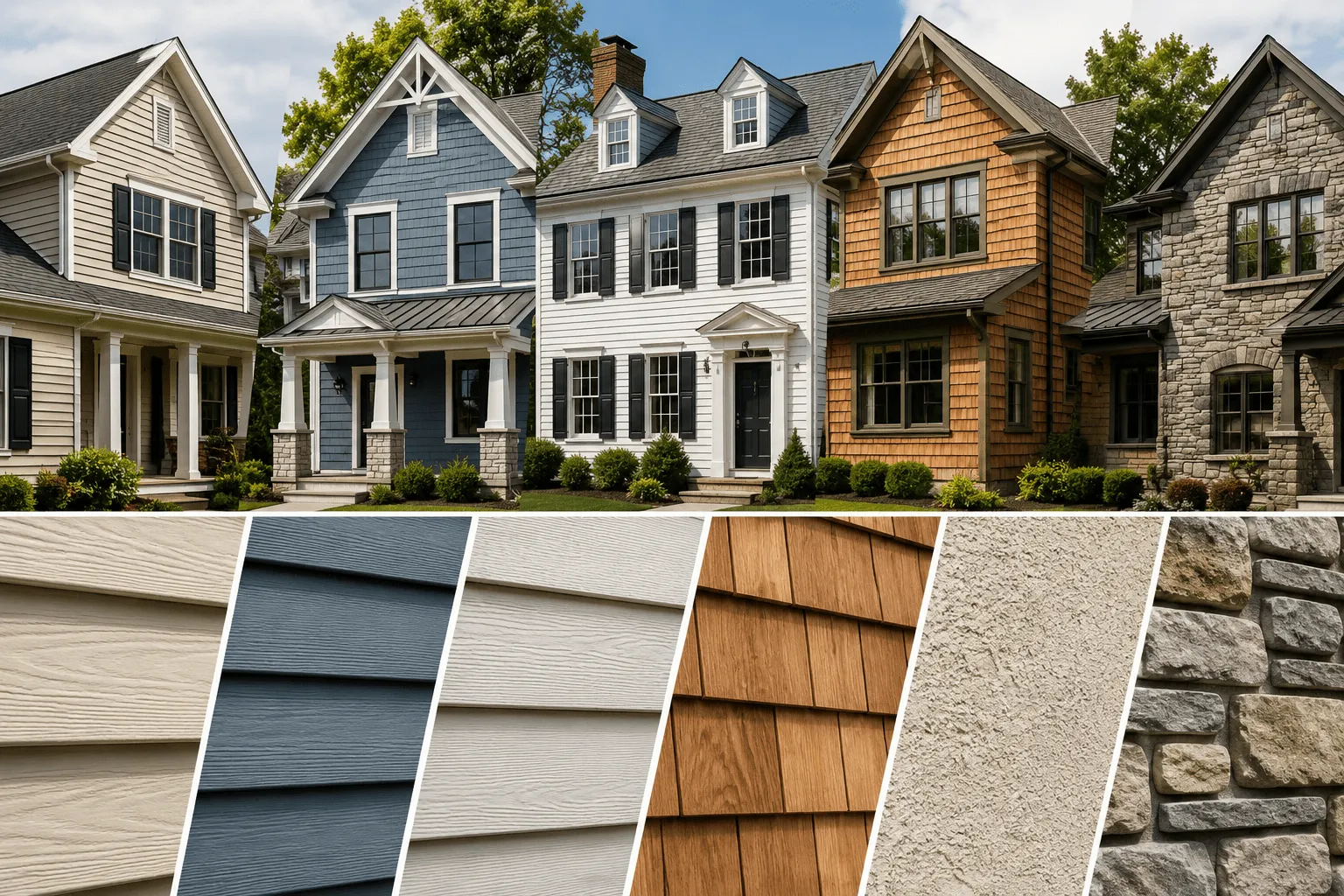
Choosing the best siding materials for Main Line, PA homes is one of the most important exterior decisions a homeowner can make because the right siding affects curb appeal, weather protection, long-term maintenance costs, and overall property value. From historic Colonials in Bryn Mawr to newer homes in Wayne, Ardmore, and Haverford, Main Line properties face demanding Pennsylvania weather conditions that require siding materials capable of handling heavy rainfall, freeze-thaw cycles, humidity, and summer heat. Hynes Construction would like to share the helpful insight that understanding the pros and cons of each siding option helps homeowners make an informed investment that aligns with their home’s architecture, maintenance expectations, and long-term budget goals.
Quick Answer: No single siding material is right for every Main Line home. James Hardie fiber cement delivers the best long-term performance for most homes. Vinyl is the best value for budget-conscious replacements. Natural wood is the right choice for historic homes where authenticity is required. This guide breaks down every major siding material so you can make an informed decision before calling a siding contractor.
Not sure which siding material is best for your specific home? Every home on the Main Line has different architectural requirements, maintenance expectations, and budget considerations. Hynes Construction provides personalized siding recommendations based on your home’s style, age, and long-term goals. Schedule your free siding consultation or call 610-880-3890 to receive expert guidance before investing in new siding.
If you are a homeowner in Ardmore, Bryn Mawr, Wayne, Narberth, Haverford, or anywhere along the Main Line, you have already noticed that the neighborhood sets a high standard for exterior appearance. The homes here are historic Colonials, Victorian row houses, Craftsman bungalows, and mid-century ranches, spanning more than a century of architectural styles, and the siding you choose needs to work with that architecture, perform in Pennsylvania’s demanding climate, and deliver real value at your price point.
Siding is not a cosmetic decision. It is the primary weather barrier protecting your home’s structural sheathing, insulation, and interior from Pennsylvania’s 44 inches of annual rainfall, its 50 to 70 annual freeze-thaw cycles, and its summer heat that regularly pushes above 90 degrees Fahrenheit. The wrong siding material installed incorrectly causes moisture infiltration, rot, mold, and energy losses that compound every season. The right material, installed correctly, protects your home for 20 to 50+ years with minimal intervention.
This guide covers every major siding material available to Main Line PA homeowners: vinyl, James Hardie fiber cement, engineered wood, natural wood, stucco, and stone veneer. For each material, we cover the real pros and cons, the cost in the Main Line market, how long it lasts in Pennsylvania’s specific climate conditions, and which home types it is best suited for. At the end, we include a comprehensive comparison table and answers to the most frequently asked siding questions from Main Line homeowners.
Hynes Construction has been installing and replacing siding across the Main Line since 1974. We work with all of these materials and have direct experience with how each performs on the specific architectural styles and in the specific climate conditions of Chester, Delaware, and Montgomery Counties. For information on our complete siding services, see our siding installation and replacement page.
Vinyl Siding – The Most Widely Installed Material in the United States
What Is Vinyl Siding?
Vinyl siding is manufactured from polyvinyl chloride (PVC), the same thermoplastic used in plumbing pipe, window frames, and many other building products. It is extruded into long horizontal panels or vertical boards that interlock along the home’s exterior wall sheathing. The color is integral to the PVC compound, which means that, in theory, there is nothing to paint and nothing to maintain beyond occasional cleaning.
Vinyl is the most-installed residential siding material in the United States for a simple reason: it costs less upfront than any other permanent siding option while requiring essentially zero maintenance. For Main Line homeowners who want a clean, updated exterior without a premium material investment, vinyl is a practical and defensible choice, particularly on post-1975 construction where the home’s architecture does not require the specific character of wood or fiber cement.
Wondering whether vinyl siding is the right investment for your home? Our team can compare vinyl with fiber cement, engineered wood, and other siding materials based on your home’s architecture, maintenance preferences, and budget. Call Hynes Construction at 610-880-3890 for honest recommendations with no sales pressure.
Pros of Vinyl Siding
- Lowest installed cost: Vinyl siding typically installs for $4 to $9 per square foot in the Main Line market, significantly below fiber cement ($9 to $18) and well below natural wood ($9 to $15). For a standard 2,000-square-foot home, the difference between vinyl and fiber cement can be $10,000 to $20,000 or more.
- Zero painting requirement: Color is integral to the PVC compound. Vinyl does not need to be painted, stained, or sealed. For homeowners who do not want ongoing exterior maintenance, this is the strongest single advantage of vinyl over wood and natural wood alternatives.
- Moisture and rot resistant: PVC does not absorb water. Vinyl siding panels will not rot, will not provide substrate for mold growth on the panel surface, and will not be damaged by rain or snow contact over their service life.
- Wide color and profile variety: Modern vinyl is available in dozens of colors, including deep tones (navy, charcoal, and forest green) and textures that replicate wood clapboard, cedar shake, board-and-batten, and beaded profiles. The profile range has expanded significantly since the 1990s.
- Lightweight and easy to install: Vinyl is lighter than fiber cement or wood at comparable panel sizes. This reduces installation labor and, on large projects, can meaningfully affect total project cost.
Cons of Vinyl Siding
- UV degradation over time: Pennsylvania’s sun exposure, combined with the freeze-thaw cycling that stresses the PVC compound, causes vinyl to fade, chalk, and eventually become brittle over 20 to 30 years. Premium vinyl with higher UV stabilizer content extends this timeline, but it is a real limitation. Repainting vinyl is possible but limited by the color rules discussed below.
- Cannot be painted a darker color: This is a critical constraint that many homeowners do not know before purchasing vinyl. If you paint vinyl in a color darker than the original, the panel absorbs more solar heat, expands beyond the material’s design parameters, and can warp or buckle. This means you are committed to the original color family for the life of the siding, which matters when color trends change over 20 to 30 years.
- Damage is difficult to repair invisibly: A cracked or dented vinyl panel must be replaced entirely. Matching the original panel after years of UV exposure and production run changes is difficult. A repaired section often reads as visually different from the original because of color drift over time.
- Not architecturally appropriate for historic homes: Historic district review boards in Lower Merion Township, Narberth Borough, and other Main Line communities frequently reject vinyl siding on pre-1940 homes. The profile of vinyl panels does not replicate the depth and character of original wood clapboard in a way that satisfies historic preservation standards. On these homes, wood, fiber cement, or engineered wood are the appropriate specifications.
- Lower perceived value than fiber cement: In the Main Line real estate market, where buyers are calibrated to premium specifications, vinyl siding on a $700,000 Colonial reads as a downgrade relative to what buyers expect. This does not mean vinyl lowers value, but it does mean fiber cement or engineered wood can command a stronger buyer response.
Vinyl Siding Cost Guide – Main Line, PA (2026)
| Vinyl Siding Grade | Cost Installed per Sq Ft | Expected Lifespan | Best Application |
|---|---|---|---|
| Entry grade (builder) | $4 to $6 per sq ft | 15 to 20 years | Rental properties, budget residential replacements |
| Mid-grade residential | $6 to $9 per sq ft | 20 to 30 years | Most Main Line residential replacement projects |
| Premium vinyl (insulated) | $9 to $13 per sq ft | 25 to 35 years | Homes where energy performance plus low maintenance is the priority |
| Vinyl with insulated backer | Add $2 to $4 per sq ft to the base cost | Same as panel grade | Improves thermal performance. Worth considering on Main Line homes with older wall assemblies |
See our detailed guide to vinyl siding installation in Main Line PA, and our full siding replacement cost guide for current pricing.
What Is Fiber Cement Siding?
Fiber cement siding is manufactured by combining Portland cement, sand, and cellulose wood fiber under high pressure and heat, creating a dense, rigid board that has the dimensional stability of concrete with a surface that can be milled to replicate wood clapboard, cedar shake, board-and-batten, and shingle profiles. James Hardie is the dominant manufacturer in the fiber cement category, and their HZ5 product line is specifically engineered and warranted for the climate zone that includes Pennsylvania.
James Hardie fiber cement has become the standard specification for premium siding replacement on Main Line, PA homes for a straightforward reason: it outperforms every other siding material on the critical metrics that matter in Pennsylvania’s climate: moisture resistance, dimensional stability through freeze-thaw cycling, fire resistance, and paint adhesion longevity. For a full breakdown of the James Hardie product line and why it performs in Pennsylvania’s climate, see our blog on James Hardie fiber cement siding for the Main Line region.
Thinking about upgrading to James Hardie siding? As a James Hardie Preferred Installer, Hynes Construction helps homeowners choose the right Hardie profile, ColorPlus finish, and trim options for lasting performance. Schedule your free siding estimate or call 610-896-6388 to discuss your project.
Pros of James Hardie Fiber Cement Siding
- Best moisture and weather resistance available: Fiber cement does not absorb water. It does not rot, does not swell when wet, and does not provide a substrate for mold or termite activity. In Pennsylvania’s 44-inch annual rainfall environment, this matters every season. Hardie’s HZ5 product line is specifically tested and warranted for the high-humidity, high-precipitation climate zone that includes the Main Line.
- Dimensional stability through freeze-thaw cycling: Fiber cement expands and contracts minimally with temperature changes, far less than wood and less than vinyl. Pennsylvania’s 50 to 70 annual freeze-thaw cycles stress every exterior material. Hardie’s dimensional stability means the panel-to-panel gaps remain consistent and the paint film does not crack or separate at panel joints over time.
- Fire resistance: Fiber cement is noncombustible. It will not ignite from flying embers and will not contribute to flame spread if a fire starts nearby. This is a meaningful safety advantage and an increasingly relevant consideration as wildfire risk awareness has expanded even to the Mid-Atlantic states.
- 60-year limited warranty: James Hardie products carry a 30-year non-prorated product warranty, extended to 60 years with ColorPlus factory finish and installation by a Hardie-preferred contractor. No other siding material in this comparison offers equivalent warranty coverage.
- Paintable with any exterior paint: Unlike vinyl, fiber cement can be repainted in any color at any time without risk of material damage. This is a significant long-term design flexibility advantage. Hardie’s ColorPlus factory finish delivers a baked-on finish that holds color for 15+ years before repainting is needed.
- Architecturally appropriate for historic Main Line homes: Hardie’s HardieShingle, HardiePlank, and HardiePanel products are available in profiles and dimensions that replicate original cedar shake, wood clapboard, and board-and-batten, making them appropriate for historic district review and architecturally consistent on pre-1940 Main Line homes where vinyl would not be accepted.
Cons of James Hardie Fiber Cement Siding
- Higher upfront cost: Fiber cement siding installs for $9 to $18 per square foot in the Main Line market, approximately 2 to 3 times the cost of mid-grade vinyl. For a full-home re-side, the premium over vinyl is significant: $15,000 to $40,000 or more, depending on home size and profile complexity. The long-term cost is more favorable when you factor in the 50+ year lifespan and paint longevity, but the upfront investment is real.
- Heavy and labor-intensive to install: Fiber cement panels are significantly heavier than vinyl at comparable dimensions. This requires a professional installation crew with appropriate equipment and experience. It is not a DIY material. The labor intensity contributes to the higher installed cost compared to vinyl.
- Requires repainting on a cycle: Even with the ColorPlus factory finish, Hardie siding will need repainting on a 12- to 15-year cycle. Vinyl never needs painting. For homeowners who want truly zero exterior maintenance, this is a relevant consideration, though most Main Line homeowners find the repainting cycle acceptable given fiber cement’s other advantages.
- Silica dust hazard during cutting: Cutting fiber cement panels generates silica dust that is a respiratory hazard if not properly managed. Correct installation requires NIOSH-approved respirators, proper saw blade selection, and dust control, which professional installers provide as standard. This is not a concern for the homeowner, but it is a differentiator between professional and amateur installation quality.
James Hardie Fiber Cement Cost Guide – Main Line, PA (2026)
| Hardie Product | Profile | Cost Installed per Sq Ft | Best Application on Main Line |
|---|---|---|---|
| HardiePlank Lap Siding | Horizontal clapboard (standard) | $9 to $14 per sq ft | Colonial, Craftsman, and transitional Main Line homes |
| HardieShingle (Cedar Shake) | Staggered shingle profile | $11 to $16 per sq ft | Victorian, Craftsman, and Cottage-style homes |
| HardiePanel (Vertical) | Board-and-batten or smooth panel | $8 to $13 per sq ft | Contemporary additions, detached garage, accent gables |
| HardieTrim | Window and door casings, corner boards | $6 to $10 per linear ft | Used alongside any Hardie panel product for a complete system |
For a complete breakdown of siding replacement costs in the Main Line market, see our Main Line PA siding cost guide for 2026.
Engineered Wood Siding – Natural Look, Improved Performance
What Is Engineered Wood Siding?
Engineered wood siding is manufactured by compressing and bonding wood strands or fibers with resins and binders under heat and pressure, creating a composite board that has the visual appearance of natural wood grain with improved dimensional stability and moisture resistance compared to solid wood. LP SmartSide and Woodtone are the leading engineered wood siding brands. The manufacturing process eliminates the structural inconsistencies (knots, grain variation, resin pockets) that cause solid wood to perform unevenly.
If you are looking for the appearance of natural wood without the higher maintenance requirements, engineered wood may be the ideal solution. Our siding specialists can explain the differences between LP SmartSide, James Hardie, vinyl, and natural wood during a free consultation. Call 610-896-6388 to discuss your options.
Pros of Engineered Wood Siding
- Natural wood aesthetic without solid wood maintenance: Engineered wood can be milled to replicate the look and profile of natural wood clapboard, cedar shake, and board-and-batten. At the installed cost of $6 to $12 per square foot, it delivers the wood aesthetic at roughly half the cost of solid wood while outperforming solid wood on moisture resistance and dimensional stability.
- Takes paint and stain naturally: Engineered wood accepts paint and stain in the same way solid wood does, providing the full color flexibility that vinyl lacks. Pre-primed panels are available, reducing the field painting scope.
- Lighter than fiber cement: LP SmartSide panels are significantly lighter than comparable fiber cement panels, reducing installation labor and making the installation process somewhat more accessible for smaller crews.
- Appropriate for historic district review: Engineered wood profiles and panel dimensions closely replicate original wood siding, making them generally acceptable in historic district review processes as a compliant alternative to solid wood on Main Line properties where an exact material match is not mandated.
Cons of Engineered Wood Siding
- Requires paint maintenance on a 5 to 10-year cycle: Engineered wood must be painted or stained on a regular cycle to protect the wood fiber core from moisture absorption. LP SmartSide recommends repainting every 5 to 10 years. If paint is allowed to degrade significantly, moisture infiltration begins at exposed edges, and the material swells and delaminates.
- Shorter lifespan than fiber cement: Engineered wood has an expected service life of 20 to 30 years with proper maintenance, compared to 30 to 50+ years for fiber cement. In Pennsylvania’s climate, with its high moisture and freeze-thaw exposure, the maintenance discipline required to achieve the full service life is significant.
- Vulnerable at edges and seams: The exposed edges of engineered wood panels are the most vulnerable point. Field-cut edges that are not properly primed and sealed before installation are a common point of moisture entry that leads to swelling and delamination. Correct installation technique is critical.
Natural Wood Siding – Authentic Character for Historic Main Line Homes
What Is Natural Wood Siding?
Natural wood siding encompasses several distinct products: solid cedar or redwood clapboard (horizontal boards that overlap to shed water), cedar or pine shake shingles (staggered-edge shingles that replicate the original siding on Victorian and Craftsman homes), and board-and-batten (vertical boards with narrow battens covering the joints). Natural wood is the original residential siding material for most Main Line homes built before 1960, and it remains the architecturally authentic specification for historic restoration projects and for HOA-controlled historic district properties where fiber cement or engineered wood profiles are not accepted.
Historic Main Line homes often require careful material selection to preserve architectural character while meeting local requirements. If you are restoring an older home, schedule a consultation with Hynes Construction or call 610-896-6388 to discuss siding options that complement your home’s historic design.
Pros of Natural Wood Siding
- Authentic architectural character: Nothing fully replicates the depth, grain variation, and tactile character of natural wood at close inspection. For historic homes in Narberth, Wayne, and the Bryn Mawr area, where original cedar clapboard or shingle siding is part of the home’s design language, natural wood delivers the authentic character that no manufactured material fully achieves.
- Full paint and stain compatibility: Natural wood accepts any paint or stain system and can be refinished in any color at any time. When properly finished and maintained, wood siding can be updated as exterior color trends evolve.
- Repairability: Individual wood siding boards or shingles can be replaced independently without disturbing adjacent panels, unlike vinyl, where color matching is a persistent challenge. On historic homes where only a portion of the siding needs replacement, wood allows invisible, board-level repairs.
Cons of Natural Wood Siding
- Highest maintenance requirement of any siding material: Natural wood must be painted or stained and sealed every 4 to 8 years to prevent moisture absorption, which causes rot, swelling, and structural deterioration. In Pennsylvania’s climate with its extended wet seasons, unprotected wood deteriorates rapidly.
- Highest cost of any conventional siding material: Premium cedar siding installs for $9 to $15 per square foot in the Main Line market, comparable to fiber cement, but requires ongoing refinishing that fiber cement does not. The total cost of ownership over 30 years significantly exceeds that of fiber cement.
- Vulnerable to rot, insects, and fire: Wood is the only siding material that is genuinely susceptible to all three of these failure modes simultaneously. Moisture and insects combine to accelerate wood deterioration on any home where maintenance intervals slip. Wood is also combustible, a meaningful distinction from fiber cement, especially on tightly spaced Main Line properties.
- Lead paint history on pre-1978 homes: The original wood siding on most pre-1978 Main Line homes was painted with lead-based paint. Any work that disturbs painted surfaces, such as scraping, sanding, or replacement, triggers EPA RRP requirements. Contractors must be certified and follow specific containment and cleanup procedures. For more on this topic, see our exterior painting page, which covers EPA RRP certification in detail.
Stucco – The Most Common Problem Siding on the Main Line
What Is Stucco Siding?
Traditional stucco is a three-coat system: a scratch coat applied directly to metal lath, a brown coat for leveling, and a finish coat that provides the texture and color. Synthetic stucco, also called EIFS (Exterior Insulation and Finish System), adds a rigid foam insulation layer beneath the stucco finish coat and became the dominant stucco specification on Main Line homes built between 1985 and 2005.
Stucco, particularly EIFS, is the most common siding problem we address on the Main Line. Water infiltration at stucco cracks, window perimeters, and penetrations leads to moisture accumulation behind the stucco cladding that causes significant structural damage to wall sheathing and framing before any visible exterior symptoms appear. For more on this specific problem and the remediation process, see our blog on stucco remediation vs repair for Main Line homeowners.
Pros of Stucco Siding
- Excellent fire resistance: Like fiber cement, stucco (particularly traditional three-coat stucco over metal lath) is noncombustible and provides a strong fire barrier at the exterior wall.
- Noise attenuation: Stucco’s mass provides meaningful noise reduction from exterior sources, particularly relevant on Main Line properties near Route 30, Route 202, or SEPTA rail corridors.
- Architectural authenticity on certain home styles: Traditional stucco is the original exterior material on many Main Line Tudor Revival and Spanish Colonial homes, particularly in Wayne, Gladwyne, and Bryn Mawr. On these specific architectural types, stucco is the correct specification.
Cons of Stucco Siding (EIFS in particular)
- High moisture infiltration risk: EIFS stucco does not drain water that gets behind the cladding. When the stucco surface cracks at window perimeters, penetrations, or in the field, water enters and has no exit path. It accumulates against the sheathing and framing, causing progressive wood rot that can advance for years before exterior symptoms appear.
- Expensive remediation when moisture damage occurs: Stucco remediation, removing the EIFS, drying the wall assembly, replacing damaged sheathing and framing, installing a drainable cladding system, and re-siding are major projects. See our complete guide to stucco remediation for full details on the process and cost.
- Requires specialist inspection when buying a home: Any Main Line home with EIFS stucco siding should receive a moisture inspection with probe testing at all penetrations before purchase. Hidden moisture damage behind stucco is a common and costly discovery in real estate transactions on the Main Line.
IMPORTANT FOR MAIN LINE HOMEOWNERS WITH STUCCO: If your home has EIFS stucco siding installed between 1985 and 2005 and has not had a professional moisture inspection in the past 3 to 5 years, we strongly recommend scheduling one before the next storm season. Early detection of moisture infiltration allows intervention at the repair stage rather than the full remediation stage. See our stucco remediation service page for full information.
Concerned about hidden moisture behind your stucco? Early detection can help prevent costly structural repairs. Hynes Construction performs professional stucco inspections and moisture evaluations throughout the Main Line. Schedule your inspection today or call 610-896-6388.
Stone and Stone Veneer – Accent and Architectural Elevation
What Is Stone Veneer Siding?
Stone veneer refers to thin-cut natural stone or cast stone (manufactured from concrete with aggregate that replicates the appearance of natural stone) applied to the exterior wall as a decorative and protective cladding. On Main Line homes, stone veneer is most commonly used as an accent material at the base course, chimney, and entry surround rather than as full-house cladding, providing architectural grounding and visual weight without the structural requirements and cost of full-depth natural stone.
Pros of Stone Veneer
- Exceptional durability: Natural stone and quality manufactured stone veneer installed with the correct moisture barrier, metal lath, and Type S mortar can last 50 to 100+ years without significant maintenance. It is the most durable of any exterior cladding material.
- Strong home value signal: Stone accent work on Main Line Colonial and Victorian homes delivers a premium curb appeal and home value signal that buyers and appraisers respond to. A stone base course on a brick or clapboard Colonial is the kind of detail that distinguishes a home at the price point where Main Line properties trade.
Cons of Stone Veneer
- High installed cost: Manufactured stone veneer installs for $15 to $30 per square foot; natural stone installs for $30 to $55 per square foot. Full-house stone cladding is typically cost-prohibitive; stone is used as an accent, not whole-house replacement siding.
- Weight and structural requirements: Full natural stone requires structural support from the foundation wall. Manufactured stone veneer is lighter but still heavier than vinyl or fiber cement. Structural assessment is required before any significant stone installation.
Stone veneer works best when combined with complementary siding materials that enhance your home’s overall appearance. If you are planning an exterior renovation, Hynes Construction can help you design the right combination of siding and stone accents. Call 610-896-6388 for a free consultation.
Side-by-Side Siding Material Comparison for Main Line PA Homes
| Factor | Vinyl | James Hardie Fiber Cement | Engineered Wood | Natural Wood | Stucco (EIFS) |
|---|---|---|---|---|---|
| Cost installed per sq ft | $4 to $9 | $9 to $18 | $6 to $12 | $9 to $15 | $10 to $20 |
| Expected lifespan (PA climate) | 20 to 30 years | 30 to 50+ years | 20 to 30 years | 20 to 40 years (maintained) | Variable (high failure risk) |
| Maintenance required | None. Wash only. | Repaint every 12 to 15 years. | Repaint every 5 to 10 years. | Repaint every 4 to 8 years. | Annual inspection. Seal cracks immediately. |
| Fire resistance | Poor (melts) | Excellent (noncombustible) | Fair (treated) | Poor (combustible) | Excellent (noncombustible) |
| Moisture resistance | Excellent | Excellent | Good (if maintained) | Fair (requires maintenance) | Poor (EIFS traps moisture) |
| Freeze-thaw stability | Good (may become brittle) | Excellent (HZ5 climate rated) | Good | Fair (expands/contracts) | Poor (EIFS cracks) |
| Paintability | Limited (darker colors warp) | Full (any exterior paint) | Full (any exterior paint) | Full (any paint or stain) | Limited (breathable paints only) |
| Historic district approval | Frequently denied | Generally accepted | Generally accepted | Standard specification | Case-by-case |
| Architecture match | Good for contemporary | Excellent for all styles | Good for traditional | Best for historic homes | Tudor and Spanish Colonial |
| Resale perception Main Line | Moderate | Highest | Good to high | High (if maintained) | Risk (moisture disclosure) |
| Warranty | Limited (product-specific) | 30 to 60-year Hardie warranty | 50-year LP SmartSide | None standard | None standard |
| Our Main Line recommendation | Budget replacements, post-1980 homes | Most Main Line replacement projects | Historic homes, budget-sensitive | Historic restoration only | Remediation typically needed |
Still unsure which siding material is the best fit for your home? Every property has unique architectural features, maintenance needs, and budget considerations. Hynes Construction can evaluate your home’s exterior and recommend the siding solution that offers the best long-term value. Schedule your free estimate or call 610-896-6388 today.
Which Siding Material Is Right for Your Main Line Home?
Every homeowner’s priorities are different. Some focus on long-term durability, others want the lowest maintenance, and many want to preserve the historic character of their home.
For Pre-1940 Historic Colonial, Victorian, or Craftsman Homes
James Hardie fiber cement in the appropriate profile (HardiePlank for clapboard homes and HardieShingle for shake-style Craftsman and Victorian homes) is the recommended specification for most historic Main Line homes. It replicates the visual character of original wood siding profiles, is generally acceptable in historic district review, and performs in Pennsylvania’s climate without the maintenance demands of natural wood.
For the most premium historic restoration projects, where HOA or Certificate of Appropriateness requirements mandate the actual original material, natural cedar or pine clapboard remains the correct specification. The maintenance commitment must be accepted as part of that choice.
For Post-1980 Colonial, Ranch, and Split-Level Homes
Vinyl is a defensible choice for post-1980 homes that are not in historic district zones and where budget is the primary consideration. Premium vinyl with an insulated backer delivers reasonable energy performance alongside the zero-maintenance profile that many Main Line homeowners want.
For homeowners who want a long-term investment that outperforms vinyl without the premium of fiber cement, LP SmartSide engineered wood in an appropriate profile delivers a natural wood appearance at a mid-range price point with a 50-year product warranty from LP.
For Homes with Existing EIFS Stucco
Stucco remediation, removal of the EIFS system, moisture assessment, structural repair, and replacement with a drainable cladding such as James Hardie fiber cement are the standard recommendations for Main Line homes with EIFS stucco showing signs of moisture infiltration. Painting over failing stucco is counterproductive; moisture behind the cladding requires intervention at the wall assembly level, not at the surface. For a full explanation of the remediation process and why it is the right approach for most EIFS homes on the Main Line, see our complete guide to stucco remediation, our stucco repair vs remediation comparison, and our stucco remediation service page.
For Homes Preparing for Sale
James Hardie fiber cement is the specification that generates the strongest buyer response in the Main Line market. If you are re-siding before listing, fiber cement in a current color palette (warm white or off-white clapboard, dark trim, and broad accent on shutters and door) is the specification most likely to support a strong asking price and a fast sale. Vinyl on a home in the $600,000+ price range sends a mixed signal to Main Line buyers whose expectations are calibrated to the price point.
What to Look for When Hiring a Siding Contractor on the Main Line
The siding material you choose matters significantly less than whether it is installed correctly. Every major siding material can fail within 5 years when installed incorrectly, and every major siding material can perform for its full expected lifespan when installed to the manufacturer’s specifications. Here is what to verify before hiring a siding contractor in Chester, Delaware, or Montgomery County:
- HICPA registration: Pennsylvania law requires home improvement contractors performing work over $500 to be registered under the Home Improvement Consumer Protection Act. Verify registration at the PA Attorney General’s website before signing any contract. See our certifications and affiliations page for our registration documentation.
- James Hardie preferred installer status (if choosing Hardie): Hardie’s contractor certification program identifies installers who have been trained on Hardie-specific installation procedures. Installation by a Hardie-preferred contractor is required to activate the full 30 to 60-year Hardie product warranty.
- EPA RRP certification for pre-1978 homes: Any work that disturbs painted surfaces on pre-1978 homes, including siding removal, requires an EPA RRP-certified contractor. This is federal law. Confirm RRP certification before any work begins on a pre-1940 or pre-1978 Main Line home.
- Written, itemized contract before any work begins: Insist on a written contract that specifies the exact siding product (manufacturer, product line, color, and coverage), the scope of substrate inspection and repair, and the total price. No verbal estimates, no open-ended material allowances.
- For guidance on what questions to ask before hiring, see our blog on important questions to ask your siding contractor.
Hynes Construction is HICPA registered, EPA RRP certified, and a James Hardie preferred installer. We’ve been serving the Main Line since 1974. See our full siding services page, our fiber cement siding page, and our vinyl siding page for complete information on our siding installation services. Call 610-896-6388 for your free siding estimate.
Frequently Asked Questions
What is the best siding for a house in the Main Line, PA?
James Hardie fiber cement is the best overall siding material for most Main Line, PA homes, based on performance, longevity, appearance, and long-term cost of ownership. It outperforms vinyl on durability and moisture resistance, outperforms natural wood on maintenance requirements, and is available in profiles that replicate the clapboard, shake, and board-and-batten character of historic Main Line architecture. Vinyl is the best choice when the budget is the primary constraint. Natural wood is the right choice for historic restoration projects where authentic material is required.
How much does siding installation cost in the Main Line, PA?
Siding installation costs in the Main Line market (as of 2026) run $4 to $9 per square foot for vinyl, $9 to $18 per square foot for James Hardie fiber cement, $6 to $12 per square foot for engineered wood, and $9 to $15 per square foot for natural wood. The Main Line market runs 15 to 25% above Pennsylvania state averages due to higher labor costs and the complexity of historic homes. For a complete breakdown, see our Main Line PA siding cost guide.
How long does James Hardie fiber cement siding last in Pennsylvania?
James Hardie fiber cement installed by a Hardie-preferred contractor with ColorPlus factory finish carries a 30-year non-prorated product warranty, extended to 60 years with qualifying installation. In practice, Hardie siding installed correctly in Pennsylvania’s climate routinely exceeds 30 years of service life, outperforming vinyl (20 to 30 years) and natural wood (20 to 40 years with consistent maintenance) in the same conditions.
Can vinyl siding be painted a different color?
Yes, technically. However, painting vinyl in a color darker than the original is not recommended. Darker colors cause the vinyl to absorb more solar heat, which causes the panel to expand beyond its design parameters. This can result in buckling, warping, and separation of the panel from the substrate. If you want to change to a significantly different or darker color, the appropriate solution is either selecting a new vinyl color that falls within the same brightness range as the original or residing with a material like fiber cement that can be painted any color without risk.
What is the difference between stucco repair and stucco remediation?
Stucco repair addresses surface-level cracks and cosmetic deterioration without removing the stucco cladding system. Stucco remediation removes the entire EIFS or stucco cladding, assesses and repairs any moisture damage to the underlying sheathing and framing, installs a new moisture management system (typically a drainable housewrap), and applies new siding, usually James Hardie fiber cement. Remediation is required when moisture has infiltrated behind the stucco. Repair is appropriate only when moisture testing confirms the wall assembly is dry and the stucco surface issues are purely cosmetic. For a full guide, see our stucco repair vs remediation comparison blog.
Is fiber cement siding worth the extra cost over vinyl?
For most Main Line homeowners, yes. The extra cost of fiber cement over vinyl, typically $5 to $10 per square foot more at installation, is justified by a 10 to 20-year longer expected service life, significantly better performance in Pennsylvania’s freeze-thaw climate, full paintability without color constraints, better fire resistance, and a stronger buyer response in the Main Line real estate market. The true cost comparison over 30 years, factoring in replacement at the end of vinyl’s 20-year life and the paint maintenance cycle of fiber cement vs the zero maintenance of vinyl, is closer than the upfront price difference suggests.
Does new siding increase home value on the Main Line?
Yes. Siding replacement consistently ranks among the highest-ROI home improvement projects nationally, and the effect is stronger in the Main Line market because buyers are highly attuned to exterior condition and material quality at the price points where Main Line homes trade. According to Remodeling Magazine’s Cost vs. Value data, fiber cement siding replacement returns approximately 75 to 80% of project cost in resale value. A deteriorated, stained, or failing original siding system is flagged in every buyer’s inspection and used as a negotiating point. New siding removes that item and signals a well-maintained home.
What siding is approved for homes in Lower Merion Township’s historic districts?
Properties in Lower Merion Township’s historic district overlay zones may require a Certificate of Appropriateness (COA) from the Historic Architectural Review Board (HARB) before siding replacement. Generally, wood (preferred and traditional), fiber cement in a profile that replicates the original wood siding (increasingly accepted), and engineered wood in matching profiles are acceptable specifications. Vinyl siding is frequently not approved for contributing structures in historic districts because its profile and surface texture do not replicate original wood siding convincingly at close inspection. We manage COA submissions for our Main Line historic district projects.
How do I know if my stucco has moisture damage?
The only reliable way to assess moisture behind stucco is professional probe testing at window perimeters, penetrations, and field locations. Surface inspection alone is not sufficient; significant moisture damage behind EIFS stucco can exist with minimal visible exterior symptoms until the damage is advanced. Warning signs that warrant immediate professional assessment: dark staining below windows, soft or spongy feel when pressing on stucco sections, cracks at window corners or at penetrations, and any visible efflorescence (white mineral deposits) on the stucco surface. See our blog on identifying stucco damage signs for a full assessment guide.
What is the best time of year to replace siding in Main Line, PA?
Spring (April through May) and fall (September through October) are the optimal seasons for siding replacement in Pennsylvania, as moderate temperatures allow siding materials to acclimate, caulks and sealants to cure at appropriate temperatures, and paint (if field-applied) to dry correctly. Summer is acceptable, but intense heat can affect some installation aspects. Winter siding replacement is possible with professional crews and is sometimes scheduled to take advantage of better availability and off-season pricing. For a full seasonal guide, see our blog on the best time of year for siding replacement in Bala Cynwyd.
Related Reading: James Hardie Fiber Cement Siding for the Main Line | Siding Replacement Cost Guide Main Line PA 2026 | Stucco Remediation vs Siding Replacement | Stucco Remediation: The Process and FAQs | Important Questions to Ask Your Siding Contractor
See how Main Line homeowners are transforming their exteriors with the right siding materials, color combinations, and architectural upgrades. Follow our Facebook and Instagram pages for real project inspiration, siding transformation ideas, and expert insights tailored for Main Line, PA homes.
Ready to Choose the Best Siding for Your Main Line Home?
Whether you are replacing aging vinyl siding, considering James Hardie fiber cement, restoring a historic home, or addressing moisture issues behind stucco, selecting the right siding is an investment in your home’s appearance, protection, and long-term value.
Since 1974, Hynes Construction has helped homeowners throughout Ardmore, Bryn Mawr, Wayne, Narberth, Haverford, Villanova, Radnor, Newtown Square, and surrounding Main Line communities choose siding solutions that fit their homes and budgets.
Schedule your free siding consultation today or call Hynes Construction at 610-880-3890 to discuss your project with our experienced siding specialists.

(President, Hynes Roofing and Siding)
With over 35 years experience in the roofing and siding industry, Michelle Hynes has built a business from 2 people into over 45 people and 19 trucks!