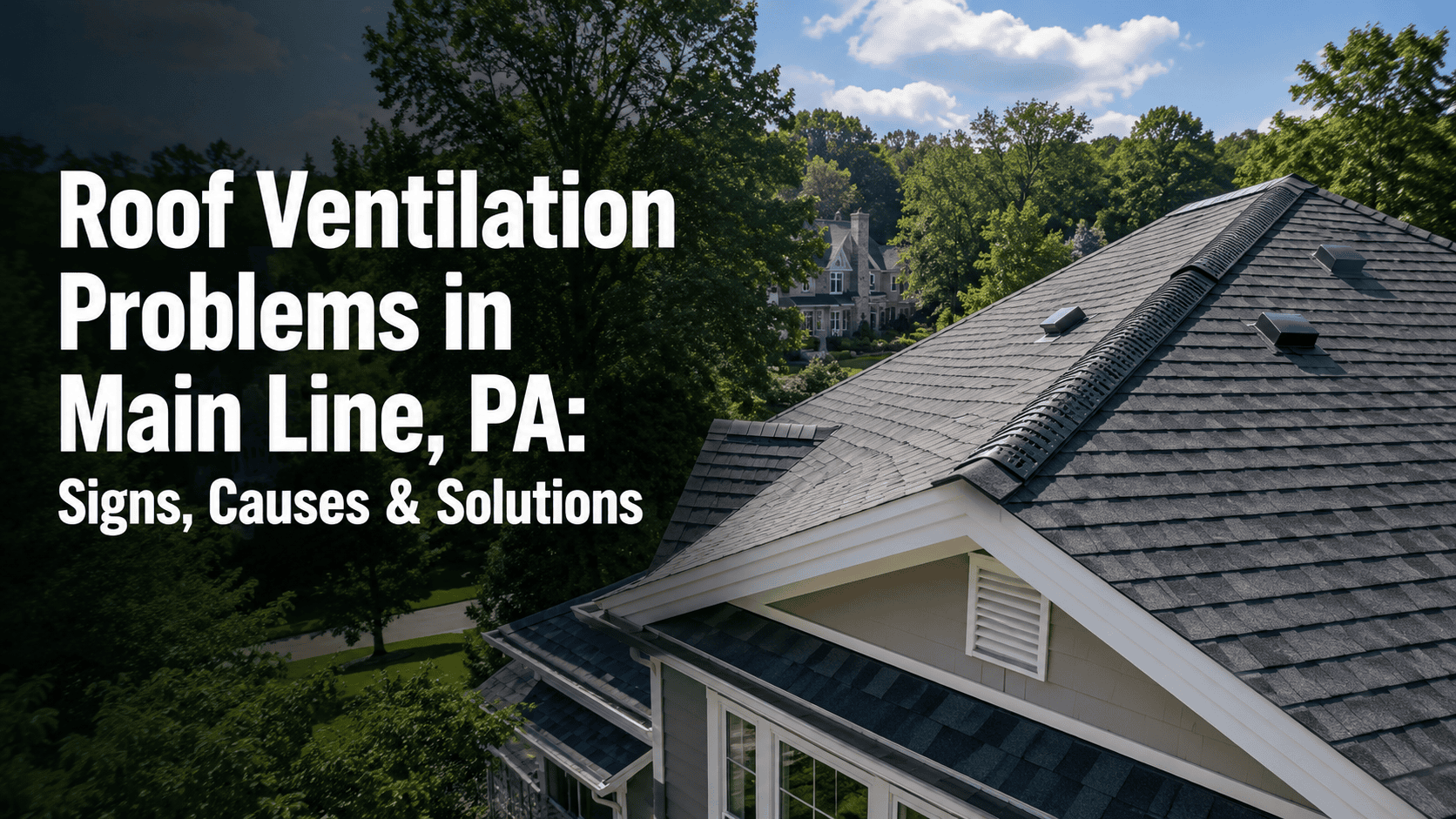
Roof ventilation problems Main Line, PA can lead to higher energy bills, premature roof deterioration, attic moisture, mold growth, and costly structural repairs. Many homeowners in Ardmore, Bryn Mawr, Wayne, and surrounding Main Line communities don’t realize their roof ventilation system is failing until signs like excessive attic heat, ice dams, or roof leaks appear. Understanding the warning signs and addressing ventilation issues early can help protect your home and extend the life of your roof.
| Key Takeaway Poor roof ventilation is one of the most overlooked causes of early roof failure, skyrocketing energy bills, and interior moisture damage in Main Line PA homes. If your attic feels like a furnace in July or you are seeing ice dams in January, your ventilation system may be failing. This guide explains everything you need to know. |
Why Roof Ventilation Matters for Main Line PA Homes
Most homeowners in Ardmore, Bryn Mawr, Wayne, and Wynnewood never think about their roof ventilation until something goes wrong. By then, the damage is often already done. Proper roof ventilation is not just a building code requirement. It is one of the most critical systems in your home for managing heat, moisture, and air quality year-round.
The Main Line climate creates specific challenges. Summers in this region bring intense humidity and heat. Winters bring freeze-thaw cycles, ice dams, and sustained cold that stresses roofing materials. A roof ventilation system that is designed, installed, and maintained correctly protects your roof deck, your insulation, your shingles, and your interior living spaces from all of it.
Concerned About Your Roof Ventilation?
If your attic feels unusually hot, your energy bills keep increasing, or you’ve noticed moisture, mold, or damaged shingles, don’t wait for the problem to get worse.
Schedule a professional roof ventilation inspection with Hynes Construction. Our experienced team will identify ventilation issues, recommend the right solution, and help protect your roof from costly damage.
Call 610-880-3890 today to schedule your inspection or request a free estimate.
[Schedule Your Free Roof Inspection]
Hynes Construction has been serving Main Line PA homeowners since 1974. In that time, we have seen what happens when ventilation is ignored: premature shingle failure, mold in attic spaces, rotting roof decking, and energy bills that climb every year without explanation. The good news is that most ventilation problems are correctable once they are identified.
What Is Roof Ventilation and How Does It Work?
Roof ventilation is a system that allows air to move continuously through your attic space. It works on a simple principle: cool air enters at the low points of your roof (through intake vents at the soffits or eaves) and warm, moist air exits at the high points (through ridge vents, box vents, or turbine vents at or near the peak of the roof).
This continuous airflow achieves three things:
- It removes heat buildup in summer, reducing the load on your air conditioning system and preventing excessive heat from degrading shingles from below.
- It removes moisture-laden air in winter before it can condense on cold roof deck surfaces, which causes rot, mold, and structural deterioration.
- It equalizes temperature across the roof surface in winter, reducing the risk of ice dam formation along the eaves.
For homes in the Main Line PA area, the general standard is 1 square foot of net free ventilation area for every 150 square feet of attic floor space, or 1 per 300 if there is a vapor barrier. Many older homes in Ardmore, Narberth, and Havertown fall well below these ratios.
Common Roof Ventilation Problems in Main Line PA
1. Insufficient Ventilation Area
The most common problem we find in Main Line homes, particularly those built before 1980, is simply not enough ventilation. Older homes in Wayne, Gladwyne, and Lower Merion were not built to modern ventilation standards. Adding insulation over the years without adding corresponding ventilation only makes the problem worse by blocking existing airflow pathways.
Signs of insufficient ventilation area include an attic that is consistently hotter than the outdoor temperature in summer, visible moisture staining on roof deck boards when you enter the attic, and shingles that are curling or losing granules faster than their expected lifespan.
2. Blocked Soffit Vents
Soffit vents are the intake side of your ventilation system. They sit under the eaves of your roof and allow outside air to enter the attic. In many Main Line homes, these vents become blocked over time by insulation that has been pushed to the edges of the attic floor, by debris accumulation, by pest nests, or by deteriorating baffles that were installed to keep insulation away from the vents.
When soffit vents are blocked, intake airflow is reduced or eliminated. Even if you have excellent ridge venting at the top, the system cannot work properly without intake. Hot and moist air becomes trapped rather than being replaced with fresh outside air.
3. Mixing Ventilation Types Incorrectly
This is a mistake we see regularly in homes that have had multiple contractors work on them over the years. When you mix different types of exhaust vents on the same roof, such as ridge vents combined with box vents or turbines, the system can short-circuit. Air will take the path of least resistance, often moving from one exhaust vent to another without ever drawing fresh air up from the soffits. The result is dead zones where no air movement occurs at all.
If your home has had additions, re-roofing, or ventilation upgrades done piecemeal over the decades, it is worth having a professional assess the current system to ensure it is functioning as a unified whole rather than a collection of incompatible components.
4. Improper Attic Insulation Placement
Insulation and ventilation must work together, not against each other. In many Main Line homes, particularly those that have been retrofitted with blown-in insulation, the insulation has migrated to cover the eave areas, blocking airflow from soffit vents before it even reaches the main attic space.
Baffles, also called rafter vents or ventilation channels, should be installed between every rafter bay at the eave to create a clear pathway for air to flow from the soffit into the attic. Without them, even well-placed insulation can negate your ventilation system entirely.
5. Damaged or Deteriorated Vents
Physical damage to vents is common in the Main Line area. Storms bring wind-driven debris. Squirrels, raccoons, and birds target damaged vent screens as entry points. Painted-over vents, a common sight in older Ardmore and Havertown homes, are effectively sealed shut.
Ridge vents can also crack, separate, or become dislodged during high winds, eliminating the primary exhaust pathway. An annual visual inspection of your vents from the exterior, along with a look inside the attic, can catch these issues before they lead to more serious damage.
Warning Signs Your Roof Ventilation Is Failing
Knowing what to look for can help you catch ventilation problems before they become expensive repairs. Here are the most important warning signs for Main Line homeowners:
Inside the Home
- Unusually high air conditioning costs in summer despite normal usage patterns.
- Rooms on the top floor that are consistently hotter than lower floors.
- Ice dams forming along the roof edges in winter, especially after a snowfall.
- Frost or condensation visible on attic surfaces during cold months.
- A musty smell in the attic or upper floors that was not there previously.
- Visible mold or dark staining on attic framing, sheathing, or insulation.
On the Roof Exterior
- Shingles that are curling, buckling, or losing granules faster than their age would suggest.
- Blistering or bubbling on the surface of asphalt shingles.
- Visible gaps, cracks, or displacement in ridge vent material.
- Soffit vent screens that are painted over, covered, or visibly crushed.
- Uneven snow melt patterns on the roof after a snowfall, with heavy melting near the ridge.
| Pro Tip from Hynes Construction Uneven snow melt is one of the clearest visual indicators of ventilation and insulation problems. If your roof is melting snow faster near the peak than the eaves, heat is escaping through the roof deck rather than being contained in the living space. This costs you money in heating bills and accelerates shingle aging simultaneously. |
The Connection Between Ventilation and Ice Dams
Ice dams are a serious and recurring problem for many Main Line PA homeowners. They form when heat escaping through a poorly insulated or poorly ventilated roof melts snow at the upper sections of the roof. That meltwater flows down toward the cold eaves, where it refreezes. As the ice builds up along the eave edge, it creates a dam that backs water under the shingles and into the home.
Proper attic ventilation, combined with adequate insulation, keeps the roof deck at a uniform temperature close to the outside air temperature. When the deck stays cold, snow does not melt selectively. Ice dams cannot form. For homeowners in Wayne, Bryn Mawr, and Gladwyne who deal with ice dams every winter, ventilation improvement is often the most effective long-term solution.
Our team has seen homes in Lower Merion where ice dam damage has resulted in interior ceiling collapse, ruined insulation, and mold remediation costs that far exceeded what proper ventilation installation would have cost.
Ventilation and Your Roof Warranty
This is a point that many Main Line homeowners do not realize: improper ventilation can void your roofing material warranty. Most major shingle manufacturers, including GAF, specify minimum ventilation requirements as a condition of their warranty coverage. If your ventilation system does not meet those standards at the time of installation, or if it deteriorates afterward, a claim for premature shingle failure may be denied.
As a GAF Master Elite Certified roofing contractor, Hynes Construction installs all roofing systems with ventilation that meets or exceeds manufacturer specifications. We also document the ventilation calculation for every job, so homeowners have a clear record if a warranty claim is ever needed.
Roof Ventilation Solutions for Main Line PA Homes
Ridge Vent Installation or Upgrade
Continuous ridge venting is the most effective exhaust ventilation method for pitched roofs. It runs the full length of the roof peak and creates uniform airflow across the entire attic. For homes that currently have box vents or turbines only, upgrading to a continuous ridge vent system, combined with unobstructed soffit venting, typically produces the most significant improvement in attic temperature and moisture levels.
Soffit Vent Repair and Clearing
If existing soffit vents are blocked, damaged, or insufficient, the solution may be as simple as cleaning them out and installing baffles to keep insulation from re-blocking them. In some cases, additional soffit vents need to be cut in to achieve the required intake area ratio.
Power Ventilators
In some situations, particularly in large homes in Wayne, Gladwyne, or Bryn Mawr with complex roof geometries that make passive ventilation difficult, powered attic ventilators can supplement passive systems. These are thermostat-controlled fans that activate when attic temperatures reach a set threshold. They should be sized carefully to avoid pulling conditioned air from the living space through gaps in the ceiling.
Ventilation Baffles
Installing proper ventilation baffles at every rafter bay is often the most cost-effective first step in improving an underperforming ventilation system. This is typically done in conjunction with insulation work and ensures that the intake pathway from soffit to attic remains open regardless of insulation depth.
How Ventilation Affects Your Energy Bills
A properly ventilated attic can reduce summer cooling costs by a meaningful margin. The Department of Energy has documented that attic temperatures in poorly ventilated homes can reach 150 degrees Fahrenheit or higher on hot summer days. That heat radiates down through the ceiling into your living spaces, forcing your air conditioning to work much harder than it should.
For Main Line PA homeowners, where summer temperatures regularly reach the high 80s and 90s with significant humidity, attic heat gain is a real contributor to high utility bills. Correcting ventilation issues, combined with proper insulation levels, is one of the highest-return home improvement investments available.
Read our guide on summer roof maintenance for Ardmore homeowners to understand how heat affects your roof system throughout the warm months.
When to Call a Professional
Some ventilation issues, such as clearing debris from soffit screens or checking that existing vents are open, can be handled by a homeowner. However, most meaningful ventilation improvements require a professional assessment and installation.
You should call a roofing professional when:
- You suspect significant ventilation deficiency based on the warning signs listed above.
- You are planning a roof replacement, because this is the ideal time to redesign the ventilation system from scratch.
- You have experienced ice dams for more than one winter season.
- You have found mold or moisture damage in your attic.
- Your energy bills have increased significantly without an obvious cause.
If you are planning a roof replacement soon, read our guide to roof replacement costs in Main Line PA to understand the full scope of what a properly designed replacement involves.
Serving Main Line PA Communities
Hynes Construction serves homeowners across the Main Line including Ardmore, Bryn Mawr, Wayne, Havertown, Wynnewood, Gladwyne, Narberth, and Villanova. We have been a trusted name in roof ventilation repair and installation since 1974.
Frequently Asked Questions
Q1. How do I know if my roof has enough ventilation?
The most reliable way is a professional attic inspection. Common signs of insufficient ventilation include an attic that is significantly hotter than outdoors in summer, ice dams in winter, moisture staining on attic framing, and shingles that are aging faster than expected. Hynes Construction offers ventilation assessments for homes across the Main Line PA area.
Q2. Can poor ventilation void my roof warranty?
Yes. Most major manufacturers including GAF specify minimum ventilation ratios as a condition of their shingle warranty. If your ventilation system does not meet those requirements, a warranty claim for premature shingle deterioration can be denied. Always confirm ventilation specifications with your roofing contractor before installation.
Q3. What is the difference between ridge vents and box vents?
Ridge vents run continuously along the peak of the roof and provide uniform exhaust ventilation across the full attic. Box vents are fixed individual units placed at intervals on the upper roof slope. Ridge vents are generally more effective and are the preferred solution for most Main Line PA homes, but they must be combined with adequate soffit intake venting to function correctly.
Q4. Does ventilation matter for flat roofs?
Flat roofs use different systems. Low-slope and flat roofs typically use insulation design and vapor barriers rather than traditional intake/exhaust ventilation. However, adequate airflow in any enclosed roofing cavity is important to prevent moisture buildup. Contact Hynes Construction to discuss the specific requirements for your roof type.
Q5. How much does it cost to improve roof ventilation?
Costs vary depending on the scope of work. Adding baffles to clear soffit vent pathways is relatively low cost. Installing a continuous ridge vent during a re-roofing project adds a modest amount to the overall job. Cutting in new soffit vents or adding a powered ventilator involves more labor. A site assessment by Hynes Construction will provide an accurate estimate for your specific home.
Q6. Will better ventilation reduce my energy bills?
Yes, in most cases. Proper attic ventilation reduces heat buildup in summer, which lowers air conditioning load. The effect is most significant in homes with dark-colored roofing, low-pitch roofs, and limited existing ventilation. Combined with appropriate insulation levels, ventilation improvements can produce noticeable reductions in cooling costs.
Q7. Can I install ridge vents myself?
Ridge vent installation requires cutting a slot along the roof peak and installing the vent material before applying cap shingles. It is possible for an experienced DIYer but carries real risk of water intrusion if not done correctly. On an older home in the Main Line area, we would strongly recommend professional installation to avoid introducing a leak at the roof peak.
Q8. My attic has mold. Is it a ventilation problem?
Attic mold is almost always related to moisture accumulation, which is directly caused by insufficient ventilation combined with inadequate insulation. However, mold remediation requires addressing both the root cause and the existing growth. Hynes Construction can assess whether ventilation improvement is the appropriate first step and refer you to a qualified mold remediation specialist if needed.
Q9. How often should I have my ventilation checked?
We recommend a ventilation assessment any time you are having roof work done, and at least every five years for homes over 20 years old. Annual visual inspections of soffit and ridge vents from the exterior are something any homeowner can do. Look for blocked screens, visible damage, or signs of pest activity.
Q10. Does adding insulation hurt my ventilation?
Only if baffles are not installed at the eaves. Adding insulation without installing ventilation baffles first is one of the most common mistakes we see in Main Line PA homes. Always install baffles at every rafter bay before adding blown-in or batt insulation to ensure the soffit vent intake pathway remains open.
| Ready to have your roof ventilation assessed? Hynes Construction provides professional roof ventilation inspections and improvements across Ardmore, Bryn Mawr, Wayne, Havertown, Wynnewood, and all Main Line PA communities. GAF Master Elite Certified. Family-owned since 1974.Call (610) 880-3890 or visit hynesconstruction.com to schedule your assessment. |

(President, Hynes Roofing and Siding)
With over 35 years experience in the roofing and siding industry, Michelle Hynes has built a business from 2 people into over 45 people and 19 trucks!