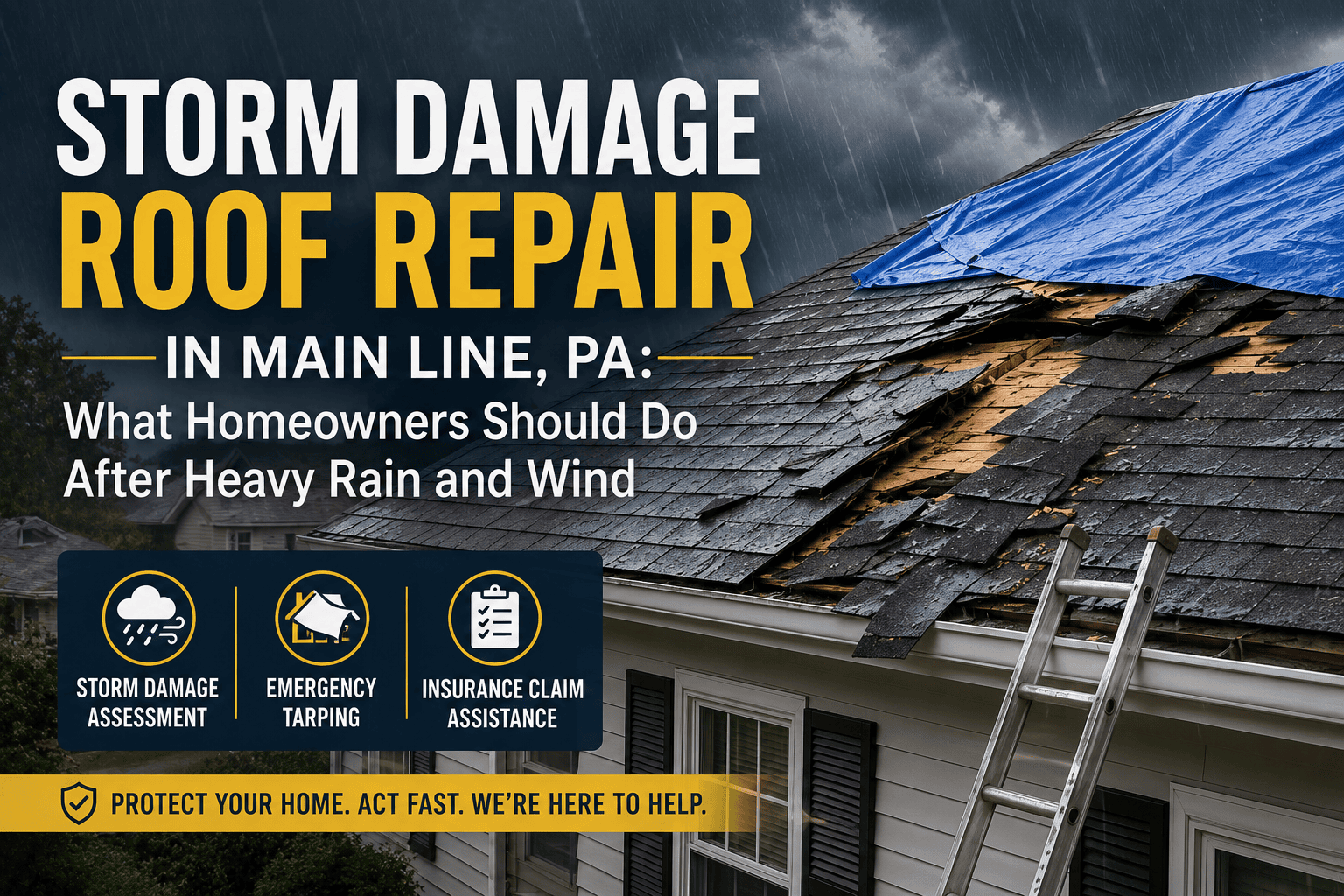
Summer 2026 has already brought several significant storm events across Chester, Delaware, and Montgomery Counties. On the Main Line, storm-related roof damage is a common concern for homeowners after heavy rain and high winds. In late June alone, a severe thunderstorm system tracked across Delaware County, producing wind gusts above 60 miles per hour, quarter-size hail, and two inches of rainfall in under an hour. This guide talks about storm roof damage Main Line.
Call 610-896-6388 for emergency response or visit our contact page to schedule an appointment with us.
What happens in the hours and days following a roof-damaging storm determines whether you end up with a manageable repair or a significantly more expensive remediation project. Water that enters through a storm-damaged roof does not wait for a convenient appointment time. It begins infiltrating insulation, attic decking, ceiling drywall, and eventually wall framing within hours of exposure. A properly installed emergency tarp from a qualified contractor can stop that clock. A homeowner who waits two weeks to schedule an inspection often finds that what started as a shingle repair has escalated into decking replacement and interior restoration.
This guide covers everything Main Line homeowners need to know about storm damage roof repair after heavy rain and high wind events: what to do in the immediate aftermath, how to identify damage you cannot see from the ground, how to document for insurance, when temporary tarping is the right call, and what separates a legitimate storm restoration contractor from the storm-chasing crews that descend on affected neighborhoods after every major weather event.
Hynes Construction provides emergency roof repair and storm damage services throughout the Main Line. We are a GAF Master Elite certified roofing contractor with over 50 years of experience serving Chester, Delaware, and Montgomery Counties.
Why Storm Damage on Main Line Roofs Is Often Invisible from the Ground
The most dangerous thing about storm roof damage is how frequently it looks minor or even invisible from street level. A homeowner who walks around the property after a storm and sees no obvious missing shingles may conclude the roof came through without significant damage. That conclusion is often wrong.
Wind does not need to remove a shingle to compromise it. A gust that peaks at 65 miles per hour can lift a shingle tab just enough to break the seal strip bond that holds it flat, then allow it to fall back into position. The shingle looks intact. The granule surface looks intact. But the seal is gone. During the next rain event, wind-driven water gets under that unsealed tab and begins moving laterally across the underlayment, finding nail holes, seam edges, and any weak point in the secondary water barrier.
Hail damage is similarly deceptive. Quarter-size hail leaves circular impact craters on shingle granule surfaces that are invisible from 20 feet below on a sloped roof. But each impact displaces granules, exposing the underlying asphalt mat to direct UV and moisture. A roof that absorbed significant hail impact in June will show accelerated aging and increased leak vulnerability through the balance of the year, even though it looks fine from the driveway.
Flashing failure is the third most common hidden damage type. The metal flashing at chimney bases, pipe boots, roof valleys, and wall-to-roof intersections is the most vulnerable point on any roof to wind-driven rain infiltration. A storm with sustained high winds and heavy rainfall can push water past flashing that is perfectly adequate in normal conditions, and that water entry point may produce interior staining weeks later when the homeowner has already assumed no storm damage occurred.
The First Six Hours After a Storm: Priority Actions for Main Line Homeowners
Step 1: Stay Off the Roof and Prioritize Personal Safety
No assessment is worth the personal risk of accessing a wet roof after a storm. Wet roofing surfaces are extremely slippery, and storm-compromised structural elements may not support additional loading. Assess from the ground using binoculars. Document what you can see from safe ground positions. Do not climb a ladder to the roof until conditions are fully dry and a professional has confirmed the structure is safe to access.
If water is entering through the ceiling and approaching electrical fixtures, turn off the circuit breaker for the affected area before placing any containers beneath the drip points. Do not touch light fixtures, ceiling fans, or electrical components near active water intrusion.
Step 2: Document the Damage Before Touching Anything
Your smartphone is your most important tool in the immediate aftermath of storm damage. Before moving debris, before placing tarps, before any contractor arrives: photograph and video the current state of damage from multiple ground positions. Capture overall roof elevations from all four sides. Photograph any material that has come off the roof and landed in the yard. Document interior water entry points, including ceiling stains, active drip points, and any related damage to furniture or flooring. Note the exact date and time of the storm event.
Time-stamp your documentation and save any NOAA weather service alerts, news coverage, or weather radar screenshots from the storm date. Insurance carriers require damage to be tied to a specific, verifiable weather event. This documentation is the foundation of your claim, and it cannot be reconstructed after cleanup has begun.
Step 3: Stop Active Interior Water Entry
If water is actively entering through the ceiling, place buckets, pots, or containers under active drip points. Move furniture and valuables away from water intrusion areas. Protect flooring with plastic sheeting or towels. Roll rugs away from water paths to prevent saturation. If safe attic access is available and the attic is accessible, place containers under active drip points at the roof deck level to capture water before it reaches the ceiling drywall below.
Step 4: Call a Roofing Contractor Before Calling Your Insurance Company
This sequencing surprises many homeowners but produces significantly better insurance claim outcomes. A licensed roofing contractor who arrives before the adjuster provides two critical elements: a professional written assessment that ties specific damage to the storm event and emergency tarping to prevent secondary damage accumulation while the claim is processed. An adjuster evaluating a claim without professional contractor documentation is working with less information. An adjuster evaluating a claim alongside a detailed contractor storm assessment is far more likely to process the claim accurately and completely.
Hynes Construction responds to emergency roof repair calls across the Main Line and provides storm damage documentation that meets insurance adjuster standards. Our insurance claims assistance covers our full process for working with carriers.
Storm damage to your roof? Call Hynes Construction at 610-896-6388 for emergency inspection and tarping across the Main Line. GAF Master Elite certified. Serving Chester, Delaware, and Montgomery Counties since the 1970s.
Types of Storm Roof Damage on the Main Line: What to Look For and What Each Requires
Missing or Displaced Shingles from Wind Uplift
Wind damage to asphalt shingles occurs when sustained gusts exceed the shingle’s wind resistance rating. Standard three-tab shingles are typically rated to 60 to 70 miles per hour. Architectural shingles are rated to 110 to 130 miles per hour, depending on the product. A nor’easter or severe summer squall that produces sustained gusts above these thresholds will lift and sometimes completely remove shingles, particularly at roof edges, ridgelines, and any area where previous seal strip degradation had already reduced adhesion.
Missing shingles expose the underlayment and, in severe cases, the roof decking to direct rainfall. This is a true emergency condition. A section of exposed decking that goes through a rain event without protection will show early-stage deterioration within days during summer conditions. Emergency tarping is the immediate priority, followed by shingle replacement from a qualified contractor.
For the full breakdown of wind versus hail damage documentation for insurance purposes, see our guide on hail damage vs wind damage on Main Line roofs and what to document before filing a claim.
Hail Impact Damage: Granule Loss and Surface Bruising
Hail damage on the Main Line most commonly affects asphalt shingles in the form of granule displacement. Each hail impact removes granules from a roughly circular area corresponding to the hailstone size. On a roof that received quarter-size hail across an entire roof surface, this impact pattern is repeated hundreds or thousands of times per roofing square, creating a consistent pattern of granule loss that is verifiable and documentable for insurance purposes.
The practical consequence of hail-induced granule loss is accelerated UV aging of the exposed asphalt mat. A shingle that loses 20 to 30 percent of its granule coverage in a single hail event will reach functional end-of-life significantly faster than the same shingle’s rated lifespan. A professional hail damage assessment documents this granule loss pattern, correlates it with hail size data from the storm event, and provides the insurance adjuster with the documentation needed to process a legitimate replacement claim.
Our dedicated hail damage roof repair and insurance claim guide covers hail documentation in detail and walks through the full insurance process for Main Line homeowners.
Tree Impact and Debris Puncture
Direct tree or branch impact is the most visually dramatic category of storm roof damage and typically the most structurally serious. Large branches that contact a roof at speed can break rafters, crack ridge boards, punch through decking and sheathing, and displace roofing materials over a significant area. Any tree or large branch resting on a roof should be treated as a structural unknown until a contractor has assessed the underlying framing condition.
Do not attempt to remove large debris from a roof without professional assistance. The weight and position of a fallen tree or large branch may be contributing to the structural stability of the roof in the short term. Removing it without properly supporting the affected structure can cause additional collapse or displacement. Call a contractor who coordinates both the debris removal and the structural assessment as a single scope.
Flashing Failure at Chimneys, Skylights, and Valleys
Flashing is the thin metal system that manages water at every transition, penetration, and directional change on a roof. Chimney flashing, skylight flashing, pipe boot flashing, and valley flashing are all designed to function adequately under normal rainfall. Under the conditions produced by a significant storm, including wind-driven rain, sustained high water volumes in valleys, and physical uplift forces, flashing that was marginal in normal conditions can fail.
Flashing-related storm leaks are particularly frustrating because they often manifest as ceiling stains in locations that are not directly beneath the visible roof surface. Water that enters at a chimney base can travel several feet along a rafter or along the ceiling drywall before appearing as an interior stain. This distance between the entry point and the visible symptom is one of the most common reasons homeowners misidentify the source of a storm-related roof leak. Our chimney repair and flashing services cover this specific issue in detail.
Emergency Tarping: When It Is Necessary and How It Works
Emergency tarping is the installation of a heavy-duty reinforced tarp over a damaged or exposed roof section to stop additional water entry while permanent repair is planned and scheduled. It is the most important immediate protective action available after storm damage exposes the roof structure to the sky.
A properly installed emergency tarp is secured to the roof deck using cap strips or sandbags rather than penetrating fasteners that would create additional leak points in the roofing system. The tarp should overlap undamaged roofing by a minimum of four feet on all sides to ensure adequate water shedding. Edges at ridgelines should be folded over the ridge and secured on the opposite slope. A tarp installed correctly can stop water infiltration for two to four weeks, providing adequate time for permanent repair planning and insurance processing.
A tarp improperly installed, particularly one that is stapled or nailed directly through the damaged roofing without adequate overlap, can itself become a source of additional damage. Hynes Construction installs heavy-duty emergency tarps as part of our storm response service, included as part of the project scope when the permanent repair follows.
Filing a Storm Roof Damage Insurance Claim: The Main Line Process
Pennsylvania homeowners’ insurance policies typically cover sudden and accidental storm damage from wind, hail, and falling trees or branches. Understanding the claim process and the documentation requirements prevents claim denials and ensures that the full scope of legitimate damage is covered:
- File promptly: Most Pennsylvania policies require storm damage claims within one year of the event. Filing within days of the storm preserves your claim position and prevents questions about why the claim was delayed.
- Document the storm event independently: Weather service archives, NWS storm reports, and local news coverage from the storm date provide independent verification of the event. Your contractor can help identify the relevant weather data for your area.
- Separate storm damage from pre-existing conditions: Insurance adjusters specifically evaluate whether documented damage existed before the storm event. A written professional assessment that clearly attributes specific damage to the storm rather than to pre-existing wear is essential for complete claim processing.
- Know your coverage type: Replacement cost value (RCV) coverage pays for new materials and labor to restore the roof. Actual cash value (ACV) coverage pays the depreciated value of damaged materials. On a 15-year-old shingle roof, ACV may pay a fraction of the actual repair or replacement cost. Review your policy type before assuming what you will receive.
Hynes Construction coordinates directly with insurance adjusters on Main Line storm claims. Our insurance claims page explains our documentation process and how we work with carriers to ensure complete and accurate claim processing.
Storm Damage Roof Repair vs Roof Replacement: Making the Right Decision
After a significant storm event, one of the most consequential decisions a Main Line homeowner faces is whether the damage warrants targeted repair or full roof replacement. The decision depends on several factors that are best assessed by an experienced contractor:
- Roof age: A 10-year-old roof with localized storm damage is a repair candidate. A 22-year-old roof where storm damage reveals underlying widespread granule loss, dried-out sealant, and brittle shingles is often better replaced. The storm may have revealed an end-of-life condition that existed before the storm.
- Damage extent: Damage confined to one roof section or elevation may be efficiently repaired. Damage affecting multiple roof planes or the full roof surface from a significant hail event often justifies replacement, particularly when the insurance settlement covers it.
- Insurance settlement: When a properly documented insurance claim produces an RCV settlement covering full roof replacement, replacement is almost always the more economical choice over targeted repair that leaves aging materials elsewhere on the roof.
Our guide on roof replacement vs repair for Main Line homeowners covers the decision factors in detail. Current replacement cost data for the Main Line market is in our roof replacement cost guide for 2026.
How to Choose a Storm Damage Roofing Contractor on the Main Line
Every significant storm event brings contractors from outside the region who move quickly through affected neighborhoods, offering fast estimates and immediate starts. These storm-chasing contractors operate on the volume and speed of the immediate aftermath rather than on the quality and community accountability of an established local presence. Protecting yourself requires knowing what to look for:
- Verify Pennsylvania Home Improvement Contractor license: Required by law. Verify the license number through the PA Attorney General’s website.
- Require current certificates of insurance: General liability and workers’ compensation both must be active. Request certificates naming you as an additional insured.
- Never sign an Assignment of Benefits (AOB): An AOB transfers your insurance claim rights to the contractor. It is a significant legal and financial risk. A legitimate contractor works alongside your claim process without requiring you to sign over your rights.
- Get written estimates before signing anything: Any contractor who pressures immediate signing without a written scope and estimate is a warning sign regardless of the circumstances.
Hynes Construction has served the Main Line community for more than 50 years. We hold GAF Master Elite certification, carry all applicable Pennsylvania licenses, and have established relationships with every major insurance carrier active in this market. Our certifications and affiliations page details our professional standing. See recent storm response work on Facebook and Instagram.
Need a storm damage roof inspection on the Main Line? Call 610-896-6388. Hynes Construction provides written damage assessments for insurance claims, emergency tarping, and complete roof repair and replacement. No pressure, no obligation.
Frequently Asked Questions
How soon after a storm should I have my roof inspected in Chester or Delaware County?
Within 24 to 48 hours for any visible damage or active interior water entry. Within three to five business days for any significant storm event, even if no obvious damage is visible from the ground. Wind damage that breaks seal strips and hail damage that displaces granules are frequently invisible from street level and only identifiable through a professional close-up inspection. Waiting longer risks secondary damage from subsequent rain events entering through compromised areas that have not yet been identified or temporarily protected.
Standard Pennsylvania homeowners insurance policies cover sudden and accidental storm damage from wind, hail, and falling trees or branches. Gradual wear, maintenance neglect, and pre-existing conditions are excluded. To maximize your claim outcome, document the damage before any cleanup or repair, call a licensed contractor before the adjuster for a professional damage assessment, and file promptly. Hynes Construction provides written storm damage assessments that meet the documentation standards of all major insurance carriers active in the Main Line market.
What is the difference between wind damage and hail damage on an asphalt shingle roof?
Wind damage typically presents as lifted, creased, or missing shingles, particularly at roof edges, ridgelines, and tab edges where seal strips have failed. The damage pattern follows the direction and intensity of the wind event. Hail damage presents as circular impact craters with granule displacement across the full exposed surface of elevations facing the storm direction, creating a consistent pattern rather than the directional pattern of wind damage. Both are covered under standard storm insurance policies but are documented and assessed differently. Our guide on hail vs. wind damage documentation covers this distinction in detail.
How long does emergency tarping last after storm damage?
A properly installed heavy-duty reinforced tarp secured with cap strips or sandbags and with adequate overlap onto undamaged roofing can protect an exposed area for two to four weeks under normal weather conditions. A tarp that is improperly installed, without adequate overlap or with edges that can be caught by wind, may fail within days. Hynes Construction installs tarps to professional standards as part of our storm response service.
Can I claim storm damage on a roof that is more than 20 years old?
Yes. Insurance coverage is not restricted based on roof age, though coverage type matters. RCV coverage pays to restore the roof to its pre-storm condition using new materials. ACV coverage pays the depreciated value, which for a 20-year-old roof may be a fraction of the repair cost. Review your policy type. Additionally, an experienced contractor’s assessment can help distinguish storm-caused damage from pre-existing wear, which is important for any roof approaching the end of its life.
Is it safe to stay in my home after storm damage to the roof?
It depends on the extent of the damage. Active water intrusion near electrical components, sagging ceiling areas indicating significant water accumulation behind drywall, or any visible structural compromise of the roof framing are conditions that warrant evacuating the affected area of the home until a professional assessment is made. For limited shingle damage with no active interior water entry, staying in the home is typically safe while waiting for inspection and repair scheduling.
What roofing materials hold up best to storm damage on the Main Line?
Architectural impact-resistant asphalt shingles rated at Class 3 or Class 4 impact resistance provide significantly better hail resistance than standard shingles and can qualify for insurance premium discounts in some Pennsylvania policies. Metal roofing holds up well to wind and hail but is a more significant investment. Slate and tile are durable under most storm conditions but can crack from very large hail. Our shingle roofing page and metal roofing page cover the specific products and their performance characteristics in Pennsylvania conditions.
How do I know if a tree impact damaged the roof structure or just the shingles?
A professional structural assessment after any significant tree impact is the only reliable way to determine whether framing has been compromised. From below, signs of structural damage include visible daylight through the decking when viewed from the attic, cracked or displaced rafters visible from the attic, or any sagging of the roof surface from the exterior. Any significant impact that has punched through shingles and decking must be assumed to have affected framing until proven otherwise by a qualified contractor.
Should I attempt temporary roof repairs myself after storm damage?
For minor temporary measures such as placing a tarp over obvious openings from accessible positions with appropriate safety equipment, a careful homeowner can stop immediate water entry. DIY tarping attempts often fail to provide adequate coverage or are not secured against wind, creating additional problems. For anything involving roof surface access, especially on steep or storm-compromised roofs, professional emergency response is the safer and typically more effective approach. The cost of professional tarping is generally covered under storm insurance claims.
How does Hynes Construction document storm damage for insurance claims on the Main Line?
Our storm damage assessment process includes close-up photography of all damage types with measurements, a written description of each damaged area and the storm mechanism responsible, correlation with available weather data from the storm event, and a written estimate covering the full scope of repair or replacement required. This documentation is formatted to meet the requirements of all major insurance adjusters active in the Chester and Delaware County market. We can be present during adjuster inspections to answer technical questions about the documented damage.
We serve homeowners in Ardmore, Wayne, Bryn Mawr, Havertown, Villanova, Radnor, Springfield, and throughout Chester, Delaware, and Montgomery Counties.
Call 610-896-6388 or use our contact page to schedule an appointment with Hynes Construction.

(President, Hynes Roofing and Siding)
With over 35 years experience in the roofing and siding industry, Michelle Hynes has built a business from 2 people into over 45 people and 19 trucks!