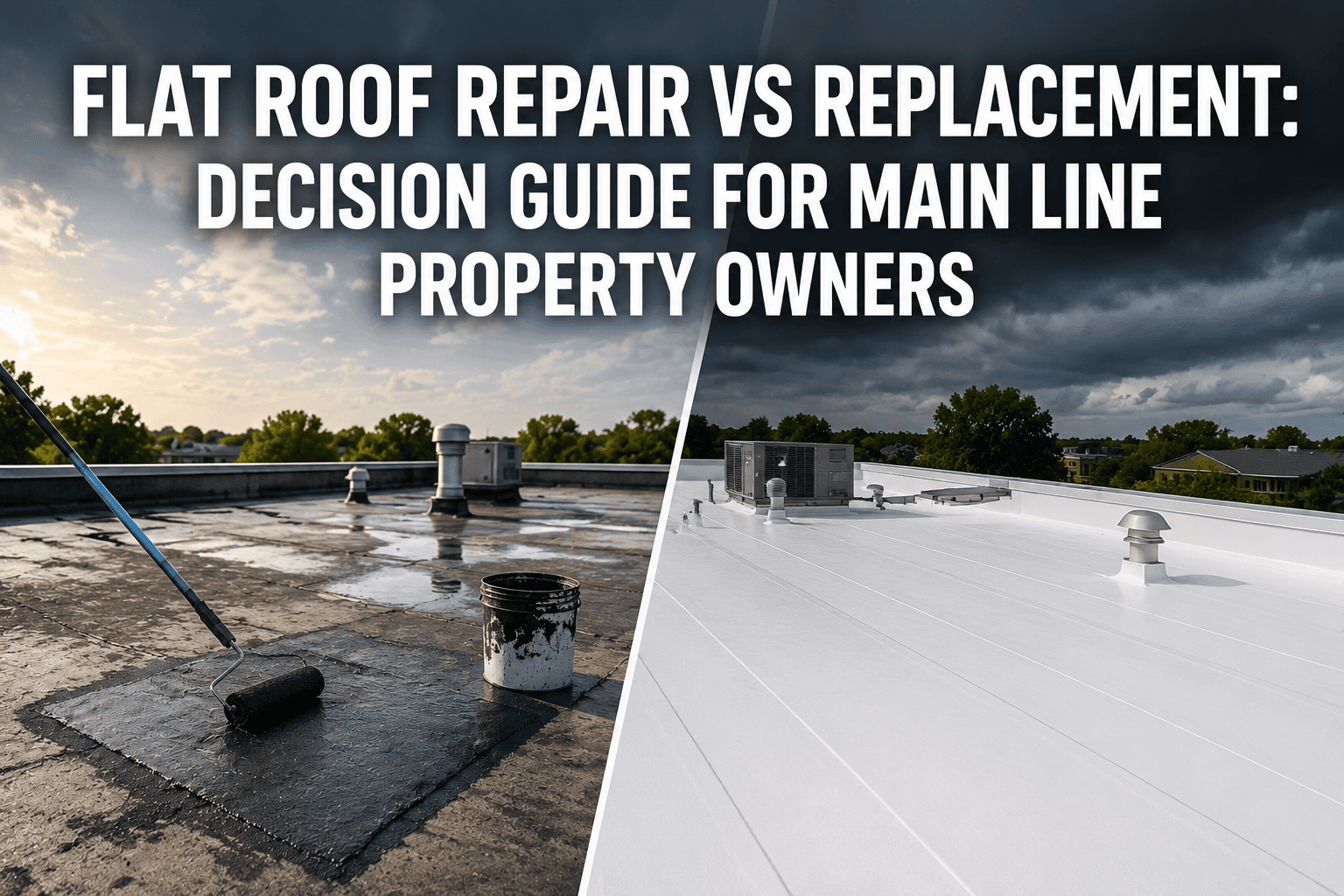
Flat roofing systems represent a specialized engineering challenge for commercial and residential property owners across the Main Line, Delaware County, Montgomery County, Chester County, and Philadelphia. Unlike traditional sloped asphalt shingle roofs that shed water rapidly via gravity, low-slope and flat roofing systems rely on specialized membranes, precise drainage slopes, and flawless waterproof seams to manage rainwater. When leaks, pooling water, or aging membrane degradation occur, property owners face a critical financial and structural decision: should they invest in targeted repairs or commit to a complete system overhaul? Evaluating the complex dynamics of flat roof repair vs replacement is essential to protecting your property value and long-term operating budget.
Flat Roof Consultation Offer
Dealing with flat roof leaks, pooling water, or membrane aging? Before making a decision, allow Hynes Construction to inspect your low-slope roof and provide professional recommendations. Our experienced team assists property owners throughout the Main Line, Delaware County, Montgomery County, and surrounding Pennsylvania communities. Call Hynes Construction today at 610-896-6388 for a professional flat roof assessment.
Property owners residing throughout Ardmore, Wayne, Bryn Mawr, Villanova, Haverford, Narberth, and surrounding suburban communities encounter diverse environmental stressors, from torrential summer downpours to heavy winter snow loads. Understanding the signs of membrane failure, analyzing repair versus replacement economics, and partnering with experienced local commercial and residential roofing specialists ensures your flat roof remains watertight and structurally sound. This comprehensive guide provides expert insights to help you make an informed, confident decision for your property.
Flat Roof Repair vs Replacement: Understanding Your Options
Evaluating whether to repair or replace a low-slope roofing system requires a comprehensive understanding of flat roof mechanics and material lifecycles. Flat roofs require specialized maintenance and structural design because they do not shed water as quickly as pitched roofs. When minor punctures, seam separations, or blistering occur, prompt intervention can extend the functional lifespan of the roof significantly.
However, when membrane degradation is widespread, insulation is saturated with trapped moisture, or the roof has exceeded its design lifespan, continuous repairs become a costly cycle of diminishing returns. Understanding the fundamental trade-offs involved in flat roof repair vs replacement allows property owners to optimize their capital expenditures. Factors such as roof age, percentage of damaged surface area, frequency of past leaks, and overall structural integrity dictate the most cost-effective and structurally sound path forward.
Common Flat Roof Problems Main Line Property Owners’ Experience
Flat and low-slope roofing systems are subject to unique environmental and structural vulnerabilities due to their horizontal design. Property owners across the Delaware Valley frequently encounter specific challenges that require professional attention.
The most prevalent issue is standing water, commonly known as “ponding.” When roof decks lack adequate slope or structural drainage, rainwater forms standing puddles that persist for forty-eight hours or longer following a storm. The intense weight of ponding water accelerates membrane degradation, weakens structural decking, and invites mosquito breeding. Other frequent problems include membrane shrinkage, thermal cracking, split seams in modified bitumen, EPDM (rubber), and TPO systems, and deteriorated flashing around roof penetrations such as HVAC units, skylights, and scuppers. Identifying these issues early through a professional flat roof inspection prevents minor surface wear from evolving into catastrophic interior water damage. Conducting a scheduled professional flat roof inspection identifies standing water, seam separation, and flashing deterioration before leaks occur.
When Is Flat Roof Repair the Right Choice?
Not every flat roof leak or membrane imperfection necessitates a total tear-off and replacement. In many scenarios, targeted repairs provide an economically efficient and durable solution that restores complete weather protection.
Flat roof repair is generally the ideal choice when damage is localized, isolated, and recent. For instance, if a fallen tree branch punctures a single section of EPDM rubber membrane or if flashing around a rooftop exhaust vent develops a localized leak, professional technicians can execute precise patching, re-sealing, or flashing reconstruction. Furthermore, if a roof is relatively young (under ten years old) and possesses a sound structural substrate, routine maintenance and minor flat roof leak repair will restore optimal performance at a fraction of the cost of total replacement. To evaluate repair frequencies and maintenance schedules, property owners should review expert guidance on how often should you reseal a flat roof. Executing timely flat roof leak repair prevents localized punctures from saturating insulation layers beneath the membrane.
When Must You Choose Flat Roof Replacement?
While repairs are effective for isolated damage, there comes a point in every flat roof’s lifecycle where patching is no longer viable. Attempting to repair a severely compromised, aging roof is akin to throwing good money after bad.
Property owners must seriously consider a complete system overhaul when encountering severe roof replacement signs, such as widespread membrane blistering, extensive cracking, severe shrinkage pulling flashings away from parapet walls, and saturated underlying insulation. When core samples reveal that moisture has infiltrated multiple layers of insulation and compromised the wooden or steel roof deck beneath, total replacement is mandatory to prevent structural collapse and chronic mold growth. For detailed financial insights into replacement costs, review comprehensive data on how much does it cost to replace a flat roof to plan your capital budget accurately. Monitoring your property for critical roof replacement signs protects commercial and residential buildings against catastrophic structural failure.
The Importance of Professional Flat Roof Inspections
Flat roofs are notoriously difficult to evaluate from ground level, and walking across low-slope membranes without professional training can cause unintentional damage or overlook hidden structural defects.
Scheduling regular, thorough inspections by certified commercial and residential roofing experts is essential. Professional flat roof evaluations involve checking seam integrity, testing membrane elasticity, inspecting drainage scuppers and internal roof drains, and utilizing non-invasive moisture meters to detect trapped water within insulation layers. For further reading on the value of expert assessments, review professional insights on professional roof inspection after storm damage to understand how comprehensive evaluations protect your property investment. Partnering with specialists ensures you receive objective data before making major capital decisions.
Economic Analysis: Repair Costs vs Replacement Investment
When property owners face roofing decisions, cost is inevitably a primary consideration. Analyzing the short-term savings of recurring repairs versus the long-term investment of a total replacement requires careful financial calculation.
Investing in minor flat roof repair Main Line PA services is highly cost-effective for young, structurally sound roofs experiencing isolated wear. However, if you find yourself paying for emergency patches multiple times a year, the cumulative cost of ongoing repairs quickly surpasses the investment in a new, high-performance roof system. Furthermore, modern energy-efficient roofing membranes—such as white TPO or reflective modified bitumen—drastically reduce summer cooling costs, providing ongoing utility savings that offset the initial flat roof replacement cost Pennsylvania over time. Professional flat roof repair Main Line PA services resolve localized leaks quickly and affordably. Evaluating the long-term flat roof replacement cost Pennsylvania helps property owners budget for energy-efficient commercial roofing systems.
Commercial Flat Roof Repair and Maintenance Strategies
For commercial property owners, apartment building managers, and industrial facility operators across Philadelphia and surrounding suburban counties, a failing roof directly threatens business operations, tenant satisfaction, and valuable inventory.
Implementing a proactive commercial roofing strategy involves establishing routine maintenance agreements with experienced local contractors. Scheduled biannual inspections, immediate removal of autumn leaves and debris from drainage scuppers, and prompt commercial flat roof repair intervention minimize unexpected disruptions. Maintaining a comprehensive facility maintenance log also supports property valuations and satisfies warranty requirements set by membrane manufacturers. To maintain overall structural resilience, integrate proactive strategies from roof maintenance guide for homeowners into your facility management protocols. Reliable commercial flat roof repair services minimize operational downtime for businesses across the Philadelphia metropolitan area.
Modern Flat Roofing Materials: EPDM, TPO, and Modified Bitumen
When property owners decide to proceed with a complete system replacement, selecting the right roofing membrane is critical to achieving maximum durability and energy efficiency. Modern low-slope architecture offers several advanced material options.
- EPDM (Ethylene Propylene Diene Termonomer): A durable, synthetic rubber membrane known for exceptional weather resistance, longevity, and ease of maintenance.
- TPO (Thermoplastic Polyolefin): A single-ply reflective membrane featuring heat-welded seams that offer superior puncture resistance and outstanding energy efficiency by deflecting solar radiation.
- Modified Bitumen: A robust, multi-ply asphalt-based system reinforced with fiberglass or polyester, providing exceptional tensile strength and durability for high-traffic flat roofs.
Understanding these material options allows property owners to choose the system that best aligns with their architectural requirements and budget. For insights into installation procedures, review detailed explanations of the roof replacement process.
Addressing Storm Damage and Insurance Claims on Flat Roofs
Flat roofs are equally vulnerable to severe weather events, including high winds, heavy hail, and torrential downpours. When severe storms strike the Main Line, low-slope membranes can suffer wind uplift tears, puncturing hail impacts, and flashing failures.
Navigating insurance claims for commercial or residential flat roofs requires meticulous documentation and professional advocacy. Partnering with experienced contractors who specialize in insurance restoration ensures that all storm-related trauma is accurately recorded and presented to insurance adjusters. Addressing storm damage promptly prevents minor wind and hail impacts from escalating into chronic interior leaks and structural decay. Furthermore, reviewing expert recommendations on common roofing problems helps property owners identify developing vulnerabilities early.
Partnering With Expert Flat Roofing Contractors in Pennsylvania
Executing successful flat roof repairs or complete system replacements requires specialized engineering knowledge, precise thermal welding techniques, and strict adherence to local building codes. Attempting low-slope roofing projects without professional expertise often results in chronic leaks, voided warranties, and structural failure.
Property owners across Main Line, Ardmore, Wayne, Bryn Mawr, Villanova, Narberth, Delaware County, and Montgomery County trust Hynes Construction for exceptional craftsmanship and reliable commercial and residential roofing solutions. From comprehensive flat roof assessments to flawless membrane installations, partnering with experienced local professionals guarantees long-term peace of mind and impenetrable weather defense.
Expert Flat Roof Solutions in the Main Line
Whether your flat roof requires targeted leak repairs or a complete system replacement, Hynes Construction delivers superior craftsmanship and reliable results. Call 610-896-6388 today to schedule your professional flat roof consultation.
Frequently Asked Questions
How do I know if my flat roof needs repairs or a complete replacement?
Localized damage on a young roof usually requires repairs, whereas widespread blistering, saturated insulation, and aging membranes necessitate total replacement.
What causes standing water (ponding) on flat roofs, and how is it fixed?
Ponding is caused by inadequate roof slope or blocked drainage; it is resolved by installing tapered insulation systems, crickets, or clearing drainage scuppers.
How long do modern flat roofing systems typically last?
Depending on the material, such as EPDM, TPO, or modified bitumen, and proper maintenance, modern flat roofs generally last between twenty and thirty years.
Can a flat roof be repaired during the winter months in Pennsylvania?
Yes, professional roofing contractors can execute emergency flat roof repairs during winter using specialized cold-applied adhesives and weather-appropriate techniques.
What is the most energy-efficient flat roofing membrane available?
White reflective TPO membranes are widely recognized for superior energy efficiency, as they deflect solar radiation and reduce summer cooling loads.
How often should commercial and residential flat roofs be inspected?
Flat roofs should be professionally inspected at least twice a year in the spring and fall, as well as immediately following severe regional storms.
Does homeowners or commercial property insurance cover flat roof leaks?
Insurance covers sudden, accidental storm damage (like wind or hail), but leaks caused by normal wear, aging, or deferred maintenance are excluded.
What are the primary signs of flashing failure on a flat roof?
Key indicators include water stains near roof penetrations, cracked caulking, rusted metal step flashing, and gaps along parapet wall interfaces.
How long does a complete flat roof replacement take to complete?
A standard flat roof replacement typically takes between two to five days, depending on project scale, weather conditions, and structural complexity.
Who should I call for flat roof repair or replacement in the Main Line?
Hynes Construction provides expert commercial and residential flat roofing inspections, repairs, and installations across the Main Line and surrounding Pennsylvania counties.
At Hynes Construction, we believe homeowners should have access to reliable information before making important decisions about their homes. Follow us on Facebook and Instagram to see recent roofing projects, storm restoration updates, homeowner tips, and exterior improvement ideas from our team serving the Main Line and surrounding Pennsylvania communities. Stay connected with Hynes Construction:

(President, Hynes Roofing and Siding)
With over 35 years experience in the roofing and siding industry, Michelle Hynes has built a business from 2 people into over 45 people and 19 trucks!