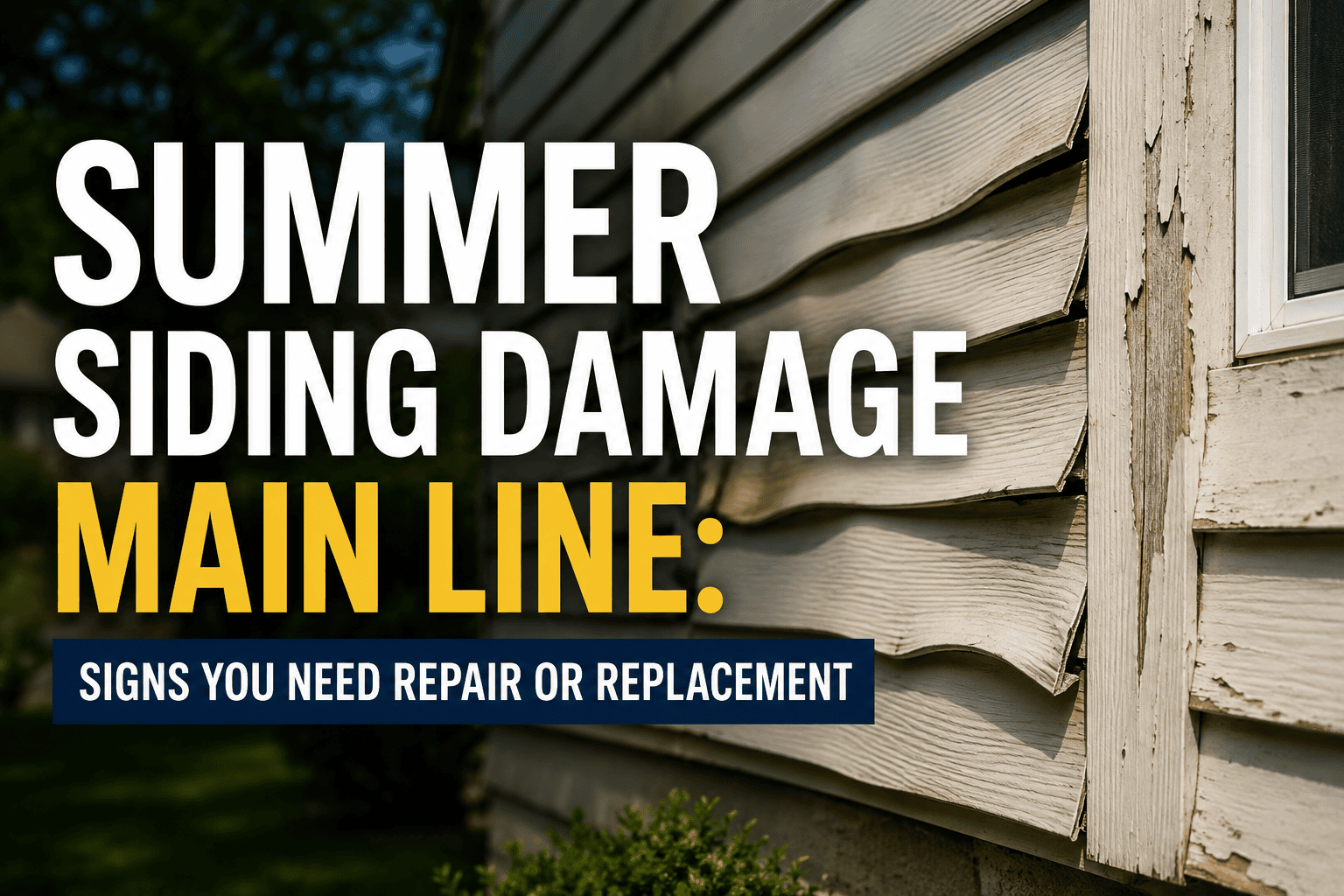
Every summer, Main Line homeowners face the same recurring issue: siding that performed well through spring begins showing signs of stress under intense heat and humidity. Rising July temperatures frequently reach the 90s, and Philadelphia-area humidity often exceeds 80 percent, creating the perfect conditions for summer siding damage Main Line. Vinyl panels that were flat in May may buckle by late June, wood trim that fit snugly in spring can start to pull away from walls, and paint on wood or fiber cement siding may blister on south- and west-facing elevations. Recognizing these early signs is crucial to prevent more extensive damage and costly repairs later in the season.
Call 610-896-6388 or visit our contact page for a free in-home assessment.
These are not random failures. They are predictable responses to the specific thermal and moisture stress cycle that Main Line homes experience every summer, and they are warning signs that indicate the current siding condition cannot adequately protect the wall assembly behind it. In many cases, summer heat and humidity are not the original cause of the damage. They are the condition that makes existing damage visible by amplifying dimensional movement, driving moisture into compromised joints, and accelerating the surface degradation processes that have been building since the last major freeze-thaw winter.
This guide covers the specific signs of heat and humidity-related siding damage on Main Line homes in 2026, what each sign indicates about the underlying condition, when repair addresses the problem, and when replacement is the more appropriate and economical long-term response. Hynes Construction installs and repairs all major siding types throughout the Main Line. Our siding service page covers our full capabilities.
The Main Line sits in what climate scientists classify as a humid continental transition zone. This means summers that consistently produce 85 to 95 degree Fahrenheit temperatures combined with 70 to 90 percent relative humidity, particularly in the afternoon hours of July and August. This specific combination creates more stress on exterior siding materials than either heat or humidity alone.
Thermal Expansion on South and West-Facing Elevations
Siding materials expand as they heat and contract as they cool. The south and west-facing elevations of a Main Line home receive direct afternoon sun during the peak heat hours of 2 PM to 6 PM and can see surface temperatures 40 to 60 degrees Fahrenheit above the air temperature in direct sunlight. A south-facing vinyl panel in the afternoon sun in July may reach 150 to 160 degrees Fahrenheit at its surface while the air temperature is 92 degrees.
At these temperatures, vinyl siding expands along its full length. If the panel is properly installed with the expansion gaps that vinyl installation standards require at every cut end and penetration point, it accommodates this expansion without distortion. If the panel was installed without adequate expansion clearance, which is an extremely common installation error on vinyl siding installed across the Main Line in the 1990s and 2000s, the expanding panel has nowhere to go, and buckling at the panel face is the result. This buckling is permanent: even when the temperature drops, a panel that has exceeded its elastic limit will not return to its original geometry.
Moisture Drive and Joint Failure in Humid Conditions
High outdoor humidity combined with air-conditioned interior spaces creates a moisture-driven condition at the wall assembly. Humid outdoor air is pushed through any gap in the exterior cladding toward the relatively drier, cooler interior. For siding that has developed gaps at joints, around window trim, or at panel ends, this moisture drive moves humid air directly into the wall cavity. In older Main Line homes where the house wrap or building paper behind the siding may have aged and lost its air barrier effectiveness, this moisture movement reaches the wood framing and sheathing directly.
The practical consequence is wall cavities that accumulate moisture through the summer months, creating conditions for mold growth in the sheathing and framing during the hottest and most humid weeks of the year. This internal wall moisture is typically invisible from both the interior and exterior until it becomes severe enough to produce interior staining or musty odors.
The Eight Specific Signs of Heat and Humidity Siding Damage on the Main Line
Sign 1: Visible Buckling or Rippling on South and West-Facing Vinyl Panels
Vinyl panels that show visible waviness, rippling, or lateral buckling on south and west-facing elevations are experiencing thermal expansion beyond the accommodation capacity of their installation. This is the most visible and common summer heat-related siding problem on Main Line homes with vinyl siding installed more than 10 years ago. Mild buckling in a narrow band of panels at the elevation most exposed to afternoon sun is an installation deficiency that may be addressable through re-installation of the specific panels with proper expansion clearance. Widespread buckling across multiple elevations on older vinyl siding typically indicates that the material has aged past the point where the thermal cycling characteristics of Pennsylvania summers can be adequately managed.
Vinyl siding that buckles in summer heat also becomes increasingly brittle as UV stabilizers deplete with age. Panels that buckle in summer can crack in winter when temperatures drop below 10 degrees Fahrenheit and the material has lost its impact flexibility.
Sign 2: Gaps at Panel Joints and Corners That Were Not Present Last Fall
Gaps that develop at panel end joints, corner posts, and trim intersections during summer heat are evidence of thermal expansion that exceeded the original installation clearances. Unlike buckling, which is a permanent deformation, gaps that open during summer heat and partially close in cooler temperatures indicate a siding system that is managing expansion at the limit of its capacity. These gaps may self-correct somewhat through the year, but they allow moisture infiltration during the humid summer months and will progressively worsen with each summer cycle as the material ages.
The most problematic gap locations are at window and door trim intersections, where caulk that has been stretched through multiple expansion cycles eventually separates from one or both surfaces. Failed caulk at window and door trim allows summer moisture to drive humid air directly into the rough opening framing, where it contacts the wood framing that is most vulnerable to moisture damage.
Sign 3: Paint Blistering or Peeling on Wood or Fiber Cement Siding
Paint blistering on wood or fiber cement siding during summer is a moisture-related failure rather than a heat failure in most cases. Blistering occurs when moisture migrating through the wall assembly from inside pushes against the paint film from behind, or when moisture has penetrated behind the paint film through micro-cracks in the surface and then vaporizes when the panel surface heats in direct sun. The resulting steam pressure creates blisters in the paint film.
On wood siding, paint blistering indicates that the wood is absorbing and releasing moisture at a rate that the current paint system cannot accommodate. This typically points to a paint system that has aged past its effective service life or to a painting application that was made to inadequately prepared or primed wood. On fiber cement siding, paint blistering typically indicates that a previous repaint was applied without proper surface preparation or that the original factory finish has failed and admitted moisture into the cement composite substrate.
Our fiber cement siding service page covers the specific painting and maintenance requirements for fiber cement to maintain its weather resistance.
Sign 4: Visible Mold or Mildew Growth on Shaded Siding Sections
Mold and mildew growth on exterior siding is a combination of moisture retention and biological activity in shaded areas where the siding surface does not dry out adequately between wet events. On the Main Line, north-facing elevations, areas shaded by large trees, and sections beneath eaves that rarely receive direct sun are the most prone to surface biological growth. While surface mold on vinyl siding is primarily a cosmetic issue that can be cleaned with appropriate products, mold growth on wood siding indicates moisture absorption into the substrate and potential for internal rot. Mold on the lower sections of any siding type, near grade, should raise concern about whether moisture is also present behind the siding at those locations.
Seeing warped, buckled, or discolored siding on your Main Line home this summer? Hynes Construction provides free in-home siding assessments with written findings. Call 610-896-6388 or schedule online. Serving Chester, Delaware, and Montgomery Counties.
Sign 5: Soft Spots or Give When Pressing Firmly on Siding Panels
On fiber cement and wood siding, a sound panel is rigid and firm when pressed firmly with the palm. A panel that flexes noticeably under moderate pressure has lost the structural rigidity of a sound substrate, typically due to moisture saturation and the beginning stages of material degradation. On vinyl siding, a panel that flexes significantly indicates that the substrate behind it, the sheathing or framing, has softened from moisture exposure, since vinyl panels themselves are inherently flexible and require the backing structure to feel firm.
Sign 6: Water Staining at the Base of Siding Panels or on Concrete Below
Dark staining that follows the path of water running down siding panels and accumulating at the base of the wall, on foundations, and on adjacent concrete or paving indicates that the gutter and downspout system is not effectively managing roof runoff. Water that flows down siding rather than through a properly functioning gutter and downspout system saturates the lower courses of siding repeatedly, accelerating deterioration at the base of the wall where moisture exposure is greatest. This condition also drives water toward the foundation, creating the basement moisture conditions that are extremely common on older Main Line homes.
The siding damage at the base of walls is both a siding issue and a gutter system issue. Our gutter replacement and installation guide for Main Line PA covers the gutter component of this problem.
Sign 7: Interior Damp Smell or Wall Staining Adjacent to Exterior Walls
When summer moisture infiltration through compromised siding reaches the interior, it typically produces a damp or musty odor in rooms adjacent to the affected exterior wall, peeling paint or bubbling drywall at the interior wall surface, or visible brown staining in the wall cavity when an outlet cover is removed. These interior symptoms indicate that moisture has penetrated through the siding, through the sheathing, and into the wall assembly. At this stage, repair requires addressing not only the exterior siding deficiency but also the moisture damage to the internal wall components.
For the specific case of stucco homes on the Main Line, summer moisture infiltration behind stucco or EIFS systems creates particularly rapid damage due to the wall cavity conditions. Our guide on stucco moisture damage signs in Ardmore covers this specific scenario.
Sign 8: Faded or Chalky Appearance on South-Facing Vinyl Siding
Vinyl siding color fading is driven primarily by UV exposure, and south- and west-facing elevations on Main Line homes receive the most intense UV exposure across the year. Quality vinyl products with premium UV stabilizers maintain their color longer, but all vinyl siding eventually shows UV-driven color shift. A panel that has faded significantly or developed a chalky surface coating when wiped has exhausted its UV stabilizer capacity and will continue to fade. More significantly, UV-depleted vinyl is also more susceptible to cold-weather brittleness and thermal expansion damage in subsequent seasons. Color fading on its own may not require immediate action, but it is a reliable indicator of siding age and the approaching timeline for replacement planning.
Repair vs Replacement: Making the Right Call on Summer Siding Damage
The decision between siding repair and replacement depends on the scope of damage, the material type, the age of the existing siding, and the economic relationship between repair cost and replacement cost:
When Siding Repair Is the Right Response
- Isolated damage to individual panels from a specific impact event on an otherwise sound and recent installation
- Localized caulk failure at trim intersections on fiber cement or wood siding where the panels themselves are sound
- Paint failure on fiber cement or wood siding where the substrate is intact and the failure is limited to the surface coating
- A small number of buckled vinyl panels on an elevation that is otherwise in sound condition, with adequate service life remaining
When Siding Replacement Is the More Appropriate Choice
- Widespread buckling across multiple elevations on vinyl siding that is more than 15 years old
- Any condition involving moisture infiltration behind the siding that has reached the sheathing or framing
- Paint failure on wood siding that has also developed soft spots, rot, or significant moisture absorption
- Total repair cost that approaches 40 to 50 percent of the replacement cost for the affected area
- Matching color is no longer possible for isolated repairs on older vinyl siding where the current color has faded significantly from the manufactured original
For detailed cost comparisons between repair and replacement across vinyl, fiber cement, and wood siding on the Main Line, our spring siding repair cost guide for Main Line homeowners covers current pricing. For the broader material comparison, see our guide on the pros and cons of different siding materials for Main Line homes.
Material-Specific Summer Heat Resilience on the Main Line
Vinyl Siding in Summer Heat
Vinyl is the material most affected by summer heat conditions due to its high thermal expansion coefficient. South and west-facing vinyl panels are at the greatest risk of heat-related buckling and joint failure. Premium thick-wall vinyl with additional UV stabilizers performs better than contractor-grade vinyl, but all vinyl siding will show accelerated aging on the most sun-exposed elevations. Our vinyl siding service page covers the product options available for replacement.
Fiber Cement Siding in Summer Heat
Fiber cement has a thermal expansion coefficient approximately one-fifth that of vinyl, making it far more dimensionally stable through Pennsylvania’s summer temperature extremes. It does not buckle or ripple in summer heat. It does not develop the gap-opening at joints that heat-stressed vinyl systems show. Its primary summer vulnerability is paint system failure on inadequately maintained or improperly painted surfaces. A properly maintained fiber cement installation tolerates Main Line summer conditions with minimal degradation. Our James Hardie fiber cement guide for the Main Line region covers the product specifications and maintenance requirements.
Wood Siding in Summer Heat
Wood siding absorbs and releases moisture with seasonal humidity changes, causing dimensional movement at every joint. In summer’s high humidity, wood siding expands as it absorbs moisture. In dry conditions and winter cold, it contracts. This cycle drives paint film failure and joint movement over the long term. Properly maintained wood siding with a high-quality exterior paint system can accommodate this movement through many seasons, but deferred painting maintenance compounds the moisture vulnerability of wood siding significantly.
Protecting Your Main Line Home From Summer Siding Damage
The most effective protection against summer siding deterioration is proactive maintenance and timely professional assessment. Annual or biannual professional siding inspections catch developing issues before they progress to the stage where moisture has reached the wall framing. Prompt caulking maintenance at all trim intersections and penetrations keeps the primary air and moisture barrier intact. Proper gutter function prevents the base-of-wall saturation that is the most common contributor to lower-siding deterioration.
Hynes Construction provides complete exterior assessments that evaluate siding, roofing, gutters, and windows as an integrated system. Our team has served Main Line homeowners for over 50 years and understands the specific conditions that drive deterioration in Chester, Delaware, and Montgomery County properties. We hold certifications and affiliations that reflect our commitment to professional standards, and all work is backed by our workmanship warranty.
Financing for qualifying siding projects is available through our financing options page. We serve homeowners throughout Ardmore, Wayne, Bryn Mawr, Devon, Malvern, West Chester, and communities across the Main Line area. Call 610-896-6388 or use our contact page to schedule your free summer siding assessment.
Summer is the right time to assess siding that buckled, blistered, or showed gaps this season. Call Hynes Construction at 610-896-6388 for a free siding inspection and written assessment. Serving Chester, Delaware, and Montgomery Counties.
Frequently Asked Questions
Why does my vinyl siding buckle in summer but look fine in spring and fall?
Vinyl siding has a high thermal expansion coefficient. On south and west-facing elevations, the surface temperature of vinyl panels in direct July or August sun can reach 150 to 160 degrees Fahrenheit, causing significant expansion along the panel length. If the original installation did not provide adequate expansion clearance at panel ends and penetration points, this expansion has nowhere to go and manifests as visible buckling or rippling. The problem is typically worse in summer and less visible in cooler seasons. It indicates an installation deficiency or aged panels that have reached the limit of their thermal accommodation.
Is summer a good time to have siding repaired or replaced on the Main Line?
Yes. Summer is an excellent time for siding repair and replacement on the Main Line. Installation temperatures above 50 degrees Fahrenheit ensure proper material handling and adhesive curing. Summer scheduling allows for assessment of damage that is most visible in hot, humid conditions. And completing a replacement in summer means the new siding provides full weather protection before the following winter’s freeze-thaw stress begins. The primary scheduling consideration is that summer is peak season for exterior work, so booking in advance is important.
Can warped or buckled vinyl siding be straightened, or does it need to be replaced?
Vinyl panels that have buckled due to thermal expansion beyond their elastic limit will not return to their original flat geometry even after temperatures drop. Permanent buckling requires panel replacement. If the buckling was caused by inadequate expansion clearance in an otherwise sound installation, the affected panels can be replaced with the correct installation. If buckling is widespread across multiple elevations on aging vinyl, comprehensive replacement is typically more economical than section-by-section panel replacement.
How does heat and humidity damage to siding affect my home’s energy efficiency?
Siding that has developed gaps at joints, failed caulk at trim intersections, or moisture-compromised sections allows uncontrolled air movement between the exterior and the wall cavity. In summer, humid outdoor air moves through these gaps toward the conditioned interior, increasing the moisture load on the air conditioning system and elevating interior humidity. In winter, conditioned interior air escapes through the same paths, increasing heating costs. Properly installed, gap-free siding with intact air sealing contributes meaningfully to year-round energy performance.
What is the difference between siding that is faded and siding that is heat damaged?
Fading is primarily a UV-driven color change that affects the surface appearance of vinyl siding without necessarily compromising its structural integrity. Heat damage, specifically buckling and joint gap opening from thermal expansion, affects the dimensional geometry and weather-protection capability of the siding panels. Both typically occur on older installations, and both indicate that the siding is approaching the end of its useful service life, but they are different failure modes with different immediate implications.
My home’s siding smells musty near the base of the walls in summer. What does that indicate?
A musty odor near the base of exterior siding, particularly in areas with known water runoff from gutters or downspouts, indicates moisture accumulation in the lower wall assembly. This is one of the more serious presentations of siding moisture damage because it suggests that moisture has penetrated behind the siding and is maintaining the wet organic conditions that support mold growth. Professional assessment is needed to determine the extent of moisture penetration and whether wall cavity remediation is required alongside siding repair or replacement.
Does siding damage from heat and humidity affect my homeowners insurance coverage in Pennsylvania?
Gradual deterioration from heat and humidity, including buckling vinyl, faded paint, and moisture infiltration from installation-related gaps, is typically classified as wear and maintenance and is not covered under standard Pennsylvania homeowners insurance policies. Insurance covers sudden and accidental damage from specific covered events. If heat-related damage is accompanied by storm damage from a specific event such as hail or wind-driven rain, the storm-related portion of the damage may be claimable. A professional assessment distinguishes storm-caused from maintenance-related damage.
How do I know if my siding damage is limited to the panels or has reached the wall framing?
Signs that moisture has reached beyond the siding panels into the wall framing include soft spots when pressing on siding panels, interior musty odors in rooms adjacent to affected walls, interior paint peeling or bubbling near exterior walls, and visible discoloration at outlet covers on exterior walls when the cover plate is removed. If any of these interior signs are present, a professional assessment should include moisture meter readings and potentially limited opening of the wall assembly to determine the extent of internal moisture damage.
What is the best siding material for handling Main Line summer heat and humidity?
Fiber cement siding, including James Hardie products, offers the best combination of dimensional stability in summer heat and moisture resistance in high humidity conditions among commonly available siding materials. Its very low thermal expansion coefficient prevents the buckling and joint-gap issues that affect vinyl in summer heat. Its cement composite substrate does not absorb moisture or support biological growth in the way wood does. For Main Line homes above $700,000, where material quality matches property value, fiber cement is the appropriate summer-performance standard.
How do I schedule a summer siding damage assessment with Hynes Construction?
Call us at 610-896-6388 or use our contact page to schedule a free in-home siding assessment. Our team will inspect all siding elevations; assess joint conditions, caulk integrity, and substrate condition where accessible; and provide a written finding with specific repair or replacement recommendations. We serve homeowners across Chester, Delaware, and Montgomery Counties, including Ardmore, Wayne, Bryn Mawr, Havertown, Devon, Malvern, West Chester, and surrounding Main Line communities.
Follow recent project updates on Facebook and Instagram.
Call 610-995-6309 or use our contact page to schedule an appointment with Hynes Construction.

(President, Hynes Roofing and Siding)
With over 35 years experience in the roofing and siding industry, Michelle Hynes has built a business from 2 people into over 45 people and 19 trucks!