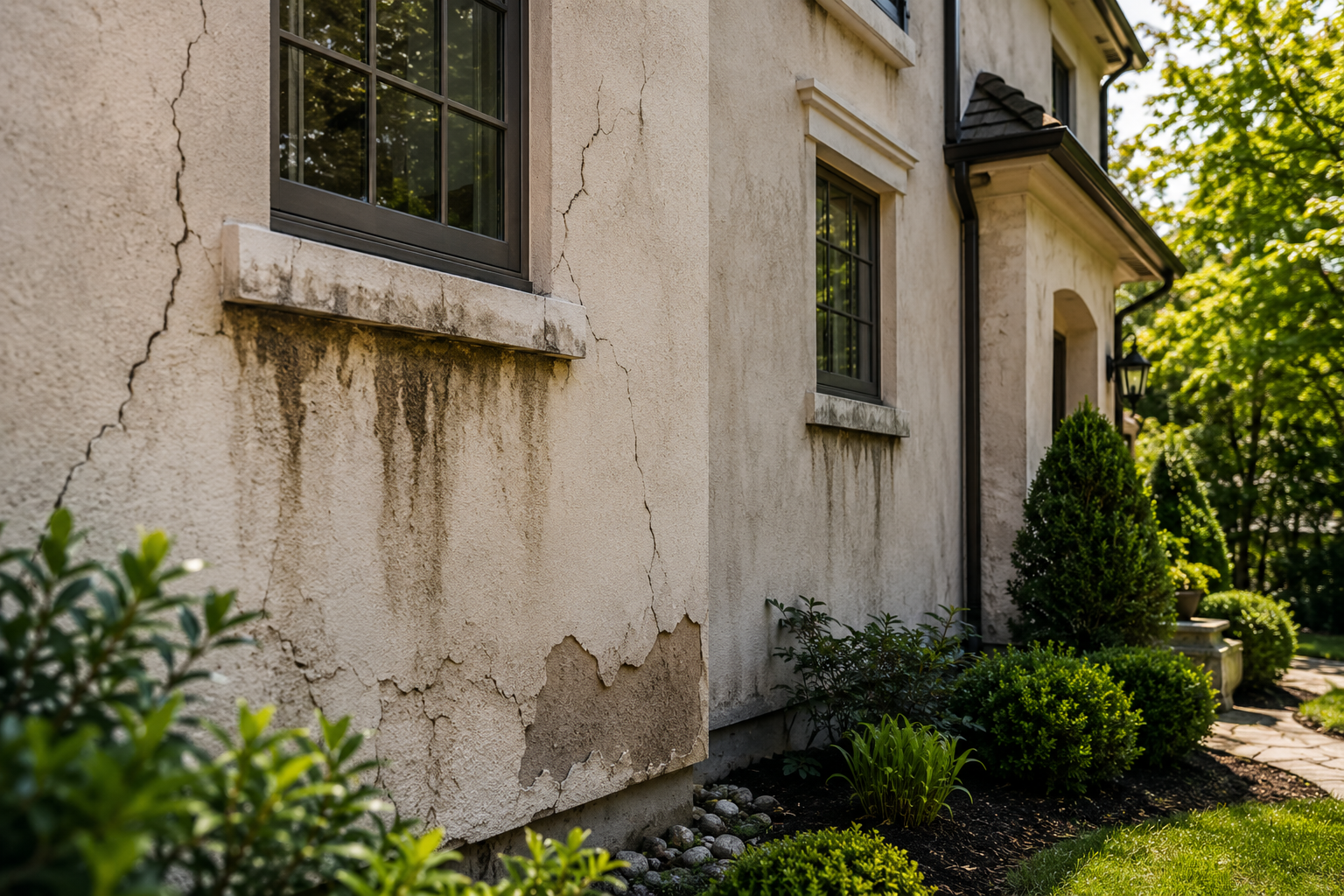
Stucco Moisture Damage Ardmore, PA: Homeowners’ experiences often become most visible during the summer months. After a long season of winter freeze-thaw cycles, spring rain, and rising humidity, moisture trapped behind stucco and EIFS systems can begin causing serious damage to wall cavities, sheathing, and structural framing. What may appear to be a minor crack or stain on the exterior can quickly develop into mold growth, wood rot, and costly remediation if left unaddressed during the warm summer season.
In summer, trapped moisture turns the wall cavity into a greenhouse for mold and rot. The combination of warm temperatures, trapped water, and organic materials like wood sheathing and framing creates an environment where mold establishes itself in 24 to 48 hours, and structural wood begins to soften within weeks. Homeowners who notice warning signs in July and wait until fall to act often find that a project that would have cost $8,000 in early summer costs $25,000 by October because the damage has spread from sheathing into structural framing.
This guide covers the specific signs that stucco on your Ardmore, Bryn Mawr, Wayne, or Havertown home is actively trapping moisture this summer, why summer is the most critical time to act, and what the difference is between a surface repair and the full remediation that actual moisture intrusion requires.
Hynes Construction specializes in stucco remediation for Main Line homes.
A small crack or stain today can turn into expensive sheathing replacement if moisture continues spreading behind your stucco. A professional inspection now can identify the source of the problem before repairs become significantly more costly.
Schedule your free stucco moisture inspection today or call us directly at 610-896-6388.
Why Summer Accelerates Stucco Moisture Damage on the Main Line
Pennsylvania winters introduce water through cracks, failed caulking around windows and doors, and compromised flashing. Freeze-thaw cycles push water deeper into wall cavities and physically expand existing cracks by forcing ice to lever the stucco surface away from the substrate. By the time winter ends, many homes have more moisture in their wall cavities than at any other point in the year.
It is summer, when temperatures climb into the 80s and 90s with significant humidity, that creates the most dangerous phase for stucco homes. The warm, humid conditions between the interior climate-controlled space and the moisture-saturated wall cavity create a perfect incubation environment for mold. The wood sheathing, house wrap, and structural framing that have been wet since January begin to degrade rapidly once temperatures reach the range that accelerates biological activity.
Unlike winter damage, which progresses slowly, summer stucco moisture damage can escalate measurably within weeks. Homeowners who schedule inspections in June routinely catch projects at the sheathing replacement stage. Homeowners who wait until September often find projects that have progressed into structural framing repair. The cost difference between these two scenarios is typically tens of thousands of dollars.
Our guide on EIFS stucco remediation on the Main Line covers the specific moisture dynamics of EIFS systems common in Bryn Mawr, Gladwyne, and Villanova homes built between 1985 and 2005.
10 Signs Your Stucco Is Trapping Moisture Right Now
1. Visible Cracks Around Windows and Doors
Every crack is a potential water entry point. Horizontal cracks running across the stucco field and any cracks at the intersection of stucco and window or door trim are the most dangerous. A crack you can insert a credit card into has been allowing significant water entry through multiple rain events. On EIFS systems, watch specifically for separation between the EIFS field coat and window j-channel. When caulk fails at these joints, the gap becomes a direct water entry path into the wall cavity.
2. Dark Staining or Discoloration on the Stucco Surface
Dark vertical staining running down from windows, door frames, or soffit lines indicates water flowing down the stucco face rather than being shed properly. Black or green biological growth on lower wall sections indicates persistent moisture at the surface and often reflects more significant moisture behind the wall.
3. Soft Spots When You Press on the Stucco Surface
Press firmly on the stucco surface with your palm, particularly below windows, at corners, and along the base of walls near the foundation. Sound stucco feels rigid and solid. Stucco over deteriorated sheathing has a hollow or slightly flexible quality because the substrate supporting it has softened or separated. This is one of the most reliable indicators of active moisture damage behind stucco.
4. Interior Water Stains Near Exterior Walls
Water stains on interior drywall adjacent to exterior walls, peeling paint near window sills on interior surfaces, warped baseboards along exterior walls, or bubbling interior paint are interior symptoms of exterior moisture intrusion. By the time these appear on the interior, moisture has penetrated through the stucco, past the sheathing, and into the interior wall assembly. This represents more advanced damage and indicates remediation, not repair, is required.
5. Musty Odors in Rooms Adjacent to Exterior Walls
By the time a musty odor is perceptible in a room, mold growth is typically well established in the wall cavity. You are not smelling surface mold. You are smelling mold growth in the wall assembly significant enough to off-gas through the drywall and into the living space. This symptom requires immediate professional evaluation.
6. Efflorescence at the Base of Stucco Walls
Efflorescence is the white, chalky crystalline deposit that appears on stucco surfaces when water moving through the wall carries dissolved salts to the surface and deposits them as it evaporates. Its presence confirms that water is actively moving through your stucco wall system.
7. Delamination or Bubbling of the Stucco Surface
Stucco that has separated from the substrate creates visible bubbling or raised areas on the surface. This delamination occurs when moisture accumulation behind the cladding swells the substrate. On EIFS systems, delamination at the base of walls near grade is particularly serious because it indicates water entry at the critical foundation transition.
8. Wood Rot at Window and Door Trim
Window and door trim adjacent to stucco is one of the first places exterior rot becomes visible. When caulk joints between stucco and wood trim fail, water runs directly into the rough opening. The rough opening framing at every window is the most commonly found rotted element when stucco is removed from Main Line homes built between 1990 and 2005. If any adjacent wood trim is soft or spongy, the framing behind it is almost certainly also affected.
9. Bowing or Irregular Surface Texture in the Stucco Field
Stucco that appears to bow outward or has irregular undulations is delaminating from the substrate. This can result from moisture swelling the substrate, from failure of the scratch coat bonding to the sheathing, or from the sheathing itself deteriorating. Any section of stucco appearing to have movement when pressed firmly should be professionally evaluated.
10. Previous Stucco Repair That Has Cracked Again
Cosmetic stucco repairs that crack again within one to three years consistently indicate the underlying problem was not addressed. Surface patching over a moisture-damaged wall assembly does not stop the moisture infiltration. Repeated cracking in the same location is essentially the wall signaling that a surface repair is insufficient. Our post on identifying stucco damage signs and choosing between repair and remediation on the Main Line provides the full diagnostic framework.
Concerned about moisture behind your stucco? Call Hynes Construction at 610-896-6388 for a free moisture inspection. Serving Ardmore, Bryn Mawr, Wayne, Havertown, and throughout the Main Line.
Stucco Repair vs Stucco Remediation: Understanding the Critical Difference
Stucco repair is a surface intervention. A crack is filled, a section is patched, and new caulk is applied around windows. The exterior looks repaired. But repair does not address what is happening behind the stucco surface. If moisture has penetrated the wall cavity and is causing sheathing deterioration, repair does nothing to remove that moisture, replace compromised sheathing, or restore a functional moisture management system. In most cases, the repair will crack again within two to three years.
Stucco remediation is a full-system replacement. The existing stucco or EIFS is completely removed. All sheathing is inspected, and compromised sections are replaced. Framing affected by rot is assessed and repaired or sistered as required. A new, properly detailed wall system is installed with a drainage plane, moisture barrier, and new cladding. Remediation addresses the cause of the moisture problem, not just the visible symptom.
On Main Line homes built between 1990 and 2005, homeowners who chose repair over remediation at first signs consistently spend more money in total than homeowners who chose remediation at the outset, because repair gave them three more years of deterioration behind the surface before the inevitable remediation became necessary.
Read more in our stucco remediation vs siding replacement guide and the stucco remediation guide for West Chester area homeowners.
What Stucco Remediation Involves on a Main Line Home
Moisture Investigation and Scope Assessment
Before a single panel of stucco is removed, a qualified remediator conducts a systematic moisture investigation using infrared thermography, probe moisture meters, and visual inspection to map areas of moisture infiltration. This investigation determines the actual project scope so the estimate accurately reflects what needs to be done.
Stucco or EIFS Removal
The existing stucco or EIFS system is removed carefully and completely in affected areas. On EIFS systems, this includes the foam board substrate. On traditional stucco systems, this includes all layers down to the sheathing surface.
Sheathing Assessment and Replacement
With stucco removed, all sheathing is inspected, and any section not meeting minimum structural requirements is replaced. On Main Line homes from the 1990s construction boom, it is common to find 20 to 40 percent of sheathing requiring replacement, primarily at window and door rough openings and at the base of walls near grade.
Framing Inspection and Structural Repair
Once compromised sheathing is removed, framing is inspected. Any structural members showing rot, softening, or dimensional loss are repaired or sistered with new lumber. This step is where projects most commonly expand in scope, because framing damage is impossible to fully quantify until sheathing is removed.
New Wall System Installation
A properly detailed drainage plane and moisture barrier are installed over new sheathing. Window and door rough openings are flashed with industry-standard methods. The new cladding, which may be a properly installed three-coat stucco system, fiber cement siding, or vinyl siding, is then installed over this properly managed substrate.
The Cost of Waiting Through Summer
The single most common pattern we see is homeowners who noticed signs of a problem in spring or early summer, decided to wait until fall to address it, and found significantly more extensive damage by September or October. Summer heat and humidity transform a moisture-damaged wall cavity into an accelerated decomposition environment. Sheathing that was merely saturated in April can have active mold colonization by June and measurable structural softening by August. Each month of delay in summer typically adds $2,000 to $5,000 to the project scope for an average Main Line home.
Hynes Construction offers free moisture inspections for Main Line stucco homes with honest guidance on whether repair or remediation is appropriate for your specific situation. See our recent remediation work on Facebook and Instagram.
Frequently Asked Questions: Stucco Moisture Damage on the Main Line
How do I know if my stucco is trapping moisture?
The most reliable external signs are cracks around windows or at wall transitions, dark staining running down from openings, soft or hollow spots when you press on the wall surface, stucco that appears to bow or undulate, efflorescence deposits, or any delamination where stucco has separated from the substrate. Interior signs include water stains near exterior walls, musty odors, and peeling paint near window sills on interior surfaces. A professional moisture inspection with a probe meter provides definitive answers.
Why is summer the worst time for stucco moisture damage in Pennsylvania?
Warm humid summer conditions create an ideal environment for mold growth and wood deterioration. Moisture built up since winter reaches critical levels, and warm temperatures activate biological processes, causing rapid mold colonization and structural softening. Projects that could have been completed as straightforward sheathing replacements in spring regularly expand into structural framing repairs by fall because summer accelerated the deterioration. Acting in early summer prevents this escalation.
What is the difference between stucco repair and stucco remediation?
Stucco repair is a surface intervention. Cracks are filled and sections are patched. It does not correct moisture that has entered the wall cavity. Stucco remediation removes all existing stucco, replaces compromised sheathing, repairs affected framing, installs a proper drainage plane and moisture barrier, and applies new cladding over a correctly detailed substrate. Remediation is the appropriate response when moisture has penetrated behind the stucco surface.
How much does stucco remediation cost in Ardmore and on the Main Line?
Stucco remediation costs on the Main Line typically range from $15,000 to $45,000 for an average single-family home, depending on the extent of moisture damage, how much sheathing and framing require replacement, home size, and choice of replacement cladding. A free on-site moisture inspection from Hynes Construction provides the only accurate estimate for your specific home.
My stucco was repaired three years ago and is already cracking again. Do I need remediation?
Almost certainly yes. Stucco repairs that crack repeatedly in the same locations consistently indicate that surface repair was applied over a moisture problem that was not corrected. The forces causing the cracking, moisture movement, and freeze-thaw cycling in a compromised wall continue to act on the repaired surface. A professional moisture inspection will confirm whether moisture is present and determine the appropriate scope of work.
Does homeowners insurance cover stucco remediation?
Typically no. Insurance covers sudden and accidental damage from covered perils like storms. Gradual moisture deterioration resulting from installation deficiencies or maintenance issues is generally not a covered cause. However, if a specific storm event directly caused water intrusion that can be documented, a portion of the damage may be claimable. Hynes Construction helps document storm-related stucco damage for insurance purposes where applicable.
How long does stucco remediation take?
A typical single-family Main Line stucco remediation takes two to four weeks from start to finish, depending on home size, extent of sheathing and framing work, and weather conditions. Projects involving significant structural framing repairs may take longer. Hynes Construction provides a written project timeline before work begins.
Can I stay in my home during stucco remediation?
Yes. Stucco remediation is an exterior project and does not typically require homeowners to vacate. Our team coordinates around weather forecasts to minimize exposure windows and uses temporary moisture barriers to protect open wall sections during the work.
What replaces stucco after remediation?
The most common replacements on Main Line homes are properly detailed three-coat stucco with a drainage plane, which maintains the original appearance while correcting moisture management deficiencies; James Hardie fiber cement siding, or vinyl siding. Our guide on the best siding materials for Main Line homes covers these options in detail.
How do I find a qualified stucco remediation contractor on the Main Line?
Look for a Pennsylvania home improvement contractor license, verifiable insurance coverage, specific experience with stucco and EIFS remediation on Main Line homes from the 1990-2005 era, a written scope of work, and references from similar projects. Hynes Construction has specialized in stucco remediation across Chester, Delaware, and Montgomery Counties for decades.
Follow our projects on Facebook and Instagram.
Protect Your Home Before Summer Moisture Causes More Damage
If your home is showing signs of trapped moisture, acting now can prevent mold growth, structural repairs, and substantially higher remediation costs later in the season. Our experienced team will inspect your stucco system, explain exactly what we find, and provide honest recommendations tailored to your home.
Schedule your free on-site stucco moisture inspection today or call 610-896-6388 to get started.
Further reading: EIFS Stucco Remediation on the Main Line | Prevent Stucco Issues on Main Line Homes | Stucco Remediation vs Siding Replacement | Stucco Remediation Service Page

(President, Hynes Roofing and Siding)
With over 35 years experience in the roofing and siding industry, Michelle Hynes has built a business from 2 people into over 45 people and 19 trucks!